 Contact Us

Table of Contents

Contact Us
Updated 1 month ago
How Much Does It Cost to Manufacture Streetwear?
arafatshuvo
Streetwear manufacturing cost is not a single number: it is the sum of what you specify. Fabric weight and consumption, garment dyeing or washing, how many decoration processes you add, and order quantity move the price most. Factories can quote accurately only once your garment, materials, quantities and finishing are defined.
Key takeaways
- Streetwear manufacturing cost is driven mainly by fabric GSM and consumption, garment dyeing or washing, decoration complexity and order quantity.
- Published per-piece estimates differ widely because they cover different garments, quantities, regions and inclusions; none of them is a streetwear benchmark.
- Minghang Garments states that its stock-fabric MOQ starts at 100 pcs per color per style, while custom fabric or custom dyeing typically requires 300–500 pcs per color.
- Sampling, labels and packaging beyond the basic level, freight and duties usually sit outside the factory unit price.
What Streetwear Manufacturing Cost Actually Covers
Streetwear manufacturing cost is the total price a factory charges to turn a defined design into finished garments: fabric and trims, cutting, sewing and construction labor, any decoration or washing applied, quality control, and usually labels plus basic packaging. Pattern making, sampling and other one-time development work are normally quoted as separate lines rather than folded into the unit price.
That distinction matters, because two quotes that look different per piece may simply be pricing different things. Minghang Garments' clothing manufacturing cost guide lists the items that must match before a quote comparison means anything: fabric composition, GSM, width and finish; trims and hardware; construction; decoration and washing; quantity; quality-control requirements; packaging; and shipping terms.
A streetwear quote is therefore a priced specification, not a market rate. Change the fabric weight or add a wash and the number changes with it, even when the silhouette stays identical.
The Four Cost Drivers That Move a Streetwear Quote Most
Fabric, wash or dye treatment, decoration and order quantity account for most of the difference between a low quote and a high one on the same streetwear design. The same four levers apply across the streetwear categories a brand is likely to be quoting, from hoodies and sweatshirts to joggers and T-shirts.
| Cost driver | Why it moves the price | What to confirm in the quote |
|---|---|---|
| Fabric composition and GSM | Heavier or more specialised fabric costs more per meter | Composition, GSM, width and finish |
| Fabric consumption | A bulkier garment uses more cloth per piece, whatever the price per meter | The consumption allowance the quote is based on |
| Garment dyeing | A wet dye process adds a separate step and a per-batch setup | Whether the price assumes a stock color or a custom dye lot |
| Garment washing and finishing | Washing and finishing add handling steps and time | The exact wash effect, and whether it is priced per piece or per batch |
| Decoration type and number of processes | Every printing or embroidery operation carries its own setup | Methods, number of colors, positions and setup charges |
| Order quantity and MOQ | Fixed setup is spread across more pieces in a larger run | Quantity per style and per color, and which MOQ applies |
[DIAGRAM: The four streetwear cost drivers — fabric GSM and consumption, dyeing and washing, decoration processes, and order quantity — feeding into one final quoted unit price]
Fabric GSM, Composition and Consumption
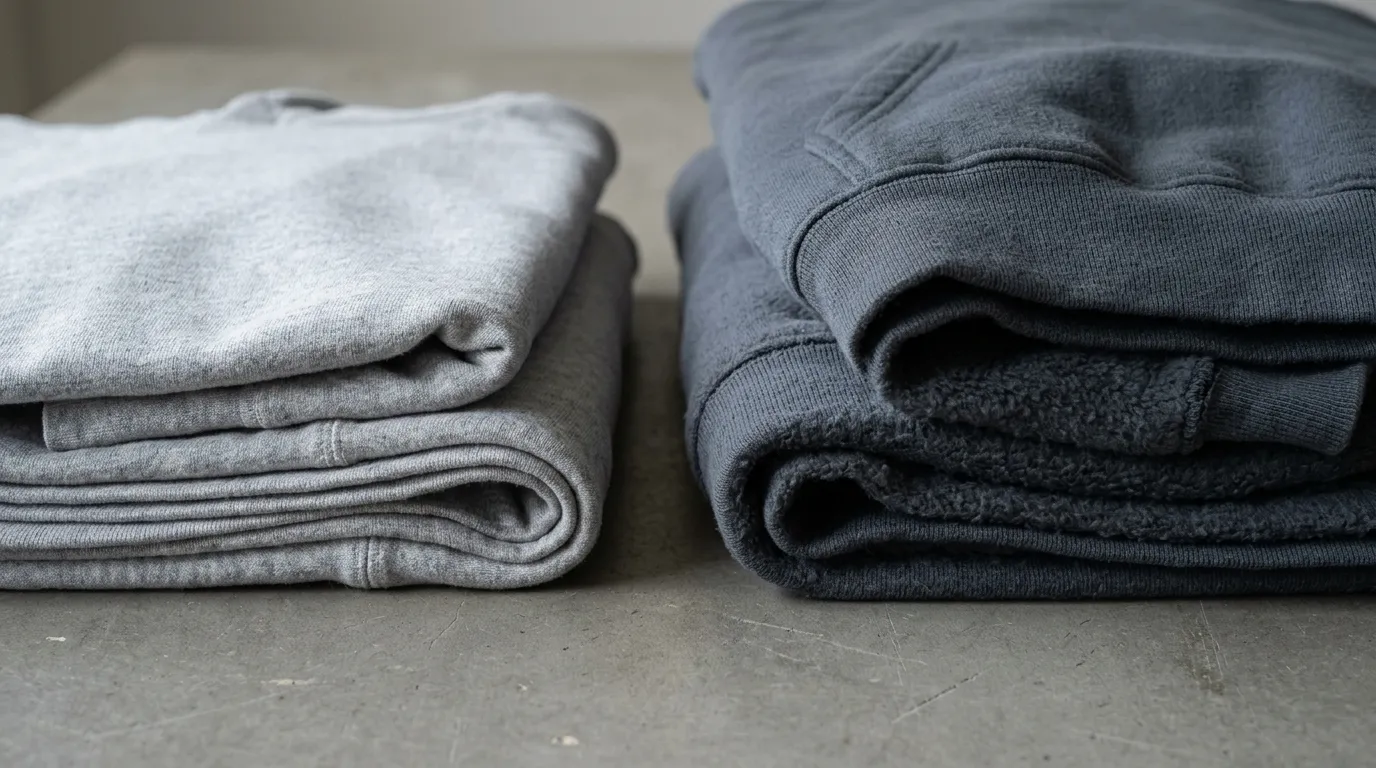
GSM stands for grams per square meter, and it describes how heavy a fabric is. Heavier fabric raises streetwear cost twice over: it usually costs more per meter, and a bulkier garment consumes more cloth per piece regardless of the price per meter.
Minghang Garments' clothing manufacturing cost guide illustrates the spread with a 320 GSM standard cotton-fleece hoodie set against a 450 GSM custom-dyed heavyweight example, where the heavier build also carries a dye process and heavier trim. The guide presents these as illustrations of how specifications diverge, not as prices.
Composition and construction change the price again, which is why a quote has to name the actual fabric rather than describe it. The same weight in two different fabric types will not price the same, and the mill's minimum for that fabric can shift the entry quantity for the whole order. Choosing between fleece weights, terry and jersey is its own decision before costing starts; best fabrics for streetwear covers that selection step.
[DIAGRAM: Two-column specification comparison — a 320 GSM standard cotton-fleece hoodie beside a 450 GSM custom-dyed heavyweight hoodie with wash, hardware and premium packaging, labelled as a specification comparison, not a price]
Garment Dyeing, Washing and Finishing
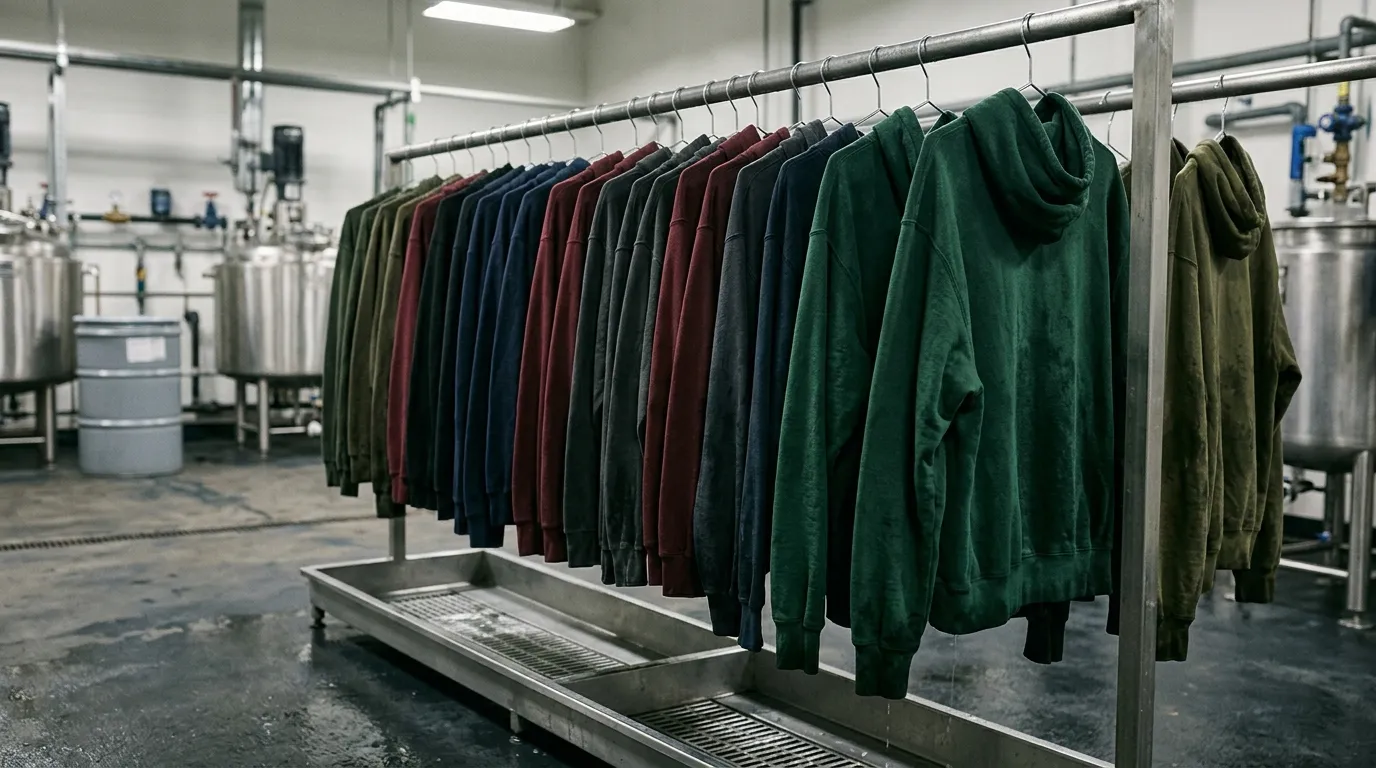
Garment dyeing and washing are wet processes applied after the garment is sewn, so they add cost on two levels: extra handling on every piece, and a setup cost on every batch. They also change the minimum quantity a factory will accept.
Minghang Garments states that custom fabric or custom dyeing generally requires 300–500 pieces per color, against 100 pieces per style per color for regular cut-and-sew styles using suitable available stock fabric. A brand choosing a custom dye lot is therefore committing to a larger run, not just to a different finish.
Minghang Garments' cost guide also places washing inside its multi-process heavyweight example, alongside embroidery, hardware and premium packaging, which shows how finishing choices stack rather than sit side by side. Brand Stuff's hoodie tech-pack guide lists dye/wash type as one of the specifications to communicate to a manufacturer, because an effect described loosely cannot be costed or repeated. Confirm the exact wash result in writing before bulk, since a process effect has to be reproduced, not selected from a swatch.
Printing, Embroidery and Multi-Process Decoration
Decoration cost scales with the number of operations, not only with the size of the artwork. A single screen print is one operation; a garment that combines embroidery, wash effects, hardware and premium packaging carries several separate setup and handling steps before it is finished.
Minghang Garments' cost guide makes that contrast directly, setting a basic screen-printed garment against a combination build that layers embroidery, washing, hardware and premium packaging. The guide uses the comparison to show how two garments with a similar silhouette land at different costs, not to publish prices for either.
In practice, each added process multiplies the things the quote has to define: print colors, print positions, stitch counts, placements and the order in which the processes run. A design that looks like one decoration idea on a mood board may be three operations on the factory floor, and it is the operations that are priced.
Order Quantity, MOQ and How the Unit Price Moves
MOQ stands for minimum order quantity, the smallest run a factory will produce for a given style and color. Setup work such as patterns, print screens, dye batches and machine changeover is largely fixed, so a larger consolidated order spreads that fixed cost across more pieces and the unit price falls.
How far it falls depends on the garment, the fabric and the factory, so no single percentage applies to streetwear as a category. The practical rule is to price the run you can actually sell, then compare every quote at that exact quantity rather than at a hypothetical volume.
Minghang Garments states a starting MOQ of 100 pieces per color per style on stock fabric, and 300–500 pieces per color for custom fabric or custom dyeing. That spread shows how much the fabric and dye decision, not the quantity alone, shapes where a streetwear production run can begin.
Because MOQ is normally quoted per color as well as per style, splitting one order across five colors creates five smaller runs, each of which has to meet the minimum on its own. Consolidating colors usually costs less per piece; spreading them across a range usually costs more.
Why There Is No Single Streetwear Manufacturing Price
Published per-piece estimates differ by several times over because they describe different garments, quantities, regions and inclusions. None of them can be applied to a streetwear brief without checking those conditions first.
| Source | What it estimates | Stated scope and conditions | Why it is not a streetwear benchmark |
|---|---|---|---|
| Plucky Reach | $18–$45 per unit | Small-batch runs of 50–150 pieces, in a Los Angeles context | Small-batch, local-labor conditions, and a guide that covers garment types generally |
| Nofal Apparel | $8–$30 per piece | Basic garments in small batches | Basic constructions with no streetwear-specific specification attached |
Plucky Reach's small-batch manufacturer guide, which references 2026, states that runs of 50–150 pieces cost $18–$45 per unit in its Los Angeles context. Nofal Apparel states a broad estimate of $8–$30 per piece for basic garments in small batches.
The gap between $8 and $45 is not a disagreement about the market; it is a difference in coverage. A quote that does not state fabric GSM, quantity and included services cannot be placed on the same scale as one that does, and neither figure transfers to a heavyweight streetwear hoodie with a custom dye and three decoration processes.
How to Compare Two Streetwear Manufacturing Quotes
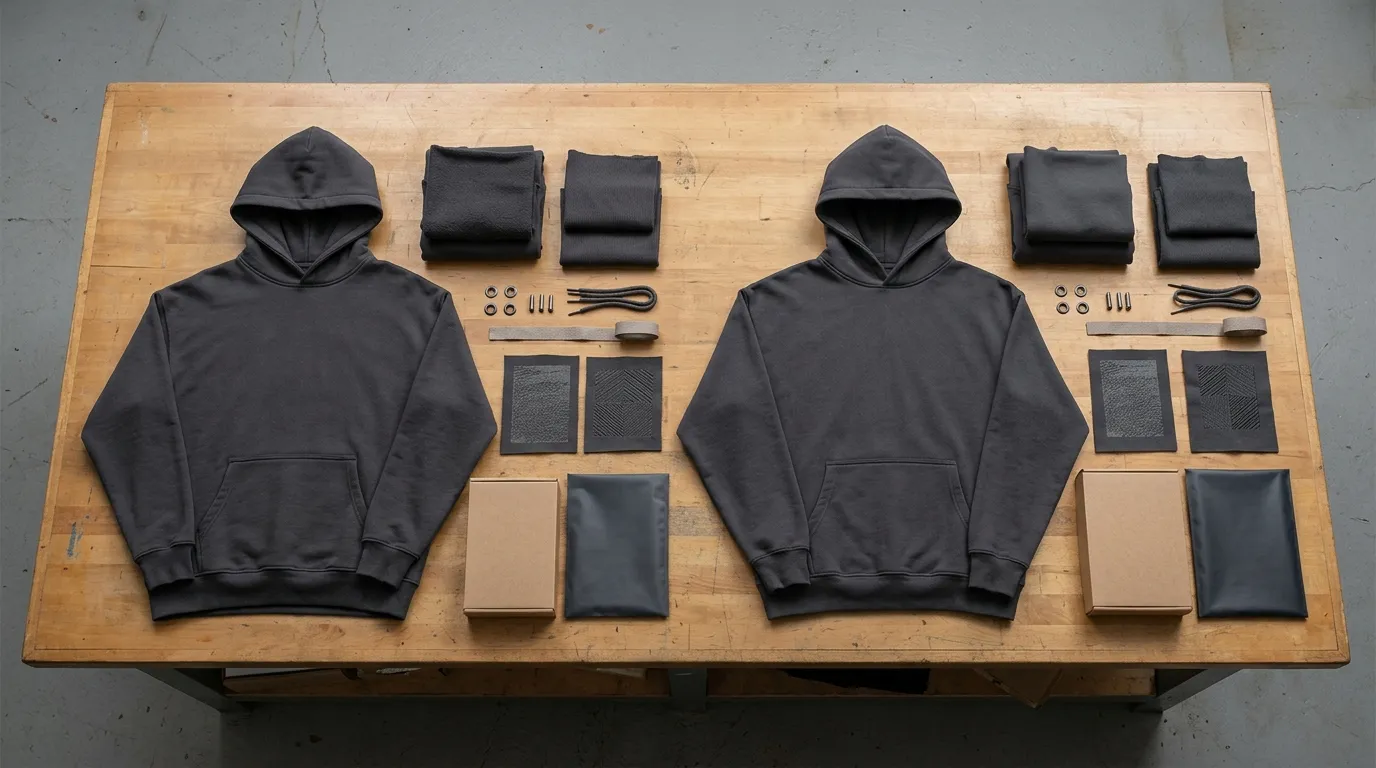
Two streetwear manufacturing quotes can only be compared when they describe the same garment, quantity and service scope. Use the same line items on both, and mark anything a supplier leaves blank.
The grid below follows the alignment points Minghang Garments' cost guide identifies, with a blank-cell rule added.
| Line item to compare | Quote A | Quote B | Why it matters |
|---|---|---|---|
| Fabric composition, GSM, width, finish | A different fabric is a different garment | ||
| Fabric consumption allowance | Two factories can assume different cloth per piece | ||
| Wash or dye route | Stock color and custom dye lot carry different minimums | ||
| Decoration method, colors, positions | Each operation adds its own setup | ||
| Trims and hardware | Small components change cost and MOQ | ||
| Quantity per style and per color | Unit price is only meaningful at a stated volume | ||
| Sample and development fees | One-time charges are often quoted separately | ||
| Labels and packaging | Basic and premium packaging are different scopes | ||
| Shipping terms | A unit price can be quoted at different delivery points | ||
| Quality-control requirements | Inspection scope changes the work included |
If any row is blank, or is described differently between the two quotes, mark it unresolved and do not treat the two unit prices as comparable yet. A cheaper per-piece figure that excludes packaging or decoration setup is not the cheaper quote until those lines are priced in.
[DIAGRAM: Blank streetwear quote comparison worksheet with the line items above and empty Quote A and Quote B columns]
How to Prepare a Quote Request That Gets an Accurate Cost
A factory can only price what it can see. Send one package that defines the garment, the quantities, the colorways and the finishing scope, then ask each supplier to quote the same itemized categories.
- Write the garment spec sheet: silhouette, measurements, fabric composition and GSM.
- Specify trims, hardware, labels and packaging.
- State the wash or dye route and the exact decoration method and placement.
- Give quantities per style and per color, plus the size breakdown.
- State the quality-control requirement and any tolerance expectations.
- Ask each factory to quote the same itemized categories as the others.
- Ask what the sample fee covers before approving sampling.
Brand Stuff's hoodie tech-pack guide lists fabric type, GSM, composition, dye/wash type, decoration method, construction, trims and packaging as the specifications to communicate to a manufacturer, which is a useful checklist to run against your own package before sending it.
Minghang Garments' stated planning windows are 7–15 working days for sampling and 25–45 days for bulk production. Those are Minghang Garments' own figures rather than an industry average, and they belong in the schedule you budget against rather than in the unit price itself.
Costs That Sit Outside the Factory Unit Price
Sampling and development work, labels and packaging beyond the basic level, freight, duties and warehousing are usually quoted separately from the garment's unit price. They are also the most common reason two quotes look further apart than they actually are.
Minghang Garments states that sampling can involve pattern making, fabric and trim sourcing, sample sewing, decoration setup, finishing and technical adjustments, and the company does not publish a universal sampling fee, because the cost depends on the work a specific garment requires.
Run this list against both quotes and mark each line included or not included:
- Sampling and pattern development
- Labels and packaging beyond the basic level
- Printing or embroidery setup
- Freight and shipping terms
- Import duties and customs clearance
- Warehousing and re-shipment
A lower unit price that leaves packaging or decoration setup out of scope is not a cheaper supplier once those lines are added.
Frequently Asked Questions
How much does it cost to manufacture a hoodie?
A hoodie's manufacturing cost depends on its fabric GSM and consumption, whether it uses a stock color or a custom dye lot, how many decoration processes it carries, and the order quantity. No published estimate applies to a specific hoodie build, so ask a factory to quote against your fabric, weight, trims and quantity.
How much does it cost to make 1,000 T-shirts?
A 1,000-piece run spreads fixed setup such as screens, patterns and machine setup across more units than a 100-piece run, which lowers the unit price. The total still depends on fabric weight, decoration and what the quote includes, so compare suppliers at the same 1,000-piece specification.
How much does clothing manufacturing cost in general?
General estimates vary widely by scope: Nofal Apparel states $8–$30 per piece for basic garments in small batches, while Plucky Reach states $18–$45 per unit for 50–150 piece runs in a Los Angeles context. Both describe different garments and conditions, so use them as orientation rather than as a price for your product.
Why do two manufacturers quote different prices for the same design?
Quotes differ when suppliers assume different fabric sourcing, included services, decoration methods, quantities or shipping terms. A quote that names the fabric, GSM and every service can be compared line by line; one that gives only a per-piece figure cannot. Ask both suppliers to itemize the same categories.
If your streetwear specification is ready, Minghang Garments can quote against it. Minghang Garments has manufactured custom clothing in Dongguan, China since 2017, runs a 12,000 m² production floor and a 2,000 m² sample center, and works with emerging labels and established apparel companies on streetwear manufacturing for fashion brands. Send a completed spec sheet and ask for the quote to be itemized line by line.
-
Share
-

-

-