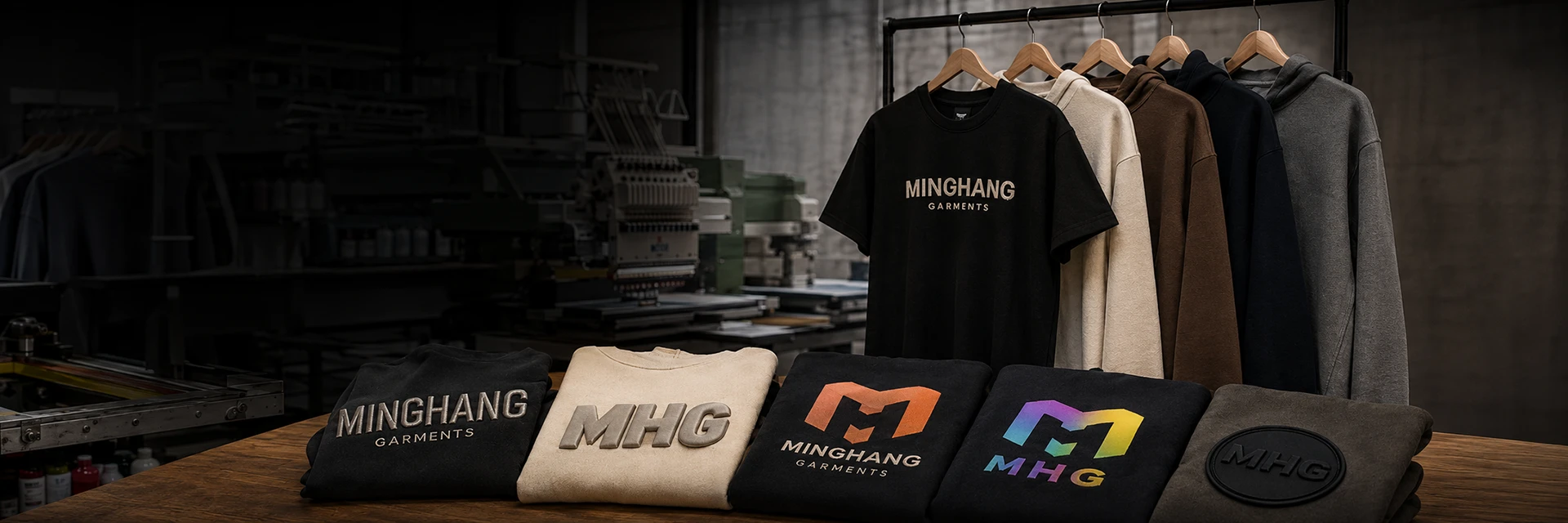
Choosing the right logo technique affects appearance, hand-feel, durability, fabric performance, production cost, and minimum order requirements. This guide compares common apparel decoration methods — including screen printing, DTG, DTF and heat transfer, embroidery, puff and high-density printing, silicone, rhinestones, laser techniques, and more.
Minghang helps brands match each decoration method to the garment fabric, design complexity, end use, target look, and production requirements before bulk production begins.
Get a Branding Technique Recommendation
How to Choose the Right Apparel Branding Technique
Compare six key factors before choosing screen printing, DTG, DTF, heat transfer, embroidery, or specialty decoration techniques.
Design Detail & Color
Fine lines, gradients, photoreal graphics, solid-color logos, and raised effects suit different decoration methods. DTG and DTF work well for detailed multi-color artwork, while screen printing is efficient for bold repeat graphics.
Fabric Compatibility
Fiber content, stretch, surface texture, and heat sensitivity determine which decoration methods will bond, cure, and perform correctly. Cotton, polyester, nylon/spandex, fleece, rib knit, and other fabrics may require different processes.
Hand-Feel & Garment Performance
Activewear often requires flexible, low-profile decoration that can stretch with the fabric, while heavyweight streetwear can support denser embroidery, puff print, high-density effects, patches, and more dimensional finishes.
Durability & Wash Performance
Repeated washing, abrasion, stretching, heat, garment dyeing, and washing processes can affect cracking, peeling, fading, adhesion, and embroidery stability. Decoration should be matched and tested against the actual fabric and finishing process.
Order Quantity & Cost Structure
Screen printing may require screen setup, while embroidery usually involves digitizing and stitch-based costing. DTG and DTF can be more efficient for smaller runs or complex multi-color artwork. Final cost also depends on logo size, color count, placement, quantity, and garment type.
Visual Effect & Brand Positioning
Different techniques create different visual identities — flat, soft-hand, matte, glossy, raised, embroidered, metallic, reflective, vintage, or highly dimensional. The right process should reinforce the look and positioning of the garment.
How Minghang Helps:
Our product development team reviews your artwork, logo size and placement, fabric composition, stretch, garment wash or finishing process, order quantity, and target visual effect. We then recommend suitable decoration methods and explain the trade-offs in appearance, durability, hand-feel, and cost before sampling begins.
Screen Printing — Deep Dive (10 Sub-Techniques)
Screen printing is a family of techniques. The final effect depends almost entirely on the ink or paste type.
True zero setup; 1 pc possible; unlimited colours; soft hand (ink penetrates natural fibers); fast turnaround.
Limitations
Best on cotton; synthetic adhesion poor; dark garments need white underbase (adds cost, heavier hand); per-piece cost doesn't drop much at scale; moderate wash durability (30-50 washes).
Cost Logic
No setup, per-print cost by ink & area.
Durability
★★★☆☆
Care
Cold wash inside-out, no tumble dry, no aggressive rubbing.
Digital Printing — No Screens, Small-Batch All-Over Prints
Process
Large-format digital printer sprays dye-based ink directly onto fabric rolls, followed by steam fixation and washing. Two main types: dye-sublimation digital (for polyester) and direct digital (for cotton, silk, nylon, etc.).
Zero screens/plates – print from 1 meter; unlimited colours including photos & gradients; ultra-soft hand (ink penetrates fibers); quick design iteration; ideal for multi-SKU small runs.
Limitations
Per-meter cost higher than bulk conventional printing (2–4x); dark fabrics need pre-treatment (coating + white underbase); different ink types per fabric (reactive for cotton, acid for nylon, disperse for polyester); requires post-print steaming & washing.
Cost Logic
Priced per meter; no setup fee. Best for <500 meter runs.
Durability
★★★★★ ( reactive/acid dyes bond with fiber)
Care
Normal machine wash.
Minghang Tip
For capsule collections with 20–50 pcs per design and full all-over prints, digital fabric printing is more versatile than sublimation (which only works on polyester). Cotton, nylon, blends all compatible. We offer digital fabric printing + custom cut-and-sew as a complete service.
Nylon / Acid Dye Printing — The Standard for Yoga & Swimwear Prints
Process
Acid dye printing paste applied to nylon fabric via screen or digital methods, then high-temperature steam fixation causes dye to chemically bond with nylon fiber. Final washing removes excess dye. Dye becomes part of the fiber.
Best for
Nylon/spandex yoga wear, swimwear, cycling wear, sports bras – any tight-fitting active product requiring high stretch + vibrant colour + no cracking/grin-through.
Advantages
Exceptional stretch compatibility – colours stay uniform when stretched, no whitening or cracking; ultra-soft hand (zero surface feel); vibrant colours with excellent fastness (wash, sweat, sunlight); zero breathability loss.
Limitations
ONLY works on nylon (polyamide); polyester requires disperse dyes. Dark base needs discharge pre-treatment. Process needs steaming + washing, extending production 2–3 days vs. standard plastisol.
Durability
★★★★★ (lifetime of garment – acid dye-nylon bond is exceptionally strong)
Care
Normal machine wash; avoid prolonged direct sunlight; no chlorine bleach.
Minghang Tip
If your brand focuses on yoga/activewear, always request acid dye printing for logos on nylon fabric – never standard plastisol. Plastisol peels off nylon after a few washes; acid dye printing lasts the life of the garment with zero stretch whitening. We offer both screen and digital nylon printing options.
Penetration / Through-Print
Process
Uses low-viscosity, high-penetration dye paste with specialized squeegee pressure and fabric pre-treatment, so dye fully penetrates through the fabric to the reverse side.
Best for
Premium activewear (no white at folds/seams), any nylon/polyester fabric requiring non-grin when stretching out.
Advantages
Highly consistent colour on both faces; zero surface feel, ultra-soft; no white base showing when fabric moves; excellent colourfastness.
Limitations
zero surface feel, ultra-soft; no white base showing when fabric moves; excellent colour fastness.
Durability
★★★★★ (dye penetration, lifetime of fabric)
Care
Normal machine wash, follow fabric care.
Minghang Tip
For lightweight premium active cover-ups, yoga wraps, or accessories worn both sides, penetration printing's "no white base at folds" effect is a quality detail standard printing cannot achieve. Our technicians adjust paste penetration and squeegee parameters based on your fabric to control front-back colour difference.
Pumice stones soaked in mild acid tumbled with garmen
Best for
Vintage denim, retro streetwear, festival fashion.
Advantages
Dramatic high-contrast distress; each piece unique.
Limitations
Weakens fibers over repeated cycles; requires wastewater treatment; semi-random result.
Cost Logic
Per kg / piece; longer = more cost.
Care
Normal wash; first wash separate.
Bio-Wash / Bio-Polish — Clean, Polished Finish
Process
Bio-polishing enzymes remove surface fuzz for a cleaner face.
Best for
Premium knitwear, fleece anti-pill, high-end basics with polished look.
Advantages
Removes micro-fuzz for clean appearance; improves colour brightness; maintains strength.
Limitations
No fading effect; purely surface refinement.
Cost Logic
Per kg / piece;
Care
Normal wash
Rhinestone & Hot-Fix — High-Shine Glamour
Process
Crystals or studs fixed via heat-activated glue into patterns.
Best for
Yoga, sports bras, caps, luxe sport pieces, streetwear
Advantages
Extreme sparkle; jewelry-like perceived value; can combine with embroidery.
Limitations
Uneven hand feel; stones may detach if poorly applied; costs add up.
Cost Logic
By stone quantity & quality; one-time layout setup. Czech stones clearer, pricier.
Durability
★★★☆☆ (with correct press, 30+ gentle washes; no tumble dry)
Care
Turn inside-out, wash in laundry bag, no tumble dry, no dry cleaning.
Frequently Asked Questions
What’s the difference between direct-to-fabric digital printing and sublimation printing?
Sublimation printing is primarily used on polyester fabrics. The dye turns into gas under heat and bonds with the polyester fibers, creating a lightweight print with excellent color vibrancy and no raised surface feel. Direct-to-fabric digital printing uses different ink systems depending on the fiber: pigment inks may be used on cotton and blends, reactive inks on cellulosic fibers such as cotton or viscose, and acid inks on nylon or silk. The right method therefore depends on the fabric composition, color, artwork, and end use.
Can standard plastisol screen printing be used on nylon activewear?
Standard plastisol is usually not the first choice for highly stretchable nylon/spandex activewear. The fabric stretches significantly, may be heat-sensitive, and can also cause dye migration, so a conventional ink system may crack, distort, or show color migration if it is not formulated and cured correctly. For stretch activewear, we may recommend stretch silicone printing, specialized stretch inks, nylon-compatible screen-printing systems, or suitable heat-transfer solutions, depending on the fabric and logo design. Testing on the actual bulk fabric is important before production.
What is penetration printing and when is it used?
Penetration printing is used when the color needs to penetrate deeply through a lightweight or relatively open fabric rather than remain only on the surface. It can be useful for items such as lightweight scarves, certain thin fabrics, and products where the reverse side should show much less unprinted white space. The result is not always perfectly identical on both sides — penetration depends on the fabric structure, thickness, fiber type, ink system, and color.
Which is more durable: embroidery or screen printing?
Both can be highly durable when properly produced. Embroidery is generally very resistant to washing and abrasion because the design is stitched into the garment, while a properly cured screen print can also remain stable through repeated wear and washing. Durability depends on the fabric, ink system, stitch construction, curing conditions, garment washing process, and care method. For example, embroidery may not be ideal on very lightweight or highly stretchable fabrics even if it is durable.
What logo technique works best on a stretchy yoga waistband?
For high-stretch yoga leggings and activewear waistbands, the branding method needs to move with the fabric without restricting recovery or cracking. Stretch silicone printing, flexible heat-transfer materials, and other stretch-compatible decoration systems are common options. The best choice depends on the nylon/spandex composition, waistband construction, logo size, placement, stretch ratio, and desired surface effect. We normally test the decoration on the actual fabric for stretch, recovery, adhesion, and wash performance before bulk production.
Which printing method is best for a small order with many colors?
For detailed, multi-color artwork in smaller production runs, DTG or DTF can often be more efficient than traditional multi-color screen printing because they do not require a separate screen for every color. DTG is particularly suitable for many cotton garments and soft-hand graphics, while DTF can work across a broader range of fabrics and garment types. Screen printing often becomes more cost-efficient as quantities increase, especially for simpler artwork with fewer colors. Final garment MOQ still depends on the product category, fabric, color, and manufacturing requirements.
Will hot-fix rhinestones fall off, and can rhinestone garments be machine washed?
Properly applied hot-fix rhinestones can remain secure through normal wear and washing, but durability depends on the adhesive, stone quality, application temperature and pressure, fabric surface, and garment finishing process. For better durability, we generally recommend washing inside out on a gentle cycle, using a laundry bag, avoiding harsh abrasion, and avoiding excessive dryer heat. For bulk orders, rhinestone adhesion should be tested on the actual garment fabric before production.
Not Sure Which Branding Technique Is Right for Your Logo?
Send us your artwork, garment type, fabric details, and target quantity. Our team will review your requirements and recommend suitable branding techniques based on appearance, fabric compatibility, durability, hand-feel, and production cost.
For more complex designs, we can also evaluate multi-process combinations such as embroidery with printing, puff effects, silicone, or other specialty decoration techniques.
 Contact Us
  Home /