 Contact Us
  Home /

Custom Apparel Production Timeline: From Design to Delivery
From design development and sampling to bulk production, quality control, and shipping, every custom apparel project follows a series of connected stages. This guide explains the typical lead time for each step — and what can make your production timeline shorter or longer.
Why Does Production Timeline Matter?
In apparel, time is your selling window. Missing a seasonal launch, campaign, or retail window can reduce sell-through and create unnecessary inventory pressure. Especially for startups and e-commerce sellers, the lead time from design to delivery directly impacts inventory turnover and cash flow.
Yet custom apparel lead times aren't a single fixed number—they depend on design complexity, fabric sourcing method, MOQ, and current production load. This page transparently breaks down the time budget for each stage, and shows how parallel workflows and production planning can reduce avoidable waiting while maintaining defined quality standards.
Stage 1: Consultation & Tech Preparation (3–4 Working Days)
You Share Your Requirements. We Review the Project.
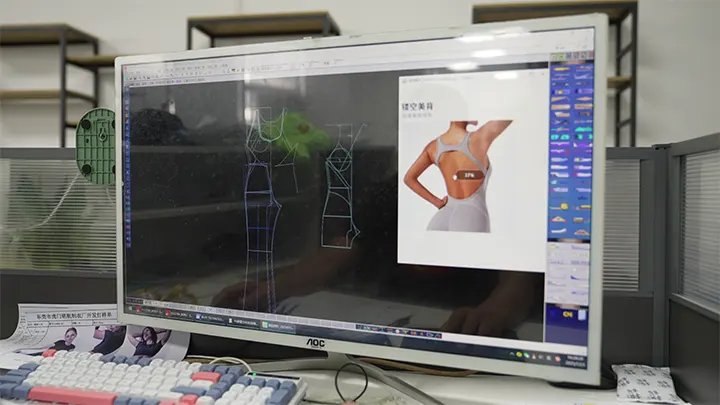
If You Have a Complete Tech Pack: We review specifications, measurements, artwork, materials, construction, MOQ, target pricing, and timeline requirements.
If You Only Have References or an Idea: Our technical development team clarifies the garment structure, fit, materials, branding, and production requirements before pattern development begins.
| Step | Time | Description |
| Consultation | 1-2 working days | Dedicated sales specialist communicates one-on-one to confirm design requirements, key techniques, target price, and timeline expectations |
| Pattern & Document Prep | 2 working days | Reviews the tech pack, develops or adjusts the garment pattern, and prepares the technical information required for sampling. |
Stage 2: Sampling & Approval (7–15 Working Days + Shipping)
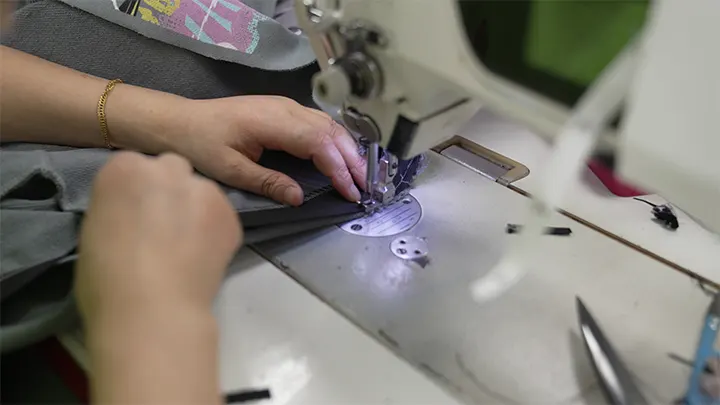
Once the pattern is confirmed, physical sampling begins.
- First sample production timeline:
- Standard styles: 7–10 working days
- Complex/heavy-work styles: 12–15 working days or longer
- Heavy-work styles involve multiple processes, e.g., screen printing, hot-fix rhinestones, garment wash/tint, multi-color embroidery—each requiring dedicated workstation time
- International courier delivery: 3–5 working days (depending on destination)
Parallel Material Sourcing: Once material specifications are confirmed, fabric and trim sourcing can run in parallel with pattern development. This reduces unnecessary waiting between technical preparation and sample sewing.
Stage 3: Sample Revision & Pre-Production Approval
Many factories make a second, third sample, charging for each round and adding weeks. Minghang operates differently.
Minor Adjustments? Move Directly to PP Confirmation
If the first sample only requires minor, clearly defined adjustments — such as logo placement, thread color, trim substitution, or small measurement corrections — a separate full revision sample may not always be necessary.
In these cases, we can update the production specifications and move toward a PP Sample (Pre-Production Sample) for final confirmation before bulk cutting.
Benefits of the PP Sample mechanism:
- Saves time: Eliminates the 7–10 days of a standalone second sampling round.
- Avoids unnecessary development cost: When a separate revision sample is not technically necessary, the project can move directly toward PP confirmation.
- True representation: PP Samples are made on the bulk production line under real production conditions, using bulk fabric and actual line workers—reflecting authentic mass-production quality, not a sample-room standalone.
When Is a Revision Sample Necessary?
Fit-critical products such as sports bras, leggings, compression garments, or highly structured styles may require another physical revision sample when changes affect fit, construction, or performance.
- Second sample is faster than the first: The pattern foundation exists, materials are already on-site, only targeted adjustments are needed. A second sample typically completes in 5–8 working days, about 2–3 days faster than the first round.
- Same logic for a third sample: each subsequent round has narrower scope and faster turnaround.
Shipping per round: approx. 3–5 working days via international courier.
Stage 4: Custom Fabric & Color Development (If Applicable)
If your style uses an available stock fabric and stock color, no additional fabric-development cycle is normally required.
Custom Pantone colors, custom fabric structures, yarn development, or special functional finishes may require additional development time.
| Development Type | Extra Time |
| Stock fabric / stock color | No additional development cycle |
| Custom Pantone fabric dyeing | Approx. 7–15 working days |
| Custom yarn / fabric development | Approx. 15–20+ working days |
Custom fabric procurement also uses a parallel strategy: once color and spec are locked, we initiate immediately to maximize overlap with the bulk production window.
Stage 5: Bulk Production (Typically 25–45 Working Days)
After fabric arrives and passes incoming inspection, bulk production officially begins. This is where Minghang's smart manufacturing infrastructure delivers maximum value.
Core workflow:
- Cutting
- Sewing (core labor hours, depending on style complexity)
- Special processes (printing, embroidery, rhinestones, washing, etc., interleaved as needed)
- Finishing (inspection, thread trimming, pressing, folding, packing)
Lead time begins after bulk materials, PP approval, order details, and production schedule are confirmed.
Cycle reference:
| Style Type | Reference Production Time |
| Basic Styles (T-shirts, basic hoodies, simple bottoms) | 20-30 working days |
| Standard activewear / gym clothing | 25-35 working days |
| Heavy-work complex styles (multi-panel, multi-print, rhinestones, washes) | 30-45 working days |
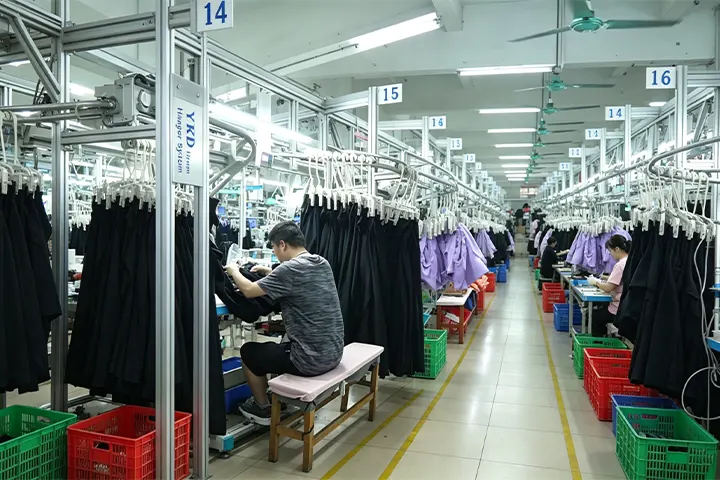
Minghang's efficiency engine—12,000 m² Manufacturing Center & Intelligent Overhead Hanging System
In traditional bundle production, cut pieces spend significant time being moved and waiting. Our intelligent hanging system automatically routes pieces to designated workstations, achieving:
More Efficient Production Flow
The overhead hanging system reduces manual bundle movement and work-in-process handling, helping production flow more efficiently between sewing operations.
Real-time Visibility
Key production data and line progress can be tracked through the hanging system, helping supervisors identify delays and balance workloads more effectively.
Rapid Exception Handling
When a station becomes overloaded or abnormal production data appears, supervisors can identify the issue earlier and respond before it develops into a larger bottleneck.
Production schedules are confirmed according to style complexity, quantity, material readiness, and current line capacity. For seasonal launches or fixed campaign dates, we recommend reserving production capacity as early as possible.
Stage 6: Final Quality Control, Packing & Shipment Preparation
Typically 2–5+ working days depending on quantity, packing requirements, and inspection arrangement.
Minghang’s 5+1 Quality Control System
We don't only inspect at the end—quality is embedded throughout:
| Stage | Inspection Point | What We Check |
| Incoming Material Inspection | Fabric & trims arrival | GSM, width, shade, defects, shrinkage, trims |
| Cut Panel Inspection | After cutting | Panel dimensions, shape accuracy, alignment marks |
| In-Line Sewing Inspection | During sewing | Stitching, seams, measurements, workmanship |
| Decoration & Process Inspection | Printing / embroidery / washing / embellishment | Placement, color, adhesion, appearance, process consistency |
| 100% Final Inspection | After finishing | Measurements, appearance, symmetry, trims, workmanship |
| Third-Party AQL Inspection | Optional pre-shipment inspection | Independent AQL inspection by SGS / BV / Intertek / QIMA or buyer-appointed agency |
Packing and shipment prep: 2–3 working days
Folding, hangtag attachment, bagging, carton packing, and shipping document preparation per brand requirements.
Start Your Custom Project
Turn your idea into a production-ready garment with full support from fabric to finishing.
Stage 7: Shipping & Delivery (Depends on Method)
Shipping transit time is separate from the manufacturing lead time and varies by destination, Incoterm, customs clearance, and logistics method.
We work backward from your target launch or stock-in date to recommend a suitable production and shipping schedule.
- Express courier (FedEx/DHL/UPS): 3–7 working days (door-to-door)
- Air freight: 7–15 working days (including customs clearance)
- Sea freight: 25–60 working days (depending on destination port)We work backward from your brand launch date to recommend the optimal shipping plan and time window.
End-to-End Timeline Overview (Typical Reference: Stock Fabric / Standard Processes)
| Stage | Standard Style | Complex / Multi-Process Program |
| Technical preparation | 2–5 days | 3–7 days |
| First sample | 7–10 days | 12–15 days |
| Sample shipping | 3–5 days | 3–5 days |
| Revision / PP confirmation | 0–8 days | 5–12 days |
| Bulk production | 25–35 days | 30–45 days |
| Final QC & packing | 2–5 days | 3–7 days |
Typical concept-to-ex-factory reference: approximately 40–65 working days for standard stock-fabric programs, while complex multi-process projects may require 55–80+ working days depending on revision rounds, custom materials, and production scheduling. Client approval time and international sample shipping may extend the calendar timeline.
If custom fabric dyeing is needed, add an extra 7–20 working days to the above.
Key Variables That Affect Production Timeline
Design Readiness
A complete tech pack, confirmed measurements, artwork files, and clear material requirements reduce clarification and pattern-development time. Projects starting only from references or ideas require additional technical translation.
Fabric Customization Depth
Stock fabrics are usually fastest. Custom Pantone dyeing, yarn development, special structures, or functional finishes require additional development time.
Process Complexity
Garment washing, embroidery, multi-color printing, rhinestones, laser work, and other special processes add production stages and coordination time.
Sample Revision Rounds
Minor corrections may move directly toward PP confirmation, while fit-critical or structural changes may require another revision sample.
Order Structure & Production Scheduling
Quantity matters, but so do SKU count, colorways, size breakdowns, process combinations, and current line capacity.
Client Approval Speed
Fast approval of samples, lab dips, trims, artwork, packaging, and shipping details prevents avoidable waiting between stages.


