 Contact Us

Table of Contents

Contact Us
Acceptable Quality Limit (AQL) is a parameter in an agreed sampling plan that sets the maximum defect rate considered acceptable when a random sample is drawn from a production lot. It does not mean that a fixed percentage of every shipment may be defective. AQL combines with lot size, inspection level and defect class to produce a lot-level accept or reject decision.
- AQL is one input into a statistical sampling decision, not a guarantee about individual garments.
- A sampling plan pairs an agreed AQL value with an inspection level and a defect class to set sample size and acceptance or rejection numbers.
- Common settings such as critical 0, major 2.5 and minor 4.0 are buyer-selected conventions; the cited standard does not mandate them.
- Random sampling can miss defects, so 100% final garment inspection is often run alongside it as a production safeguard.
- Buyers and suppliers should document defect definitions, defect classes, AQL values, inspection level and sampling table in the order terms before inspection.
What Does AQL Mean in Garment Quality Inspection?
In garment quality inspection, the Acceptable Quality Limit (AQL) is the defect rate that a buyer and supplier agree to treat as acceptable when a random sample of a production lot is inspected. It anchors a statistical sampling plan that determines how many units to check and how many defects trigger rejection of the lot.
According to QIMA, AQL sampling uses a sample drawn from a production lot to support a lot-level accept or reject decision, and the sampling plan itself sets the sample size and defect thresholds. QIMA also describes AQL as a risk-management tool: the value chosen should reflect the product type and how much risk the buyer is prepared to carry.
Two limits are worth stating plainly. AQL is a parameter inside a sampling plan, not the plan itself, so the value alone does not describe an inspection. And because the decision applies to the lot, a passing result describes the lot as a whole rather than each individual garment in it.
How a Sampling Plan Produces an Accept or Reject Decision
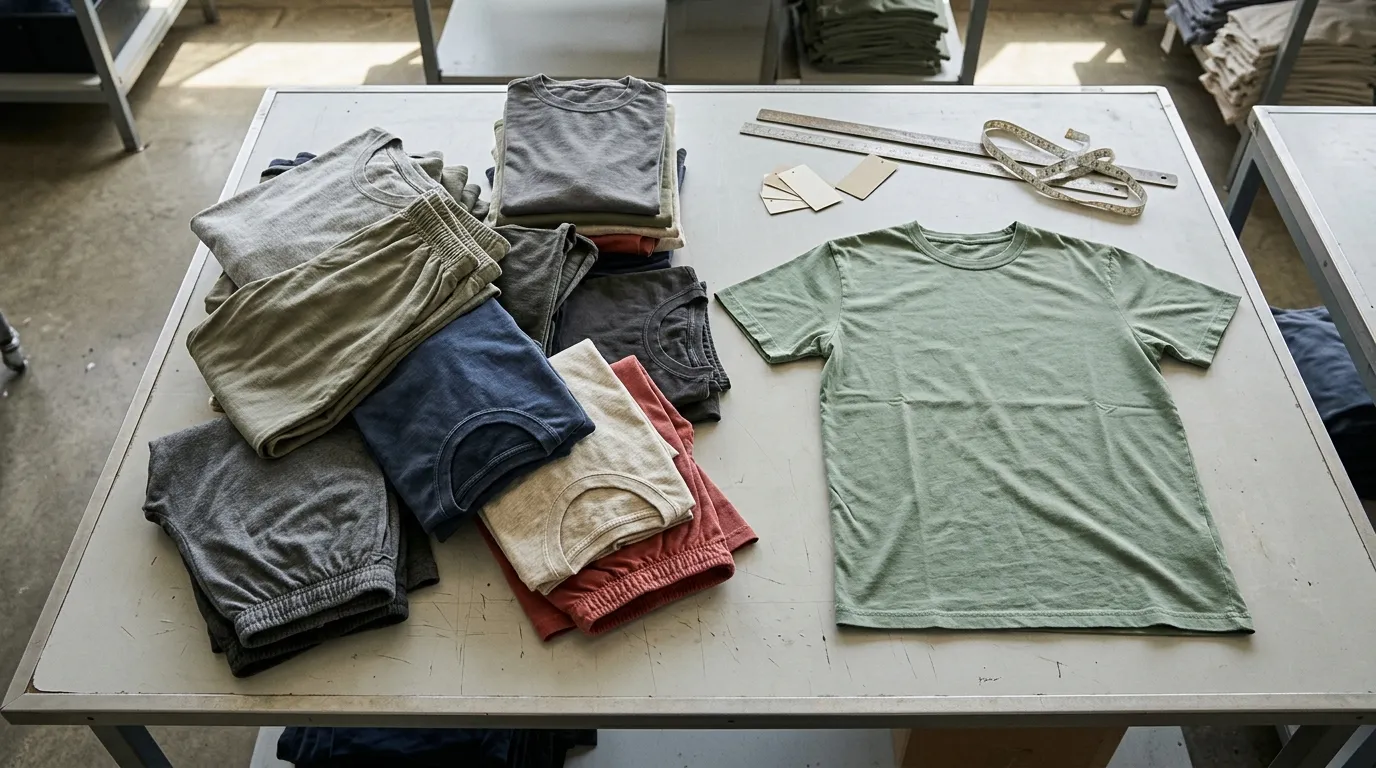
A sampling plan converts lot size, inspection level and the agreed AQL into a sample size and a paired acceptance number and rejection number. If the defects found in the sample stay within the acceptance number, the lot passes; if they reach the rejection number, the lot fails.
HQTS explains that inspection levels and AQL chart tables are used to determine both the sample size and the acceptable number of defective units. The AQL value on its own does not tell an inspector how many garments to open or how many defects to allow.
Because plans differ, any worked figure is illustrative. QIMA's guide states that its sampling tables are based on ANSI/ASQ Z1.4–2008, and in its example, code letter L at AQL 2.5 calls for a 200-unit sample, with acceptance at 10 or fewer defects and rejection at 11 or more. That is QIMA's example under its stated table, not a universal rule for apparel orders.
| Input to the plan | Output it affects | Note |
|---|---|---|
| Lot size | Sample size | Larger lots move to a larger sample under the same plan |
| Inspection level | Sample size | The level changes how much of the lot is checked |
| AQL setting | Acceptance and rejection numbers | Chosen by the buyer, not fixed by the standard |
| Defect class | Which acceptance and rejection numbers apply | Critical, major and minor are usually treated separately |
Critical, Major, and Minor Defects in Apparel

Garment inspections group defects into three classes, and each class normally carries its own acceptance criteria. Critical defects are safety or compliance failures. Major defects are functional or clearly visible problems that affect whether the garment can be sold. Minor defects are smaller issues that are unlikely on their own to prevent sale.
AQI Service describes critical 0, major 2.5 and minor 4.0 as a common buyer-selected pattern, and points out that ISO 2859-1 does not mandate those specific apparel values. The classification matters as much as the number: if a buyer and supplier disagree about whether a seam fault counts as major or minor, the same inspection result can be read two different ways. Defect definitions belong in the order terms for that reason.
| Defect class | Typical apparel examples | Common inspection treatment |
|---|---|---|
| Critical | Safety or compliance failures | Often set at zero tolerance in the buyer's order terms |
| Major | Measurement errors, seam or stitching faults, trim and labelling problems that affect function or sale | Commonly set at AQL 2.5 under the pattern AQI Service describes |
| Minor | Small appearance issues such as loose threads or light surface marks | Commonly set at AQL 4.0 under the same pattern |
What Do AQL 2.5 and AQL 4.0 Mean — and Are They Mandatory?
AQL 2.5 and AQL 4.0 are frequently selected values on apparel orders, but they are buyer-selected settings rather than values the referenced standard requires. AQI Service notes that the common pattern of critical 0, major 2.5 and minor 4.0 is a choice made by buyers, and that ISO 2859-1 does not mandate those particular values.
QIMA frames the choice as a trade-off in both directions. Too lenient a setting risks accepting poor batches, while too strict a setting risks rejecting good ones. A buyer tightening AQL 2.5 to a smaller number is not simply buying more quality; they are also buying a higher chance of a failed inspection and the sorting or rework that follows.
The practical answer to "which AQL should I use" is that the value should match the product type, price point and risk tolerance, as QIMA describes, and should be written into the order terms rather than assumed from a previous order.
Does AQL Mean a Percentage of Every Order May Be Defective?
No. AQL is a threshold used to make a lot-level decision from a random sample, not a licence for a fixed percentage of defects in every order. QIMA describes AQL as a risk-management parameter rather than a defect allowance that a supplier is entitled to fill.
Sampling also cannot certify every unit. HQTS states in its January 13, 2022 guide that AQL sampling does not guarantee a defect-free shipment, and that some defects may go undetected in a sample. That limitation comes from sampling itself; a stricter AQL value does not remove it, and QIMA notes that it increases the chance of rejecting a good batch instead.
AQL Sampling vs. 100% Final Garment Inspection
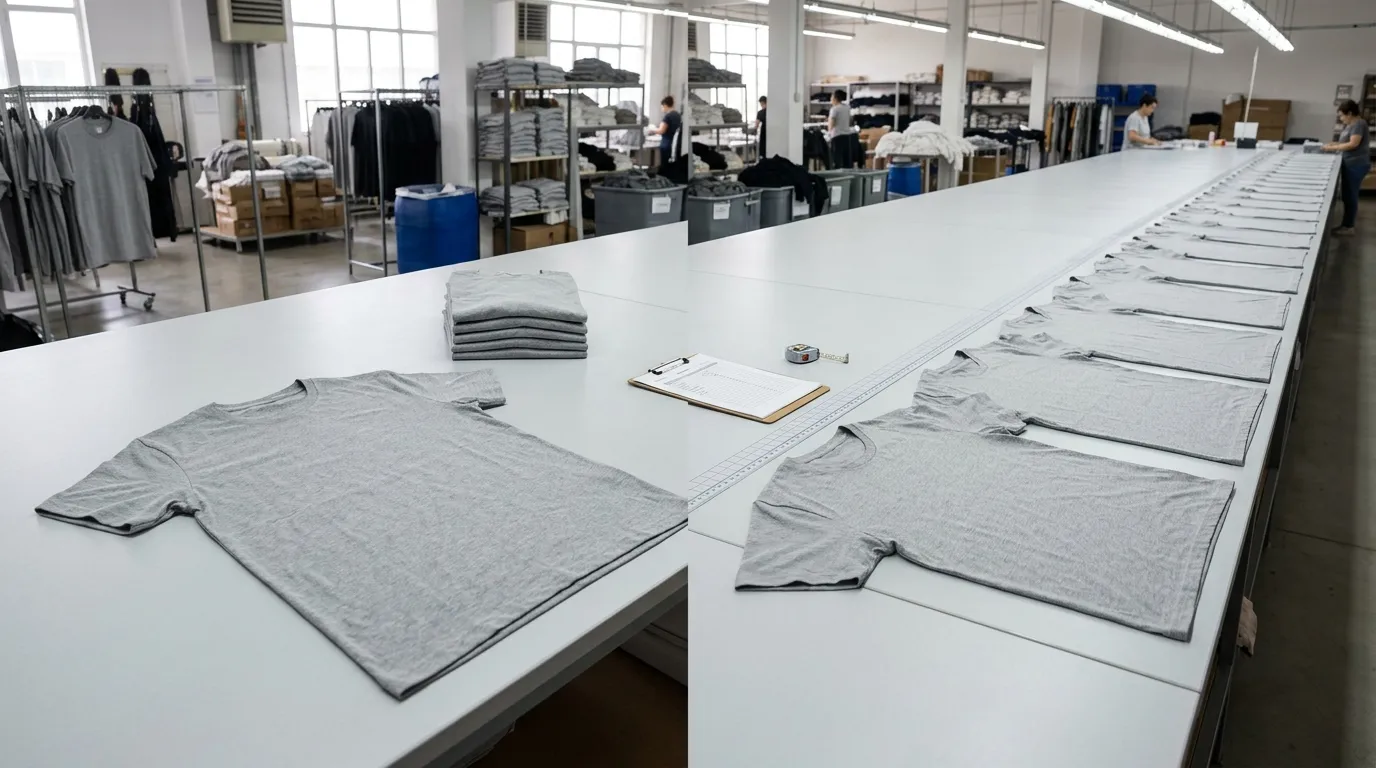
AQL sampling examines a random sample to make one decision about the whole lot, while 100% final garment inspection examines every garment to catch individual-piece defects that sampling can miss. The two answer different questions and can operate together in the same production run.
At Minghang Garments, 100% final garment inspection is standard. Minghang Garments's quality-control process covers checkpoints at incoming materials, cutting, in-line sewing, decoration and finishing, with 100% final garment inspection, and third-party inspection can be arranged when required. Inspection is carried out according to the buyer's agreed AQL level, product specifications and inspection requirements, so the sampled plan and the full check are not treated as substitutes for one another. This end-of-line step sits inside a wider garment quality control process that also covers incoming materials, cutting and in-line stages.
| AQL sampling | 100% final garment inspection | |
|---|---|---|
| Scope | A random sample from the lot | Every garment produced |
| Purpose | Accept or reject decision for the lot | Individual-piece defect detection |
| Defect detection | Estimates lot quality from the sample | Finds defects on each checked garment |
| Key limitation | Some defects may go undetected in the sample | Checks only the attributes and criteria it is set to look for |
| Typical use | Pre-shipment lot acceptance against agreed criteria | End-of-line verification before packing |
What Happens When a Sampled Lot Fails Inspection?
When a sampled lot fails, the number of defects found in the sample has reached the agreed rejection number, so the lot does not meet the acceptance criteria in the order terms. What happens next is a commercial decision, and the sampling standard does not make it for the parties.
Linenwind's buyer guide advises documenting defect classes, AQL values, inspection level and the sampling table in the order terms so both sides read the result against the same criteria. QIMA's treatment of AQL as a risk-management tool points the same way: the plan produces the accept or reject signal, while the contract supplies the remedy for a failed lot.
Decision rule: agree in writing, before inspection, whether a failed lot is sorted, reworked, re-inspected or rejected, and who carries the cost of each outcome.
What Buyers and Suppliers Should Agree on Before Inspection
Before inspection, the buyer and supplier should put the inspection criteria in writing so both sides read the result the same way. Linenwind's buyer guide recommends documenting defect classes, AQL values, inspection level and the sampling table in the order terms. That set of decisions, rather than the AQL number alone, is what makes an inspection result unambiguous.
Minghang Garments conducts inspection according to the buyer's agreed AQL level, product specifications and inspection requirements. A checklist worth settling before production starts:
- Defect definitions for the critical, major and minor classes.
- The AQL value assigned to each defect class.
- The inspection level to be used.
- The sampling table both parties will apply.
- The inspection stage — in-line, pre-shipment, or both.
- Who inspects, and what happens if the lot fails.
For general questions about how a manufacturing order is set up — order steps, documentation and common buyer questions — the FAQs page covers the basics.
Minghang Garments operates a 5+1 quality-control system that includes 100% final garment inspection, and its team works to the AQL level and defect definitions a buyer sets in the order terms.
FAQ
What is AQL 2.5 in the garment industry?
AQL 2.5 is a common buyer-selected setting, usually applied to major defects rather than to the whole order. It forms part of a sampling plan that also fixes sample size and acceptance and rejection numbers. AQI Service notes that the critical 0, major 2.5 and minor 4.0 pattern is a buyer choice, not a requirement of ISO 2859-1.
What does an AQL of 4.0 mean?
An AQL of 4.0 is a looser agreed threshold than 2.5 and is commonly assigned to minor defects. It does not mean 4% of garments may be defective. It is one value inside a sampling plan, and AQI Service points out that ISO 2859-1 does not mandate 4.0 as an apparel requirement.
Does AQL apply to every garment in an order?
No. AQL is applied to a random sample drawn from the lot, so a passing result describes the lot rather than each unit. HQTS states in its January 13, 2022 guide that sampling does not guarantee a defect-free shipment, because some defects may go undetected in the sample. Checking every garment is a separate step.
How do I select an AQL level for my apparel order?
Base the value on product type, price point and how much risk you are willing to carry, as QIMA describes. Then write it down per defect class. Linenwind's buyer guide recommends documenting defect classes, AQL values, inspection level and the sampling table in the order terms so both parties apply identical criteria.
-
Share
-

-

-