 Contact Us

Table of Contents

Contact Us
Updated 2 weeks ago
How to Develop a Custom Sports Bra for Your Brand?
arafatshuvo
Sports bra development follows a defined sequence: set the intended activity and support level, choose a fabric with suitable stretch and recovery, define cup, lining and padding, specify strap and underband construction, then sample, wear-test and grade sizes. Each decision should be recorded in a tech pack before bulk production so fit and performance stay repeatable.
- Set the support level from the intended activity before choosing fabric, cups or straps.
- Compression bras press the breasts toward the chest, while encapsulation bras use individual cups, according to the Gym Clothes guide.
- Fit validation should cover more than one base size: YOU Seamless recommends checking XS, M and XL.
- Minghang Garments' sports-bra page lists high-, medium- and low-impact, seamless, front-zip, plus-size, yoga and cotton types.
- Record approved support, fabric, cup, padding, strap, underband, measurement and grading decisions in a tech pack before bulk.
Step 1 — Define the Brief, Wearer and Support Level
Define the intended wearer, activity, coverage, support level, size range and price position before any design work begins. These requirements determine fabric, cup, strap and underband choices, so they should be locked before sketching or sampling.
Sports bra development at brand level starts with the wearer, not the pattern. A bra designed for running has a different construction brief from one designed for yoga, and the difference shows up in fabric recovery requirements, cup structure and how firmly the underband holds. Minghang Garments' sports-bra page lists high-, medium- and low-impact, seamless, front-zip, plus-size, yoga and cotton types as starting points, and Minghang Garments' homepage names compression, strap construction, underband support, cup design and removable padding among its sports-bra options. A practical first range usually starts with one use case and one support level; adding a second support level later is easier than correcting a construction that tried to serve both.
Compression vs Encapsulation: What's the Difference?
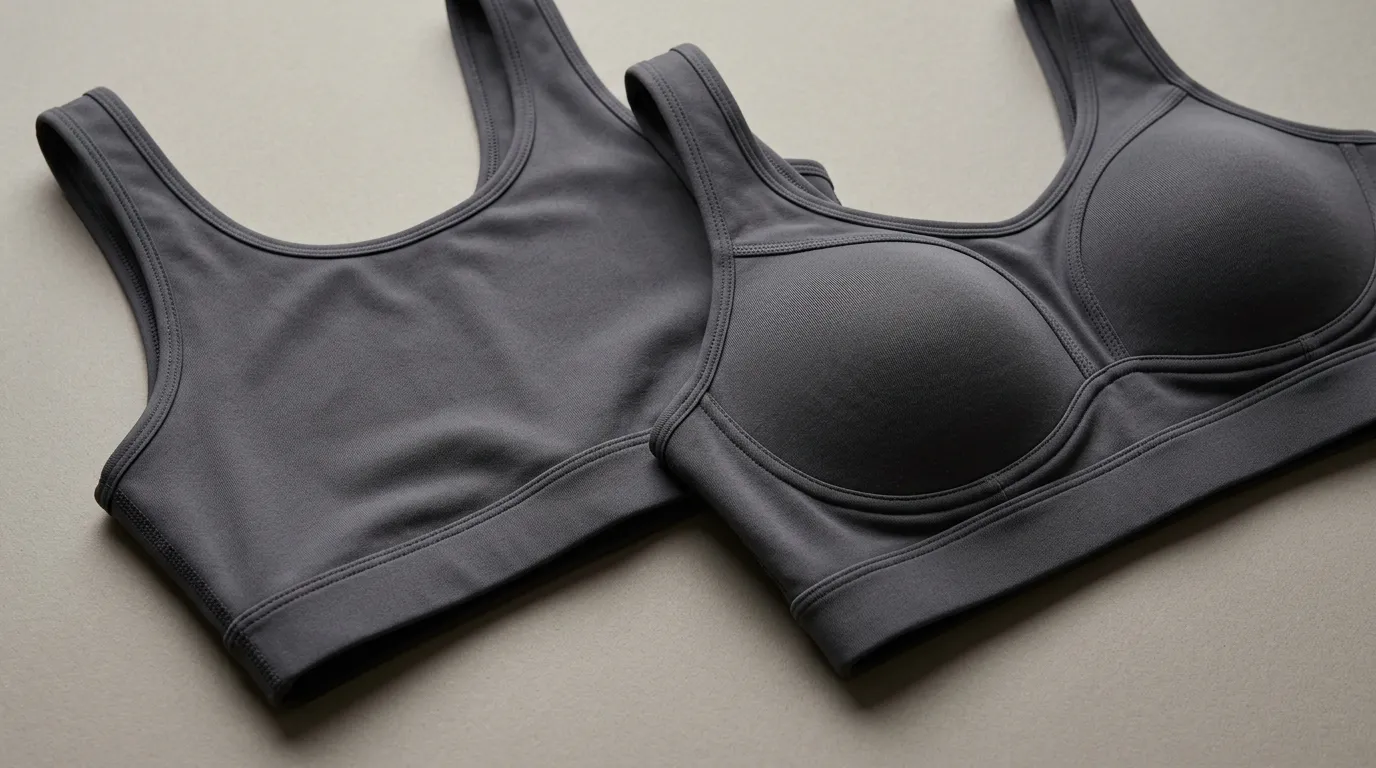
Compression bras press the breasts toward the chest, while encapsulation bras use individual cups to support each breast separately. According to the Gym Clothes guide, these are two distinct support mechanisms, and the choice changes pattern complexity, cup development and how the bra is tested.
| Support mechanism | How it works | Development focus | Typical brief fit |
|---|---|---|---|
| Compression | Presses the breasts toward the chest (Gym Clothes) | Fabric tension and recovery carry the support, so fabric selection is critical | Briefs that prioritise a close, compressed feel and a simpler cup build |
| Encapsulation | Uses individual cups to support each breast separately (Gym Clothes) | Cup development, pattern work and size-graded cup geometry | Briefs that call for individual cup support across a graded size range |
Mechanism descriptions are from Gym Clothes; the development focus and brief-fit columns are design considerations.
Step 2 — Choose Fabric for Stretch, Recovery and Comfort
A sports bra fabric must deliver stretch, recovery, moisture management, opacity and skin comfort, and those properties should be confirmed through fabric testing and a wear trial rather than hand-feel alone. Fabric choice follows the support level set in Step 1; it does not lead it.
| Fabric property | Why it matters | Development check |
|---|---|---|
| Stretch | Allows the bra to go on and move with the body | Test in the direction the pattern loads |
| Recovery | Determines whether the bra holds shape during and after wear | Wash and re-measure after repeated cycles |
| Moisture management | Affects comfort during sustained activity | Wicking test or supplier data |
| Opacity | Prevents show-through when the fabric is stretched | Check in the most stretched areas |
| Skin comfort | Reduces friction at straps, band and seams | Confirm through wear-testing, not fabric samples alone |
As a supplier-specific reference point, YOU Seamless states a 280–320 g/m² fabric range and ≥90% recovery after five washes for a high-intensity example. Those figures come from one supplier and should be treated as a starting reference rather than a universal requirement; brands should set their own thresholds and confirm them with test results for their chosen fabric. For a fuller material comparison, the guide on how to choose fabric for activewear covers the wider activewear fabric set, and fabric and trim sourcing is part of the development services Minghang Garments provides.
Step 3 — Define Cups, Lining and Padding
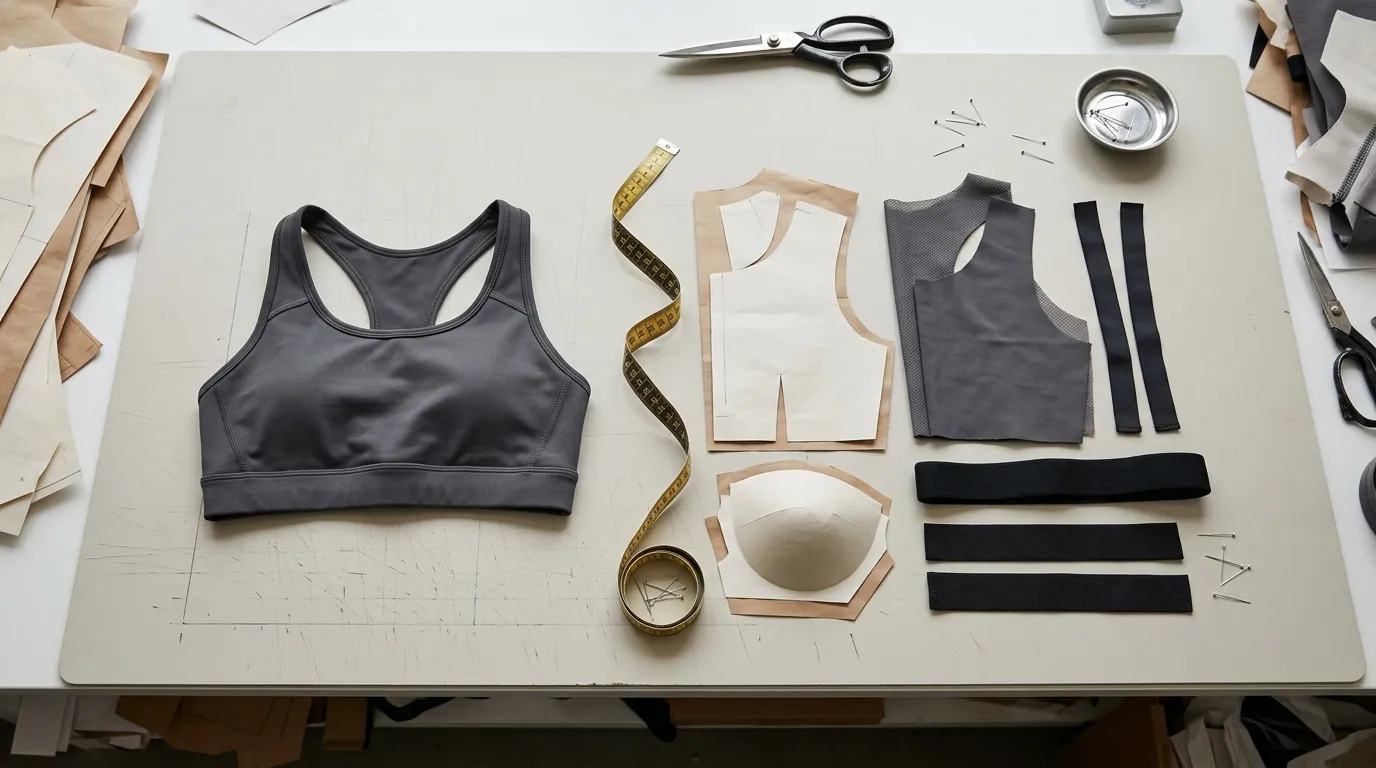
Specify whether the bra uses molded cups, fixed cups, a pocket construction or removable pads, then define lining, pad shape, thickness and placement so coverage and support match the brief. Minghang Garments' sports-bra page states that cup and padding options include removable pads, fixed cups, molded foam and pocket constructions.
Each option carries a different development cost. Removable padding, which Minghang Garments' homepage also lists among its sports-bra options, gives the wearer flexibility but adds a pocket layer and a pad that must be checked for movement during wear-testing. Fixed cups and molded foam hold their shape more consistently but commit the brand to a fixed silhouette across the size range. Pocket constructions sit between the two. Whichever route is chosen, plan the decision as a single instruction to the sample room rather than adjusting pad and cup separately after the first sample.
Step 4 — Specify Straps, Underband and Seam Construction
Straps and the underband carry much of the support, so define their width, adjustability, stretch direction, attachment points and seam placement as one system. Minghang Garments' homepage names strap construction and underband support among its sports-bra options.
Treat these four decisions as linked:
- Strap width and adjustability — wider, less elastic straps distribute load differently from narrow adjustable ones, and the choice must match the support level.
- Stretch direction — straps that stretch along their length behave differently from straps cut to limit stretch.
- Underband stability — the band should stay in place during movement; YOU Seamless describes an arm-raise movement check to observe whether the underband shifts.
- Seam placement — keep seams away from high-friction zones, then confirm comfort during the wear test rather than assuming it from the pattern.
Step 5 — Build and Wear-Test the Prototype
A prototype should be checked in movement, not only while standing still, for underband stability, strap comfort, coverage, pad movement, chafing and freedom of movement. YOU Seamless's guide describes an arm-raise movement check to observe whether the underband shifts, which is one example of a movement-based test rather than a formal standard.
Use the same checklist across every prototype so results can be compared:
| Check | What to observe | Decision rule |
|---|---|---|
| Underband stability | Does the band shift during arm raises? | If it shifts, revise band tension or elastic before grading |
| Strap comfort | Pressure points or slipping during movement | Adjust width, adjustability or attachment points |
| Coverage | Does coverage change when the body moves? | Revise cup or pattern rather than adding fabric |
| Pad movement | Do removable pads migrate or fold? | Revise pocket opening or pad shape |
| Chafing | Friction at seams, straps or band edges | Reposition seams or smooth the finish |
| Freedom of movement | Can the wearer move without restriction? | Confirm the support level is not over-built |
Minghang Garments states that sampling typically takes 7–15 working days, and it runs a 2,000 m² sample center, so a prototype round is a scheduled stage rather than an open-ended one. See the sampling process guide for how approval steps typically progress. Cycle time is a company-stated figure, not a guaranteed delivery date.
Step 6 — Grade Sizes and Validate Fit Across the Range
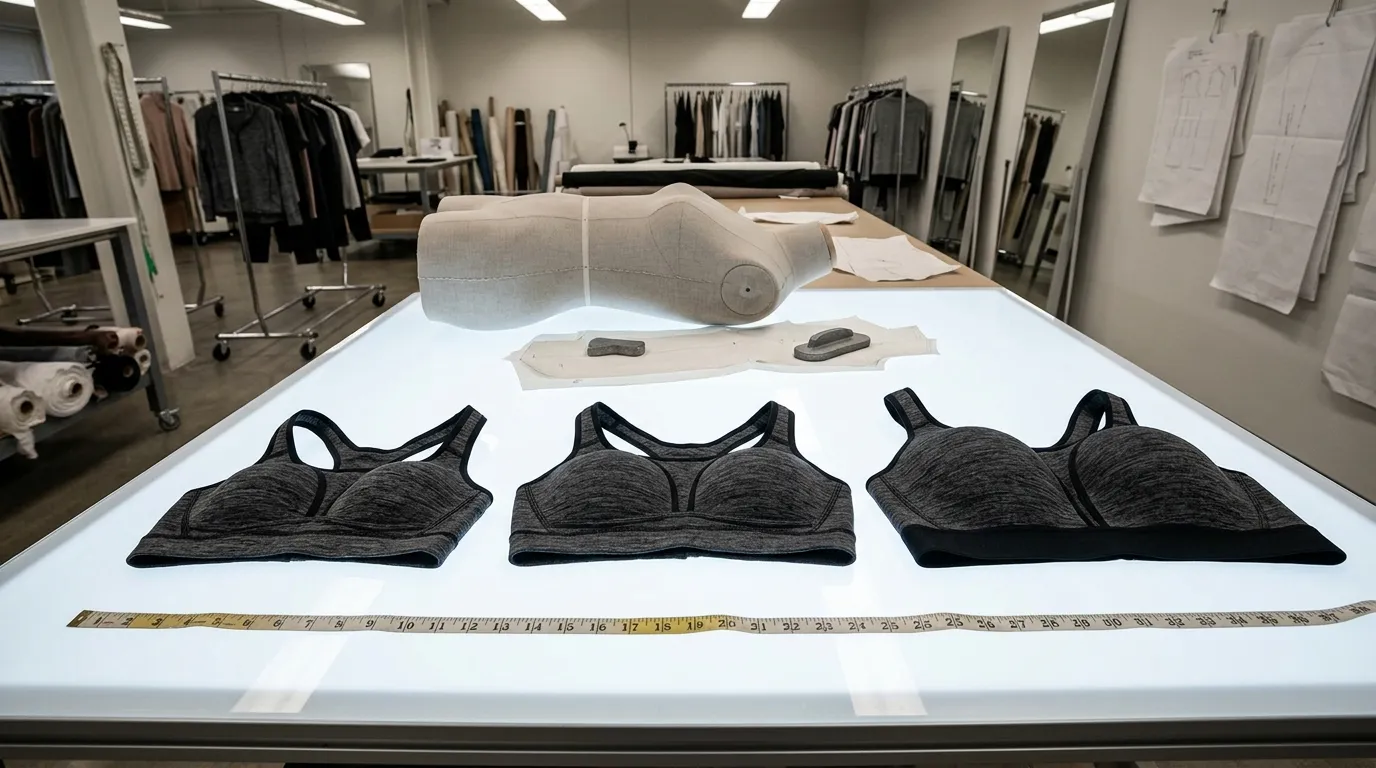
Grade the approved base size into the full size range, then fit-test key sizes across that range instead of relying only on one base-size sample. YOU Seamless recommends validating a prototype in XS, M and XL rather than relying on a single base size.
Good grading for a sports bra is not just scaled measurements: underband tension, cup coverage and strap placement all behave differently at the ends of the range, and the pattern rules should account for that. Review the smallest and largest sizes for band stability and coverage, check that pads stay in position at both ends, and only then sign off the size range. If fit changes materially between sizes, correct the grade rules before placing a bulk order rather than relying on size-specific adjustments later.
Step 7 — Lock the Final Spec in a Tech Pack
A production-ready tech pack records the approved support level, fabric and trims, cup and padding, strap and underband construction, measurements, grading, seams, labels and packaging. Minghang Garments' services cover product development, pattern making, sampling, labels and packaging, so those details sit inside the same development file.
| Decision area | What to record | Why it matters |
|---|---|---|
| Support level | Compression or encapsulation, and intended activity | Sets the reference for every later change |
| Fabric and trims | Approved fabric, elastic, thread and findings | Prevents substitution during production |
| Cup and padding | Cup type, lining, pad type and placement | Keeps coverage consistent across sizes |
| Straps and underband | Widths, adjustability, attachment points | Protects the approved fit |
| Measurements and grading | Base-size spec and grade rules | Allows bulk QC against a fixed reference |
| Seams and stitching | Approved seam types and positions | Prevents friction problems returning |
| Labels and packaging | Care, brand and size labelling | Avoids last-minute production changes |
What to Confirm With a Manufacturer Before Bulk
Before committing to bulk, confirm minimum order quantity, sampling timeline, bulk lead time, testing and QC scope, and the procedure for changes after approval.
Minghang Garments states that MOQ starts at 100 pcs per color per style on stock fabric, sampling takes 7–15 working days and bulk generally takes 25–45 days after sample and material approval. Minghang Garments also runs a 5+1 QC system. Different fabric and dyeing conditions can change the order quantity, so confirm the figures in writing for the specific style rather than assuming the standard terms apply. Ask for the QC checkpoints and the change procedure in the same conversation, and keep both in the file with the approved tech pack.
Frequently asked questions
Can you have a custom sports bra made for your brand?
Yes. OEM, ODM and private-label manufacturing can produce custom sports bras when the brand supplies or approves the design brief, fabric, sizing and labelling. Minghang Garments states that MOQ starts at 100 pcs per color per style on stock fabric, with sampling typically taking 7–15 working days. Sports-bra style options are listed on its custom sports bra manufacturer page.
Do consumer fit rules like the two-finger rule apply to sports bra development?
No. Rules such as the two-finger band check are retail fitting heuristics for shoppers, not production standards. For brand development, define a size range, wear-test the prototype in movement, and validate fit across key sizes such as XS, M and XL. Record approved measurements and grade rules in the tech pack rather than relying on general consumer rules.
-
Share
-

-

-