 Contact Us
Table of Contents

Contact Us
Updated 1 week ago
How to Choose Fabric for Activewear: Stretch, Recovery, Compression & Moisture Management

Minghang Garments
Minghang Garments is a custom apparel manufacturer specializing in activewear, streetwear and private-label clothing development. Our team supports brands through fabric sourcing, product development, sampling, bulk production and quality control, with OEM and ODM solutions for startups, growing labels and established apparel businesses.
Choosing fabric for activewear is different from selecting material for ordinary casual clothing.
Activewear fabrics need to move with the body while maintaining fit, coverage, comfort, and shape during repeated stretching and wear.
A fabric may feel soft in your hand but perform poorly once it is made into leggings. Another material may offer excellent compression but feel too restrictive for a lightweight training top.
For this reason, activewear fabric should not be selected based only on composition, GSM, or how the swatch feels.
Brands should evaluate how the material stretches, recovers, manages moisture, maintains opacity, and performs in the actual garment.
This guide explains the main fabric properties brands should consider when developing leggings, sports bras, training tops, jackets, and other activewear products.
What Makes a Fabric Suitable for Activewear?
Activewear fabric needs to balance several properties at the same time.
The exact priorities depend on the garment.
Leggings may require strong recovery, opacity, and compression, while a lightweight training top may prioritize breathability, softness, and moisture management.
A good fabric specification therefore starts with the intended use of the product rather than a fixed fiber composition.
Performance
Comfort & Appearance
A fabric does not need to maximize every property.
For example, increasing compression may reduce the soft, barely-there feel some brands want. A thicker material may improve coverage but also make the garment warmer.
The goal is to find the right balance for the intended activity and product positioning.
Nylon vs Polyester for Activewear
Nylon and polyester are two of the most common synthetic fibers used in performance apparel.
Both can be blended with elastane to create stretch fabrics, but they often produce different hand feels and performance characteristics.
Nylon
Often chosen when brands want:
- Softer hand feel
- Smooth surface
- Good stretch
- Comfortable next-to-skin feel
- Premium appearance
Nylon-based fabrics are commonly used for leggings, sports bras, and fitted activewear where softness and body feel are important.
Polyester
Often chosen when brands want:
- Strong moisture management
- Faster drying
- Good dimensional stability
- Durable performance
- Versatility across training apparel
Polyester is widely used for training tops, shorts, jackets, and many performance-focused garments.
Which One Is Better?
Neither fiber is automatically better.
A nylon-spandex fabric can feel completely different from another nylon-spandex fabric depending on yarn, knitting structure, weight, finishing, and elastane content.
The same is true for polyester.
For this reason, brands should evaluate the finished fabric rather than selecting material based on fiber name alone.
How Much Spandex Does Activewear Need?
Elastane, also known as spandex, is added to activewear fabrics to improve stretch and recovery.
More spandex does not always mean better performance.
The ideal percentage depends on the garment, knitting structure, fabric weight, and intended compression level.
As a general reference:
- 5–10% spandex — Light stretch, often used in tops or casual performance garments
- 10–20% spandex — Common for leggings, sports bras, and fitted activewear
- 20%+ spandex — Higher stretch and compression potential, depending on construction
The percentage alone does not determine how stretchy the fabric feels.
A tightly knitted fabric with 15% spandex may feel more compressive than a softer fabric with 20% spandex.
2-Way Stretch vs 4-Way Stretch
2-Way Stretch
Usually stretches mainly in one direction.
Commonly suitable for:
- Some jackets
- Casual performance tops
- Less body-contoured garments
- Styles where full multidirectional movement is not required
4-Way Stretch
Stretches both lengthwise and crosswise.
Commonly preferred for:
- Leggings
- Sports bras
- Yoga wear
- Compression garments
- Training apparel requiring unrestricted movement
For fitted activewear, 4-way stretch is usually more practical because the fabric needs to move with the body in multiple directions.
However, stretch alone is not enough. A fabric also needs good recovery.
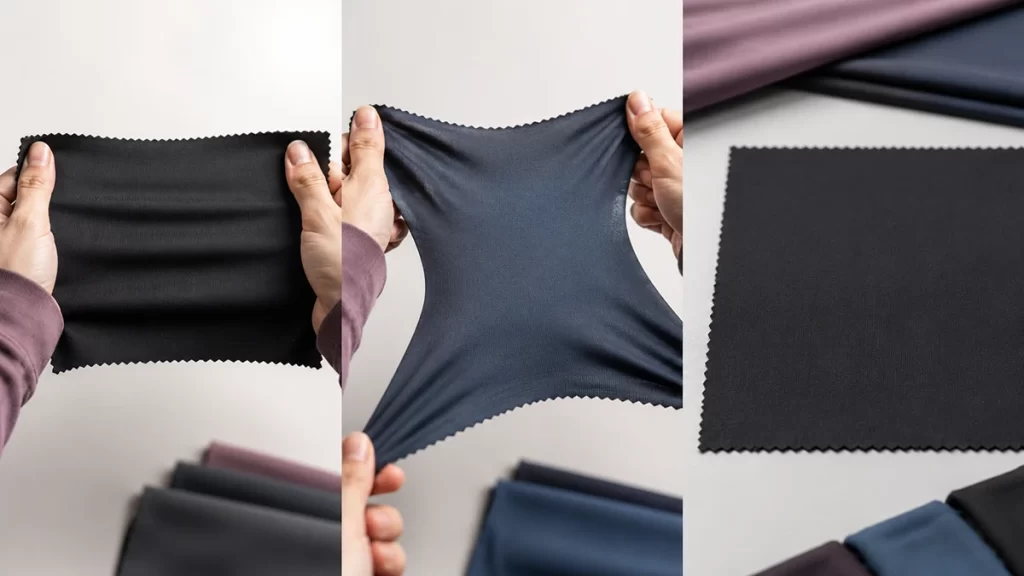
Why Stretch Recovery Matters
Stretch recovery describes how well a fabric returns to its original shape after being stretched.
This is especially important for leggings, sports bras, waistbands, and fitted tops.
Poor recovery can lead to:
- Knee bagging
- Loose waistbands
- Sagging
- Loss of compression
- Distorted fit after repeated wear
A fabric may stretch easily and still perform poorly if it does not recover properly.
This is why activewear fabrics should be tested after repeated stretching rather than judged only by how flexible they feel when new.
Key takeaway:
High stretch without good recovery can still result in poor fit and shape retention.
Compression vs Soft Hand Feel
Activewear fabrics often need to balance support and comfort.
A fabric with stronger compression can help create a secure, sculpted fit, but it may feel less soft or flexible. A very soft fabric may feel excellent against the skin but provide less support during high-intensity movement.
The right balance depends on the intended product.
For example, compression may be more important for:
- Training leggings
- Running tights
- Medium- to high-support sports bras
- Performance garments designed for intense movement
A softer hand feel may be more important for:
- Yoga leggings
- Lounge-activewear crossover products
- Low-impact sports bras
- Lifestyle activewear
- Everyday fitted tops
Stronger Compression Is Not Always Better
More compression does not automatically mean higher quality.
If the fabric is too restrictive, it may reduce comfort, limit movement, or create excessive pressure around the waistband and seams.
Compression should support the body without making the garment uncomfortable to wear.
The final result depends on several factors working together:
- Fabric density
- Elastane content
- Stretch recovery
- Garment measurements
- Pattern construction
- Waistband design
- Seam placement
This is why compression should be evaluated on the actual garment rather than judged from the fabric swatch alone.
Higher Compression
Best suited for:
- Running
- Gym training
- High-support leggings
- Performance-focused activewear
Key characteristics
- Firmer hand feel
- Stronger support
- Better shape control
- More secure fit
Soft / Second-Skin Feel
Best suited for:
- Yoga
- Pilates
- Low-impact training
- Lifestyle activewear
Key characteristics
- Softer touch
- More flexible feel
- Less restrictive fit
- Greater comfort for long wear
The goal is not to choose one over the other, but to match the fabric feel with the intended activity and product positioning.
What Makes Activewear Fabric Squat-Proof?
For leggings, opacity is one of the most important performance checks.
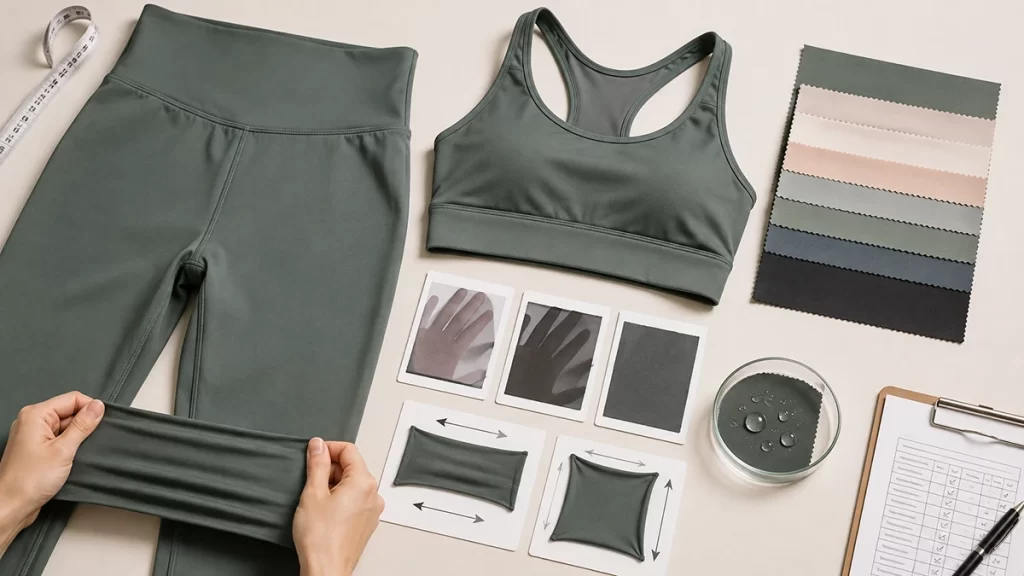
A fabric may look completely opaque when relaxed but become noticeably more transparent when stretched across the hips, thighs, or knees.
This is why leggings fabric should be evaluated under stretch rather than only by holding the swatch up to light.
Several factors can affect opacity:
- Fabric density
- GSM
- Knitting structure
- Fiber type
- Color
- Stretch level
- Elastane content
- Surface finishing
Darker colors may appear more opaque than lighter shades, but color alone does not guarantee coverage.
Key takeaway:
Squat-proof performance depends on fabric density, stretch and construction — not just GSM or color.
Test Opacity in the Finished Garment
The most useful test is to check the actual sample while the fabric is under realistic stretch.
For leggings, this may include:
- Deep squat
- Forward bend
- Lunge
- Hip stretch
- Knee flexion
The fabric should maintain reasonable coverage through these movements without becoming excessively transparent.
Opacity Should Be Balanced With Comfort
Simply increasing fabric thickness is not always the best solution.
A very heavy fabric may improve coverage but make the leggings warmer, less breathable, or too stiff.
A better solution is usually a fabric with suitable density, stretch, recovery, and knitting structure for the intended use.
Moisture Management and Quick-Dry Performance
Moisture management is important for activewear because the fabric needs to remain comfortable as the body heats up and sweats.
However, “moisture-wicking” and “quick-dry” are not exactly the same thing.
Moisture-wicking refers to how efficiently sweat moves away from the skin and spreads through the fabric, while quick-dry performance refers to how quickly that moisture evaporates.
A good activewear fabric may need both properties, depending on the intended activity.
What Affects Moisture Management?
Several factors can influence moisture performance:
- Fiber type
- Yarn structure
- Knitting construction
- Fabric thickness
- Surface treatment
- Air permeability
- Fabric density
- Finishing process
Polyester is commonly used in performance apparel because it absorbs relatively little moisture and can dry quickly.
Nylon can also perform well, especially when fabric construction and finishing are optimized for activewear.
The final performance should therefore be evaluated on the actual fabric rather than assumed from fiber composition alone.
Breathability Also Matters
Quick drying does not automatically mean the garment will feel cool.
For high-intensity training, airflow and breathability can be just as important as moisture transport.
A very dense compression fabric may offer strong support and coverage but feel warmer during extended training.
For this reason, brands should consider the balance between:
compression + opacity + breathability + moisture management
rather than maximizing only one property.
Key takeaway:
Moisture-wicking, quick-dry performance and breathability should be evaluated together based on the intended activity.
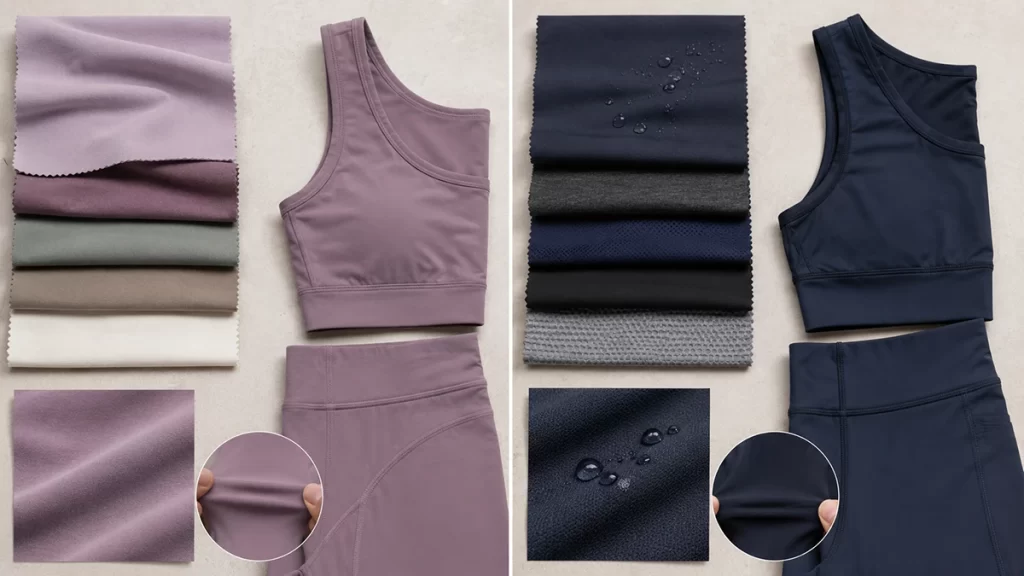
Choosing Fabric for Different Activewear Products
Leggings
Key fabric priorities:
- 4-way stretch
- Strong recovery
- Good opacity
- Suitable compression
- Shape retention
- Soft skin contact
- Moisture management
For yoga leggings, brands may prioritize softness and flexibility.
For gym or running leggings, stronger recovery and compression may be more important.
Fabric should always be evaluated under realistic stretch and movement.
Sports Bras
Key fabric priorities:
- Stretch and recovery
- Support
- Comfortable compression
- Skin comfort
- Moisture management
- Shape retention
Support does not come from fabric alone.
Pattern construction, elastic, straps, lining, and cup design also affect the final performance of the sports bra.
Training Tops & Jackets
Key fabric priorities:
- Breathability
- Moisture management
- Lightweight comfort
- Stretch
- Quick drying
- Surface durability
Fitted tops usually require more stretch and recovery, while training jackets may prioritize structure, wind resistance, or surface durability depending on the design.
What Brands Should Check Before Approving Activewear Fabric
Before approving an activewear fabric for bulk production, brands should evaluate both the material itself and how it performs in the finished garment.
A swatch may look suitable on the table but behave differently once it is stretched, sewn, worn, and washed.
For this reason, fabric approval should include both physical properties and performance testing.
Physical Properties
Check the Fabric
- Composition
- GSM
- Knitting structure
- Hand feel
- Surface appearance
- Stretch direction
- Stretch percentage
- Fabric density
- Color consistency
Performance Testing
Check the Performance
- Stretch recovery
- Opacity under stretch
- Compression level
- Shape retention
- Moisture management
- Breathability
- Pilling resistance
- Wash performance
- Comfort during movement
A fabric does not need to score equally well in every area.
The priority should depend on the intended product.
For example, opacity and recovery may be critical for leggings, while breathability and quick-dry performance may matter more for lightweight training tops.
Test the Fabric in the Finished Sample
Whenever possible, approve activewear fabric together with the actual garment sample.
This allows you to evaluate how the fabric interacts with:
- Pattern shape
- Seam placement
- Waistband construction
- Elastic
- Lining
- Garment measurements
- Decoration or branding
A fabric that performs well as a swatch may still create issues if the pattern, construction, or tension is not suitable.
Do Not Change Fabric After Fit Approval Without Rechecking the Garment
Changing fabric can also change fit.
A new material may have different stretch, recovery, thickness, compression, or drape, even if the composition looks similar on paper.
If the bulk fabric differs significantly from the fabric used for the approved sample, the garment should be reviewed again before production.
Key takeaway:
Activewear fabric should be approved based on real garment performance, not composition, GSM, or swatch feel alone.
Final Thoughts
Choosing the right activewear fabric means balancing stretch, recovery, compression, opacity, comfort, and moisture performance around the needs of the product.
There is no single fabric that is best for every type of activewear.
A soft nylon-spandex fabric may work well for yoga leggings, while a denser fabric with stronger recovery may be more suitable for training tights. Lightweight polyester blends may perform better in breathable training tops, while sports bras may require a different balance of support and comfort.
For brands, the most reliable approach is to define the intended activity first, compare suitable fabric options, and then evaluate the material in an actual sample.
The final decision should be based on how the fabric performs when worn — not just how it looks on a specification sheet.
Written by
Minghang Garments
Apparel Manufacturing Team
Minghang Garments is a custom apparel manufacturer specializing in activewear, streetwear and private-label clothing development. Our team supports brands through fabric sourcing, product development, sampling, bulk production and quality control, with OEM and ODM solutions for startups, growing labels and established apparel businesses.
-
Share
-

-

-