 Contact Us

Table of Contents

Contact Us
Updated 1 month ago
What Payment Terms Do Clothing Manufacturers Offer?
arafatshuvo
Clothing manufacturer payment terms commonly follow a deposit-and-balance structure: a deposit before bulk production begins, then the balance before shipment, often once production and inspection are complete. At Minghang Garments, terms are typically a 30–50% deposit with the balance paid after production and inspection, and repeat or long-term programs are reviewed per project. Exact splits and due dates are negotiated in writing.
Key takeaways
- The common pattern is a deposit before bulk production and a balance before shipment; Shanghai Garment describes 30–50% down with the 50–70% balance before shipment, so the split is negotiated rather than fixed.
- 30/70 and 50/50 are the two splits buyers meet most often, and both can share the same trigger logic — what changes is how much is paid early.
- Payment terms set timing, while payment methods such as telegraphic transfer, letters of credit, escrow and net terms set how money moves and what protection it carries.
- Terms commonly shift with relationship history and order profile: Shanghai Garment's comparison shows 50/50 for a first order under $10,000 and 30/70 for an established client.
- The amount, currency, balance trigger, inspection rights and fees belong in the written order agreement, not in a message thread or a verbal understanding.
What payment terms do clothing manufacturers commonly offer?
Most clothing manufacturers work on a deposit-and-balance schedule: part of the order value is paid before bulk production, and the remainder is settled before shipment. Exact splits, percentages and deadlines vary by manufacturer, order size and relationship history.
According to Shanghai Garment, a common structure is a 30–50% deposit with the 50–70% balance paid before shipment. Plucky Reach's 2026 guide lists 50/50, 30/70 and 100% upfront among possible structures — that is the publisher's own list of options, not a measured frequency across the industry.
One practical point that often gets lost: the payment schedule is a separate question from the total order value. A deposit percentage tells you when cash leaves your account, not what the garment costs to make, and the two are negotiated independently when you compare clothing manufacturing cost estimates against each other.
This page covers payments a brand makes to a factory. It does not cover credit terms a brand extends to boutiques, department stores or corporate clients, which run in the opposite direction.
What do deposit and balance mean in a clothing order?
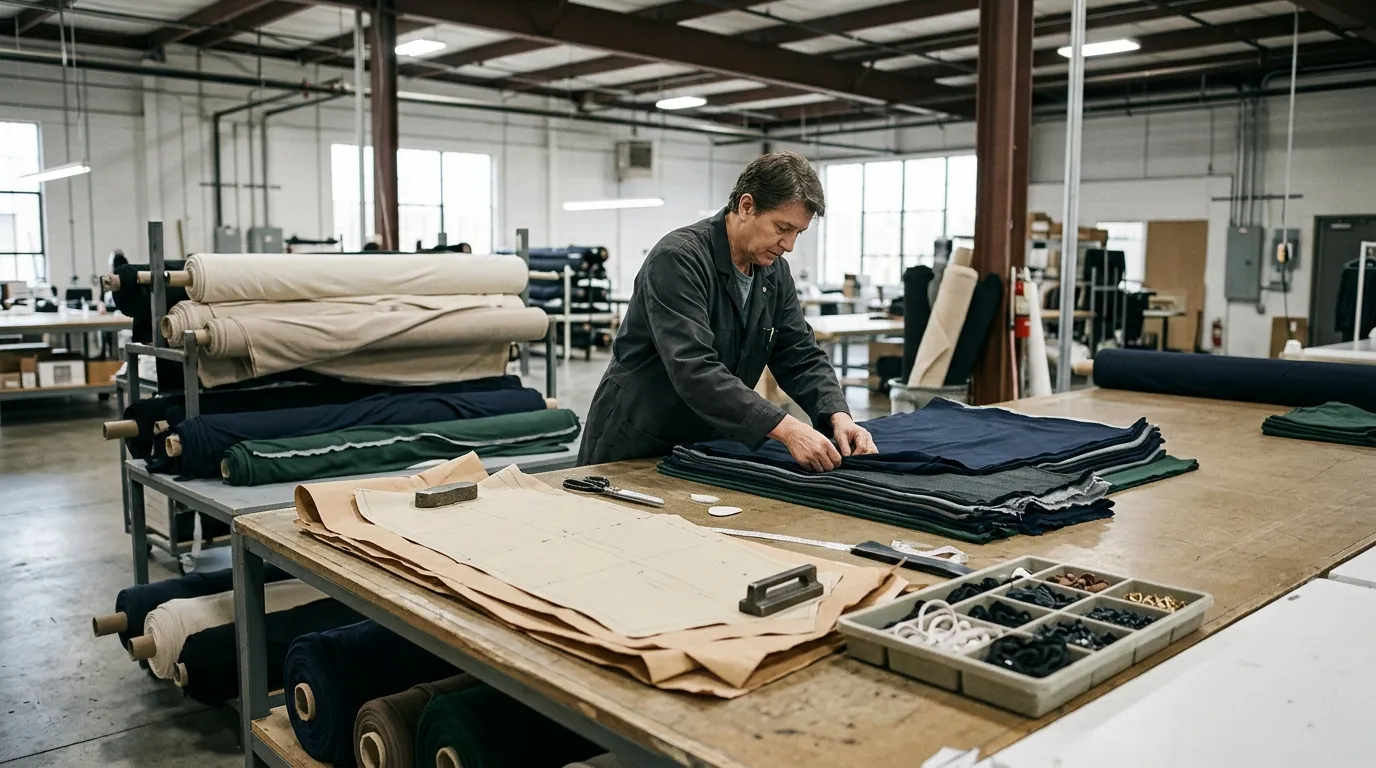
A deposit is the advance payment that authorizes fabric and trim purchasing and production; the balance is the final payment that releases the order. Manufacturers may tie that balance to different triggers — after inspection and before shipment, against shipping documents, or after delivery — so the trigger, not the percentage, is the term to pin down.
The three balance triggers buyers encounter most:
- After inspection, before shipment. The balance becomes due once quality inspection is signed off, while goods are still at the factory. This gives the buyer an inspection checkpoint before the money leaves.
- Against shipping documents. The balance is released when the manufacturer presents documents such as the bill of lading. Weft Apparel states its own structure as a 30% deposit at purchase-order confirmation with a 70% balance tied to shipping documents or inspection sign-off.
- After delivery, on agreed days from the invoice date. This is a credit-style arrangement rather than a pre-shipment settlement.
Milestones matter because they sit before these triggers. Minghang Garments' sampling typically takes 7–15 working days, and bulk production generally takes 25–45 days after sample and material approval, so the point at which a balance falls due usually lands well after the deposit. A custom apparel production timeline is useful for seeing where those checkpoints sit relative to each payment.
30/70, 50/50 and milestone schedules: what the splits actually mean
A 30/70 schedule means 30% is paid up front and 70% later; a 50/50 schedule splits the order value evenly. Milestone schedules divide payment across several stages instead of two, and are typically described for larger or more complex orders.
| Structure | First payment and when it is due | Later payments and their trigger | Source | What to watch |
|---|---|---|---|---|
| 30/70 | 30% deposit | 70% balance before shipment | Shanghai Garment | Confirm whether "before shipment" means after inspection or against documents |
| 50/50 | 50% deposit | 50% before shipment | Shanghai Garment, shown for a first order under $10,000 | A larger early payment means more exposure if the order changes |
| Four-stage milestone, 25% each | 25% at the first stage | 25% at each of the remaining three stages | Shanghai Garment, given as an example for complex or large orders | More stages mean more administrative steps and more dates to track |
| 100% upfront | Full order value at confirmation | No balance | Plucky Reach, listed as a possible structure | Highest buyer exposure; the source presents it as an option, not a recommendation |
| Net 30 / Net 60 | Nothing at confirmation | Payment due 30 or 60 days after the invoice date | Selai Sourcing, October 25, 2023 | Measured from invoice date, so the due date moves if the invoice is late |
The percentages are only half the term. A 30/70 schedule with the balance due after inspection is a different commercial arrangement from a 30/70 schedule with the balance due on a calendar date, even though the numbers look identical on a quotation.
Weft Apparel's guide works through an example: a 200-unit order at $18 per unit totals $3,600, split into a $1,080 deposit at 30% and a $2,520 balance at 70%. That is an illustration of how the arithmetic works, not a price benchmark for any particular product.
What changes the payment terms a manufacturer will offer?

Relationship history and order profile are usually what move the numbers. The retrieved guides point to first orders carrying larger deposits and to repeat or established clients being quoted differently, while order size, fabric and trim positions, and production complexity are commonly cited as factors.
Shanghai Garment's comparison table shows 50% deposit and 50% before shipment for a first order under $10,000, against 30% deposit and 70% before shipment for an established client. That single comparison is the clearest example in the sources reviewed of how history changes the split.
Plucky Reach's 2026 guide makes broader claims about which structures apply to which buyers; treat those as the publisher's position rather than a general rule. Weft Apparel presents milestone gates in the context of larger or more complex orders, where tying money to stages reduces the risk on both sides.
A workable decision rule: treat every quoted split as specific to that order until the manufacturer tells you otherwise. If a factory offers the same schedule to every buyer, that schedule is standard rather than negotiated — and in that case the balance trigger deserves more of your attention than the percentage.
Payment terms vs payment methods: T/T, L/C, escrow and net terms
Payment terms set when money is due; payment methods set how it moves and what protection it carries. Telegraphic transfer is a bank transfer, a letter of credit is a bank-backed instrument tied to documents, escrow holds funds with a third party, and net 30 or net 60 means payment is due a set number of days after the invoice date.
According to Selai Sourcing, published October 25, 2023, Net 30 and Net 60 mean payment is due 30 or 60 days after the invoice date respectively. The same source explains that under documents against payment (D/P), documents are handed over upon payment, while under documents against acceptance (D/A), documents are handed over when a draft for future payment is accepted. It also describes open account as shipment first with payment at an agreed future date, associated with established relationships and mutual trust.
The mistake worth avoiding is treating these as one list. A buyer can have a 30/70 payment term and settle both payments by telegraphic transfer; another buyer can have the same 30/70 term settled through a letter of credit. The instrument changes the protection and the bank fees, not the schedule.
Freight responsibility and Incoterms are a separate commercial question from payment terms and are settled in the same contract.
What to confirm in writing before you pay
Confirm the payment schedule in the order agreement before the first transfer, not in a chat message. At minimum, fix the amount and currency, the invoice milestones, the exact balance trigger, the inspection step, who covers bank fees, and how changes or disputes are handled.
Use this as a written checklist:
- Total order value and the percentage attached to each payment.
- Currency, and which party bears transfer and intermediary bank fees.
- A named trigger for each payment — inspection sign-off, document presentation or a calendar date.
- The inspection right: who performs it, against what specification, and what happens if the result is disputed.
- Which shipping documents release the balance.
- The process if quantity, specification or delivery dates change after the deposit is paid.
- The written remedy if delivered goods do not meet the approved sample or specification.
How to reduce risk on a first order
A first order carries more exposure than a repeat order, and the structure can be adjusted rather than accepted as offered. Start with a smaller order to build a payment history, and tie the balance to inspection rather than to elapsed time wherever the manufacturer agrees. Avoid paying the full order value up front on a first order, and keep every schedule change in the written agreement rather than in a message.
Weft Apparel ties its stated balance to shipping documents or inspection sign-off. That is one manufacturer's described approach and a reasonable risk-management option to request — it is not a market standard that every factory follows.
How Minghang Garments handles payment terms
Minghang Garments confirms the payment schedule with the order agreement for each program, so brands know what is due and when before production starts. Terms are typically a 30–50% deposit, with the balance paid after production and inspection, and repeat or long-term programs may be reviewed per project.
The company is a custom clothing manufacturer based in Dongguan, China, operating since 2017, providing OEM, ODM and private label manufacturing of activewear, sportswear, loungewear and streetwear. Minimum order quantity starts from 100 pcs per color per style on stock fabric, sampling takes 7–15 working days, and bulk production takes 25–45 days after sample and material approval, supported by a 5+1 QC system across a 12,000 m² production floor and a 2,000 m² sample center.
If you are planning a first production run and want to confirm the schedule that applies to your order, contact Minghang Garments directly. Broader manufacturing questions, from samples to labels and packaging, are covered in the FAQs.
Is there an industry standard for clothing manufacturer payment terms?
There is no single published standard, but there is a common shape: deposit before bulk production and balance before shipment. The splits in the sources reviewed range from 30% to 50% down, with Shanghai Garment citing 30–50% deposits and Plucky Reach's 2026 guide listing 50/50 among possible structures. What applies to your order is whatever the agreement states.
What are LC and TT payment terms in clothing manufacturing?
T/T stands for telegraphic transfer, a bank transfer between buyer and manufacturer. An L/C is a letter of credit, a bank-backed instrument released against specified documents. These describe how money moves, not when it is due — Selai Sourcing defines Net 30 and Net 60 as due 30 or 60 days after the invoice date.
Can a new brand get net 30 terms from a clothing manufacturer?
Net terms mean payment after shipment on an agreed future date, and Selai Sourcing associates open account arrangements with established relationships and mutual trust. For a first order, a deposit-and-balance schedule is the more likely starting point. Ask the manufacturer directly what they offer a new buyer rather than assuming credit terms are available.
-
Share
-

-

-