 Contact Us

Table of Contents

Contact Us
Updated 3 weeks ago
Screen Printing vs DTF Printing: Which Is Better?
arafatshuvo
Screen printing is usually the more cost-efficient choice for repeat bulk runs with few colors, because one screen per color is set up once and the setup cost spreads across the whole order. DTF printing suits small runs, full-color artwork and fine detail, since it needs no screens. Neither method wins outright — the right pick depends on quantity, color count, artwork and fabric.
Key Takeaways
- Screen printing pushes ink through a prepared mesh stencil, and UploadDTF's process guide notes that each color in the design needs its own screen, so color count drives setup work.
- DTF printing prints artwork onto PET film, applies adhesive powder, cures it and transfers it with a heat press, according to UploadDTF — no screens are involved at any stage.
- Printful's comparison places DTF with small batches and complex or full-color designs, and screen printing with bulk orders and bold artwork.
- There is no universal cost crossover. Heart & Hook reports 48 shirts for a one- to two-color design at its own shop, while Main Street Shirt Company cites 36 pieces — both figures are supplier-specific, not industry rules.
- The comparison pages reviewed do not settle durability in favor of either method; wash performance depends on process execution, materials and care.
How Do Screen Printing and DTF Printing Work?
Screen printing pushes ink through a prepared mesh stencil, with a separate screen for each color; DTF printing prints artwork onto film, powders and cures it, then heat-presses the transfer onto the garment.
What Is Screen Printing?
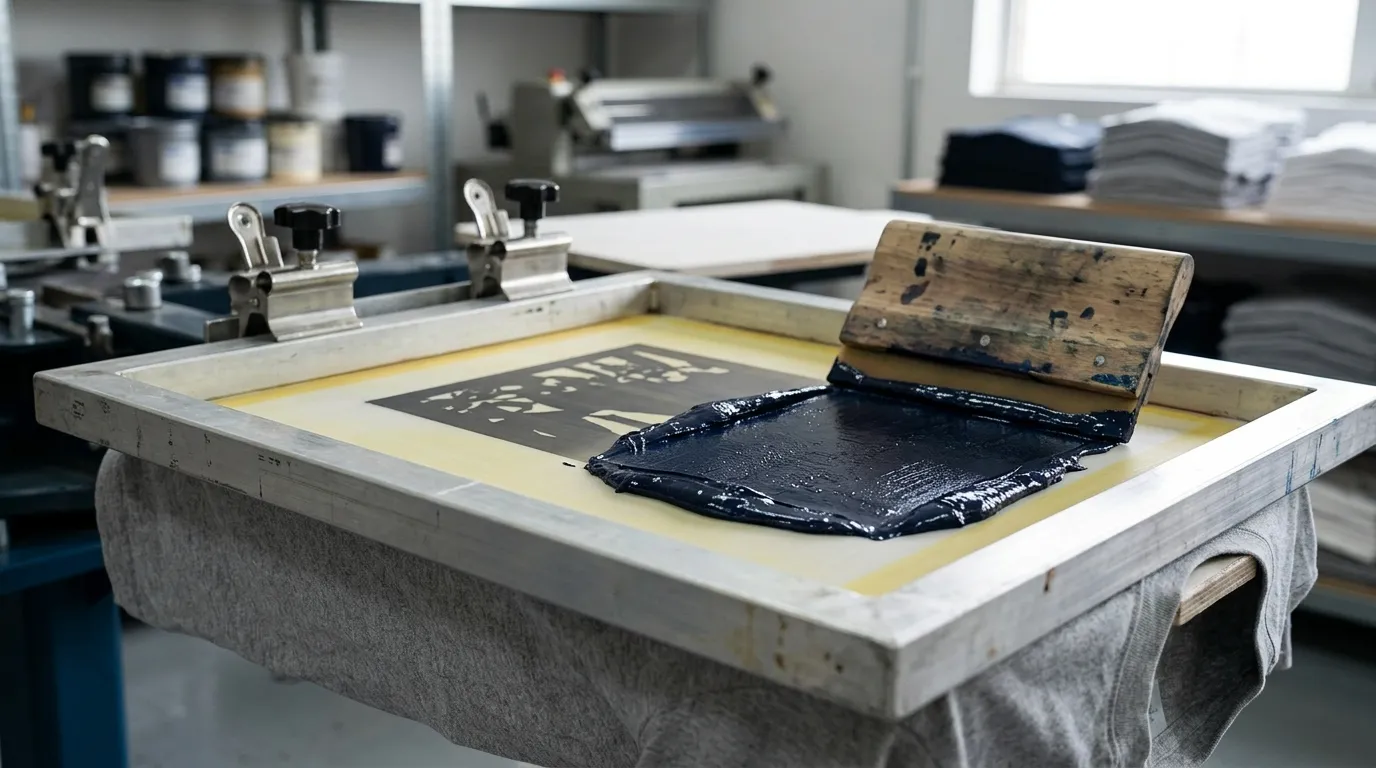
Screen printing is a decoration method in which ink is pushed through a mesh screen onto fabric, and the image is controlled by a stencil on that mesh. According to UploadDTF's comparison of DTF transfers and screen printing, each color requires its own screen — which is why color count becomes a setup cost question rather than a print quality question.
Because the stencil holds the artwork shape, screen printing reproduces solid shapes and bold graphics predictably. Fine gradients and photographic detail are harder to hold, since they depend on separating artwork into a limited number of ink layers.
What Is DTF Printing?
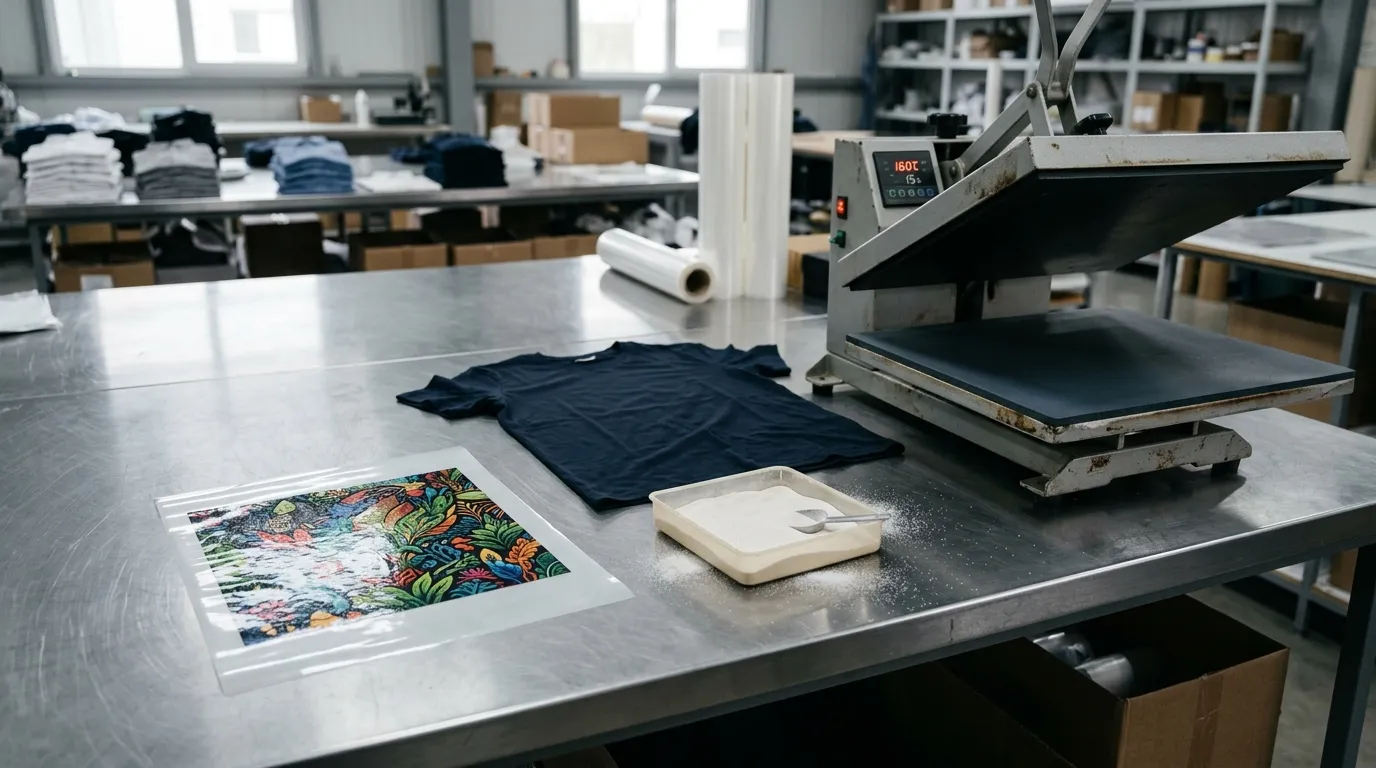
DTF printing — direct-to-film printing — is a transfer method. UploadDTF describes the sequence as printing artwork onto PET film, applying adhesive powder, curing it, and then transferring the image to fabric with a heat press. Because no screens are prepared, a design with many colors or soft gradients does not add screen setup steps.
These two methods sit alongside direct-to-garment printing, embroidery and vinyl in custom t shirt printing methods, which is useful context when a design does not clearly fit either one.
Which Is Cheaper: Screen Printing or DTF?
For repeat bulk runs in a few colors, screen printing is generally cheaper per piece because screen setup is a one-time cost spread across many units; for small runs or artwork with many colors, DTF usually costs less because it skips screens entirely.
| Factor | Screen printing | DTF printing |
|---|---|---|
| Setup cost driver | One screen prepared per color in the design (UploadDTF) | Artwork printed, powdered and cured onto film; no screens (UploadDTF) |
| Per-piece trend as quantity rises | Setup cost spreads across more units (Main Street Shirt Company) | Film and transfer cost stays attached to each piece (UploadDTF) |
| Effect of adding colors | Adds a screen and extra setup per color (UploadDTF) | Color count does not add screen setup (Caydo) |
| Effect of changing the design | New artwork means new screens | New artwork means a new film print, not new screens |
| Best-fit quantity profile | Bulk orders and bold designs (Printful) | Small batches and complex or full-color designs (Printful) |
| Published crossover examples | Heart & Hook reports 48 shirts for a one- to two-color design at its own shop | Main Street Shirt Company cites 36 pieces as its own recommendation |
Is There an Order-Size Threshold Where Screen Printing Becomes Cheaper?
There is no universal threshold. Both retrievable examples are shop-specific recommendations rather than industry standards: Main Street Shirt Company's comparison attributes the cost difference to screen setup being spread across the order, and Heart & Hook's comparison states that its own crossover is 48 shirts for a one- or two-color design. Two suppliers, two different numbers — which is why the crossover has to come from an actual quote for your design.
Four variables move that point: how many colors the artwork uses, how large the print area is, how many pieces the run covers, and whether the same design repeats across future orders. Setup also differs in kind — screen printing requires screens to be prepared and registered before the run, while DTF requires the film to be printed, powdered and cured first, as UploadDTF's process description shows. Neither method holds a universal speed advantage.
Which Handles Color Count and Fine Detail Better?
DTF printing handles photographs, gradients and fine detail more easily, while screen printing is strongest on solid colors and simpler, bolder designs.
Caydo's guide describes DTF as suitable for detailed images and gradients and screen printing as well-suited to solid colors and simpler designs. Printful's comparison points complex and full-color designs toward DTF and bulk or bold artwork toward screen printing. UploadDTF's process explanation supplies the reason: adding a color to a screen-printed design adds a screen, while a DTF film carries the full artwork in a single print.
Decision rule: count the distinct colors in the design, then check whether it contains gradients or photographic detail. Those two checks, not the garment type, drive this part of the decision. If the artwork has many colors, gradients or fine linework, DTF removes the setup risk that color separation creates. If it is a bold design in one to three flat colors, screen printing keeps the process straightforward.
For finished garment output, the same logic applies to custom graphic t shirts — the artwork check comes before the decoration method is fixed.
How Do Print Feel, Coverage and Durability Compare?
Print feel and surface coverage differ because DTF transfers a printed film layer onto the garment while screen printing deposits ink through the mesh, and durability is not settled by method name alone — process execution, materials and care all matter.
UploadDTF's process comparison explains the structural difference: a DTF transfer sits on the fabric as a transferred layer, whereas screen printing drives ink into and onto the surface through open mesh areas. That difference is what readers usually describe as hand feel, and it changes with ink type, coverage area and the fabric underneath.
Printful's comparison covers quality and durability as factors but does not resolve them into a universal winner, and this page should not do so either. Wash performance depends on the specific ink, the fabric, the curing or pressing settings and how the garment is cared for.
Sampling rule: test the exact artwork, ink and fabric combination before committing to a bulk run. That single step answers the feel and durability question more reliably than any general claim about either method.
Which Fabrics and Garments Suit Each Method?
Fabric type, surface structure, garment weight, artwork complexity, color needs, quantity and print location all affect which method fits — so the garment is checked before the method is chosen.
Minghang Garments' printing-methods guide lists those factors as the ones that determine method selection. A lightweight, textured or stretch fabric behaves differently from a dense cotton fleece, and the print location matters too: a large back panel and a small left-chest area place different demands on the process.
Decision rule: on dark or high-color-count garments, test the specific fabric rather than assuming either method transfers the same result. Coverage, opacity and feel can all shift with the base fabric and its color, and the only reliable check is a sample on the intended garment.
Streetwear Use Cases: Oversized Back Prints, Puff and Specialty Inks
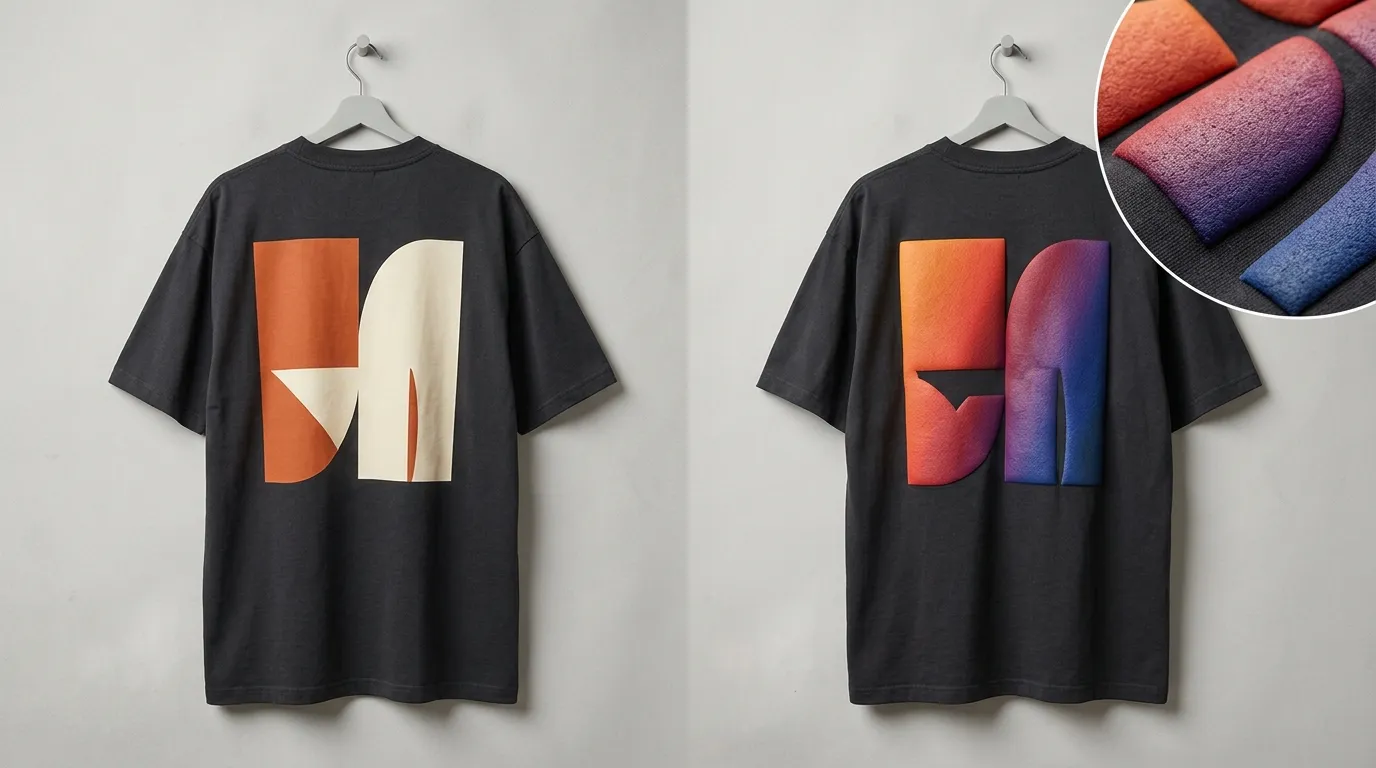
Oversized back prints work with either method, but they are chosen for different reasons: screen printing when the design has few colors and repeats, DTF when the back print is full-color or the run is small. Puff and other specialty effects are screen-printing techniques, not DTF equivalents.
For streetwear labels, the back print is often the largest single decoration on the garment, and size changes the economics. A large print area with one to three flat colors favors screen printing across a repeating run, while a detailed or full-color back graphic in smaller quantities points toward DTF.
Specialty finishes follow different rules. Minghang Garments' printing-methods guide describes puff printing as a screen-printing technique that raises the print surface, and it notes that fine lines and small gaps should be tested because the expansion can affect definition. Raised, textured and specialty-ink effects therefore belong on the screen-printing side of the decision. If a design mixes a specialty finish on the front with a detailed graphic on the back, the two can be handled as separate decisions — and puff print vs screen print vs embroidery for streetwear covers how that choice plays out across finishes.
[PHOTO: Two streetwear garments side by side — an oversized few-color back print, and a close-up of a raised puff print showing the surface texture difference.]
Quick Decision Checklist: Screen Printing or DTF?
Work through quantity, color count, artwork detail and required finish in that order; the first two checks settle most orders, and the last two settle streetwear and specialty work.
- Confirm the order quantity per design and whether the design will repeat in later runs.
- Count the distinct colors and check for gradients or photographic detail.
- Confirm the garment fabric, base color and print location.
- Confirm the required finish — a standard print, or a raised or specialty effect.
- Sample the artwork on the actual garment before bulk, then compare quotes rather than relying on a rule of thumb.
| If your order looks like this | Start with | Because |
|---|---|---|
| Few colors, repeating bulk run | Screen printing | Setup spreads across the units (Printful, Main Street Shirt Company) |
| Full-color or detailed artwork, small run | DTF printing | No screens are needed (UploadDTF, Caydo) |
| Raised or specialty finish required | Screen printing | Puff is a screen-printing technique (Minghang Garments) |
| Durability is the deciding concern | Sample first | See the section on print feel, coverage and durability |
| Crossover point unclear | Get a quote for your design | Published thresholds are supplier-specific (Heart & Hook, Main Street Shirt Company) |
If a design sits close to the crossover point, the deciding step is a sample on the actual garment rather than a rule of thumb. Minghang Garments handles printing within its sampling and bulk production process — sampling takes 7–15 working days, and orders start from 100 pcs per color per style on stock fabric.
Frequently Asked Questions
Is DTF replacing screen printing?
No. The two methods answer different production profiles rather than one superseding the other. Screen printing remains the practical route for repeat bulk runs in a few colors, where screen setup spreads across the order, while DTF serves small runs and full-color artwork that would need many screens. Printful's comparison presents them as complementary options rather than successive generations.
Is DTF just as good as screen printing?
Neither method is better overall — quality depends on the artwork, the fabric and how the process is executed. Caydo's guide places DTF ahead on detailed images and gradients and screen printing ahead on solid colors and simpler designs. The section on print feel, coverage and durability explains why sampling the exact combination is the reliable test.
How do I get a DTF print to feel more like screen printing?
Print feel is affected by coverage area and the transferred film layer, so feel shifts with the design rather than the method alone. UploadDTF's process description shows why a DTF transfer sits as a layer on the fabric, while screen printing drives ink through the mesh. Testing the exact artwork on the intended garment is the practical route.
-
Share
-

-

-