 Contact Us

Table of Contents

Contact Us
Rhinestone T-shirts are made by converting artwork into a stone-by-stone layout, arranging and orienting the stones into a template or onto a carrier sheet, then bonding hotfix stones to the garment with controlled heat and pressure. The finished shirt is inspected for placement and adhesion, then checked on the actual fabric and finish before bulk production.
[DIAGRAM: The rhinestone T-shirt production sequence — artwork, stone layout and sizing, stone sorting and orientation, template or carrier sheet, heat press, inspection, then garment-level validation.]
Key Takeaways
- Hotfix rhinestones carry heat-activated adhesive on the back; heat melts the adhesive and cooling leaves the stone attached (ColDesi).
- Artwork is digitized into stone positions and stone sizes, and a proof is approved before any template is cut (Broken Arrow Wear).
- A rhinestone design reaches the shirt either from a reusable cut template or as a pre-arranged transfer on a carrier sheet (ColDesi; Your Custom Transfers).
- Application results depend on transfer quality, garment type, temperature, pressure, pressing time and peel method, so a new garment style should be tested before a large run (Your Custom Transfers).
- None of the process guides referenced here specifies wash-test conditions or pass criteria, so those belong in the buyer's own specification.
What Is a Rhinestone T-Shirt, and What Does "Hotfix" Mean?
A rhinestone T-shirt is a T-shirt decorated with small faceted stones arranged in a designed pattern, usually attached to the fabric rather than sewn. "Hotfix" describes rhinestones that carry a heat-activated adhesive on the back: according to ColDesi, heating melts that adhesive and cooling leaves the stone attached to the garment.
Hotfix is therefore a property of the stone, not of the design. Stones that need a separate liquid or sheet adhesive are a different application route, and calling them hotfix would mislead a supplier quoting the job.
Rhinestones are one option among several ways a T-shirt surface can carry a brand mark; the wider set of decoration routes is compared in this guide to clothing branding techniques.
How Artwork Becomes a Rhinestone Layout or Template
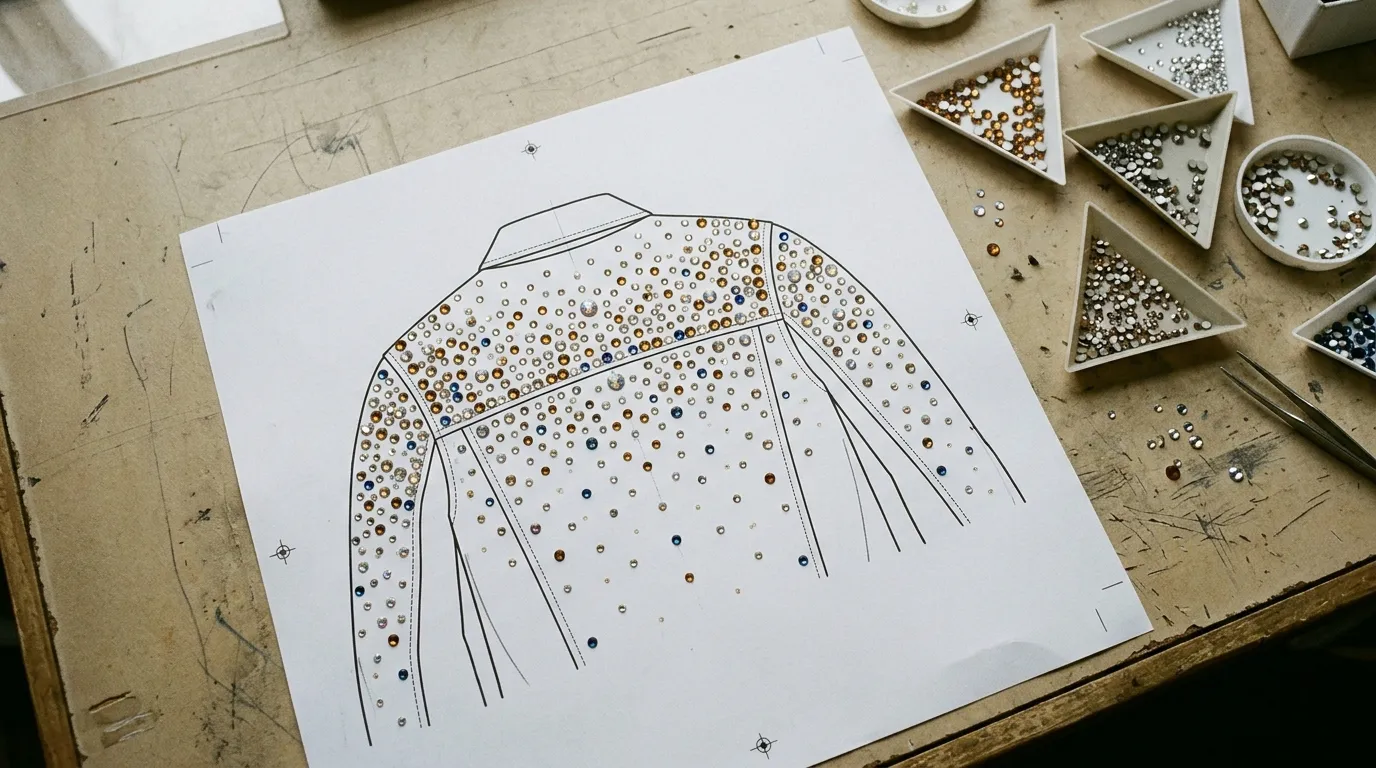
Artwork is not production-ready until it has been converted into a stone-by-stone layout. According to Broken Arrow Wear, that conversion means digitizing the artwork into stone positions, selecting stone sizes that suit the design, and sending a proof for approval before anything is produced.
The layout file also drives tooling. ColDesi describes design software that previews the resulting pattern, calculates stone cost and sends the file to a cutter that produces the template. That is why a design can look correct on screen and still fail in production: the layout has to account for the physical footprint of each stone.
Decision rule: no template is cut and no stones are ordered until the stone-size and spacing proof has been approved in writing. Changes after that point mean re-cutting and re-laying the design.
How Stones Are Selected, Sorted, Oriented and Placed
Stones are held by size and color, then oriented face-up before placement. Broken Arrow Wear describes machine hoppers that hold stones by size and color, with equipment orienting each stone before placing it onto a carrier sheet. In the manual route, ColDesi describes loose stones being brushed into the holes of a template, lifted out with transfer tape and then heat pressed.
Orientation is the step most often underestimated. Decision rule: a stone sitting face-down has no adhesive contact with the fabric and cannot bond, so a face-down stone is a rejectable defect at this stage, not something to correct after pressing.
How the Finished Stone Layout Gets Onto the Shirt
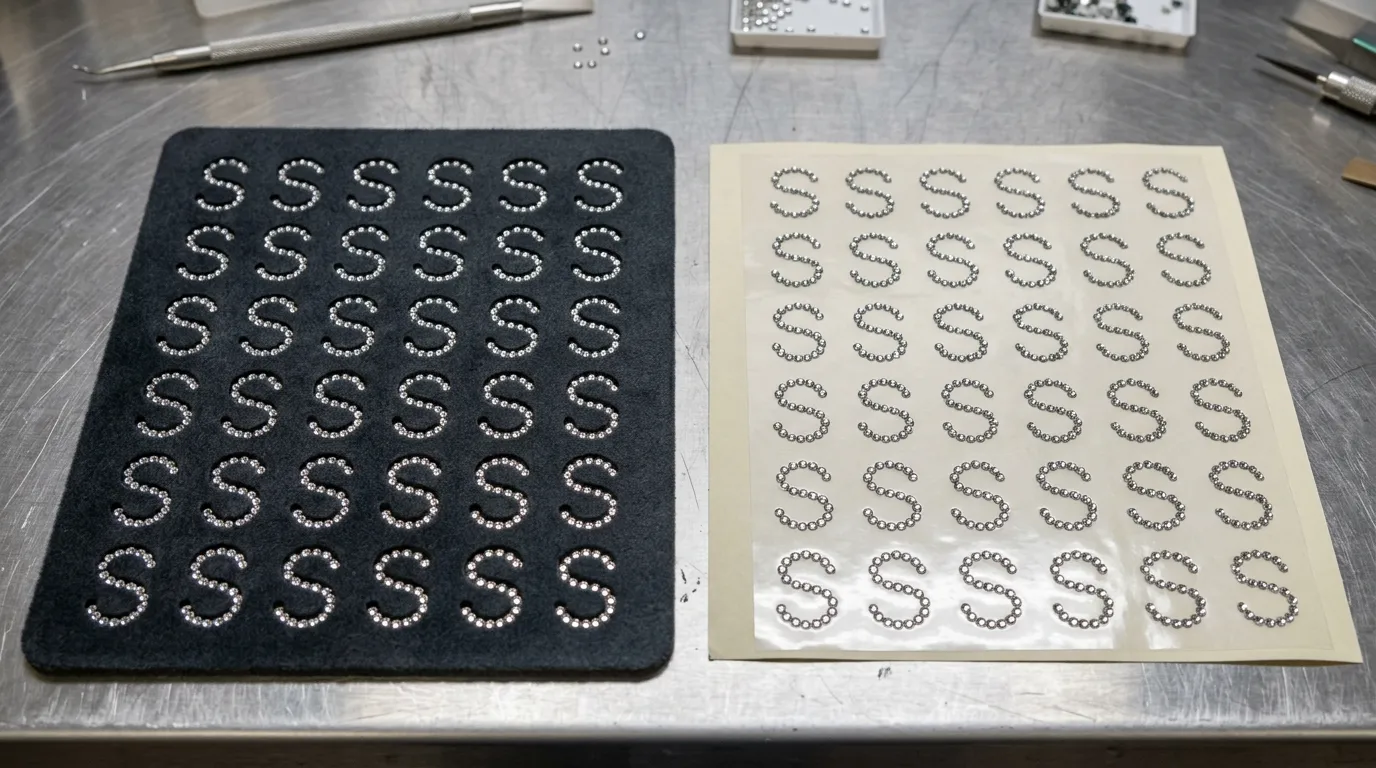
A pre-arranged rhinestone transfer is a set of stones already positioned on a carrier sheet that attaches to the fabric through heat and pressure, as defined by Your Custom Transfers. A reusable cut template works differently: it holds the arrangement only long enough for the stones to be lifted onto a carrier sheet, which is the stencil workflow ColDesi describes.
The two routes are not interchangeable, and the choice changes what has to be confirmed before production.
| Route | How the design is arranged | What transfers to the shirt | Where it suits | What must be confirmed first |
|---|---|---|---|---|
| Reusable cut template / stencil | Stones dropped into holes cut to the layout | Stones plus a carrier sheet lifted from the template | Repeat lettering and repeated graphics | Template file and stone sizing approved; orientation checked |
| Pre-arranged rhinestone transfer | Stones set in position on a carrier sheet off-garment | The completed stone arrangement on its carrier | Complex multi-color artwork, mixed stone sizes | Transfer supplier's garment type, temperature, pressure, time and peel method |
| Hand-set single stones | Individual stones placed directly on the garment | One stone at a time | Small accents, repairs | Verify with the supplier |
[PHOTO: A reusable rhinestone template holding stones in its cut holes, photographed beside a pre-arranged rhinestone transfer on its carrier sheet before pressing.]
How Heat and Pressure Attach Hotfix Rhinestones
Heat and pressure activate the adhesive already on the back of each hotfix stone. ColDesi explains the mechanism plainly: the heat melts the adhesive, and once it cools, the stone is held in place. There is no separate glue step for hotfix stones.
The settings are the part that cannot be generalised. According to Your Custom Transfers, application results depend on transfer quality, garment type, temperature, pressure, pressing time and peeling method. Bling by Design publishes a do-it-yourself iron instruction of 15–30 seconds with no steam and a cloth or pressing paper over the stones; that is a home-ironing method for that page's audience, not a factory press setting.
Decision rule: take temperature, pressure, time and peel method from the transfer or garment supplier, then confirm them with a test press on the actual fabric.
What Quality Checks Catch Misplaced Stones or Missing Adhesive
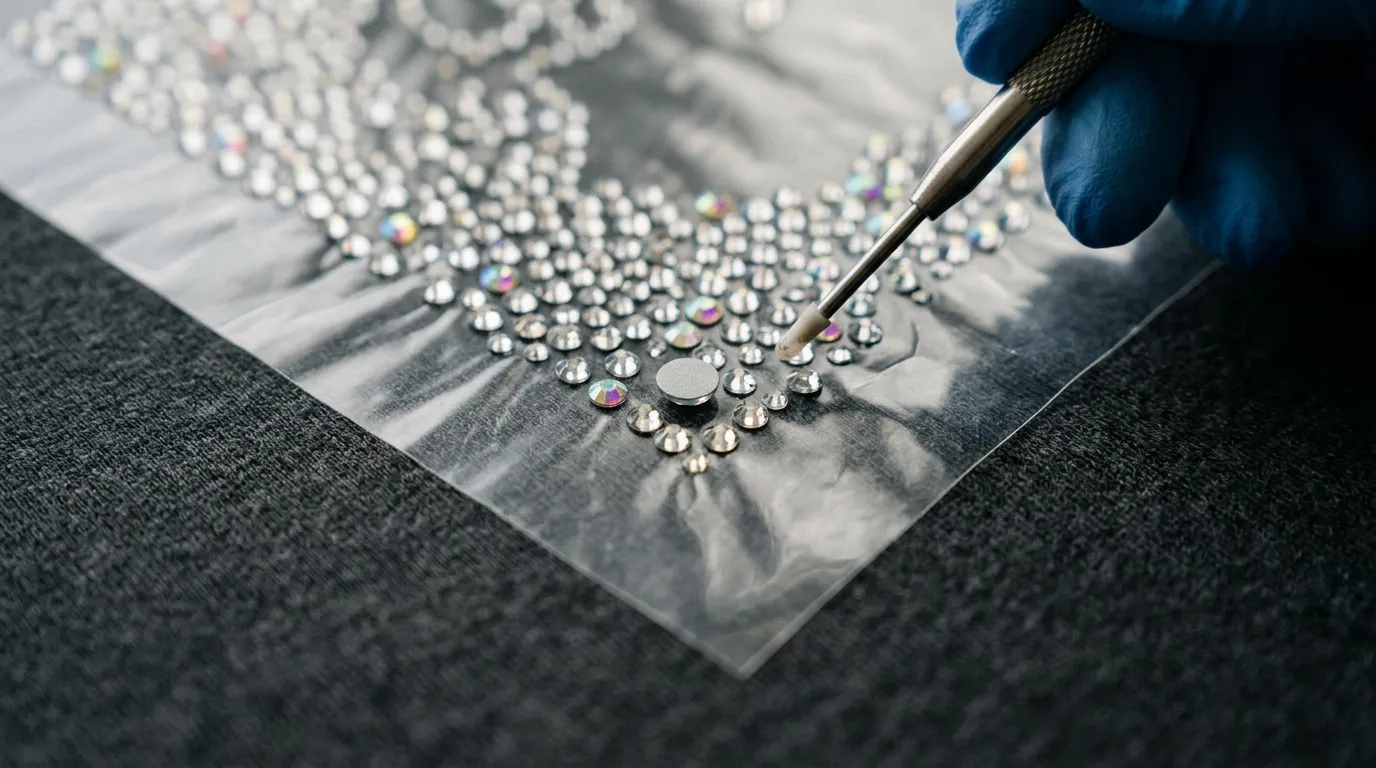
Inspection happens before pressing, not only after. Broken Arrow Wear describes transfer quality control that checks stone placement and the adhesive backing before a garment is pressed.
Pre-press inspection checklist:
- Layout position matches the approved proof.
- Stone count matches the approved layout.
- Every stone is face-up.
- Each stone's adhesive backing is intact.
- After pressing, seating and edge lift are re-checked.
Wash and wear checks are a separate stage, covered under "Why the Finished Shirt Is Checked on the Actual Garment, Including After Washing" below.
How Rhinestones Combine With Printing and Garment-Washed Finishes
Rhinestones can sit on the same T-shirt as screen-printed graphics and a garment-washed finish. Minghang Garments' case pages show a custom rhinestone graphic t shirt in cotton jersey with graphic print and rhinestone decoration, a custom rhinestone letter t shirt in cotton with a boxy silhouette, screen-printed graphics, a garment-washed finish and rhinestones, and a custom washed graphic t shirt in cotton with a relaxed fit, washed finish, graphic prints and rhinestone embellishment.
Those case descriptions do not state whether washing runs before or after rhinestone application, and the decoration order is not something to infer from a finished photo. Decision rule: agree the sequence of print, wash and stone application in the tech pack and confirm it with the supplier before sampling.
Why the Finished Shirt Is Checked on the Actual Garment, Including After Washing
The final check has to happen on the real garment, not on a swatch. Because results depend on transfer quality, garment type, temperature, pressure, time and peeling method, Your Custom Transfers advises testing a new garment style before committing to a large order.
Wash validation is a specification the buyer writes, not a fixed industry rule. Decision rule — the clause to put in the spec: a nominal garment in the actual fabric, color and finish; a defined wash method, temperature and number of cycles; a defined drying method; and pass criteria agreed in advance, such as stones retained, no visible edge lift and design position unchanged. Treat this as a validation step, not a durability guarantee.
FAQ
Is there a machine to put rhinestones on clothes?
Yes. Automated stone-setting equipment holds stones by size and color in hoppers and orients them before placing them onto a carrier sheet, according to Broken Arrow Wear. Hand placement into a cut template is the alternative route, where loose stones are brushed into the template holes and lifted out with transfer tape.
Is it hard to rhinestone a shirt?
The pressing step is the straightforward part. The difficulty sits in converting artwork into accurate stone positions, choosing stone sizes and getting every stone placed and oriented correctly. That is why Broken Arrow Wear digitizes the design, selects the stone sizes and sends a proof for approval before production begins.
What material is used for rhinestone templates?
The template material has to hold the stone arrangement and release it onto a carrier sheet, and ColDesi describes design software sending the file to a cutter that produces the template. The material therefore follows the cutting and transfer system in use rather than one industry-wide specification. Confirm the material with whoever produces the template.
Can rhinestone shirts be washed?
They can be washed, but no shared test standard for rhinestone T-shirts is published in the process guides referenced here. The wash method, temperature, cycle count, drying and pass criteria should be agreed in writing with the supplier and confirmed on a test garment before bulk production, then repeated as part of normal quality control.
-
Share
-

-

-