 Contact Us

Table of Contents

Contact Us
Updated 1 month ago
Best Printing Methods for Custom T Shirts: Screen Printing, DTG, DTF & Sublimation

Minghang Garments
Minghang Garments is a custom apparel manufacturer specializing in activewear, streetwear and private-label clothing development. Our team supports brands through fabric sourcing, product development, sampling, bulk production and quality control, with OEM and ODM solutions for startups, growing labels and established apparel businesses.
Selecting the Best Printing Methods for Custom T-shirts involves more than looking at the artwork. Fabric composition, surface structure, stretch, print coverage, number of colors, order quantity, required hand feel and expected wash performance can all affect the final result.
At Minghang Garments, we select printing methods according to both the design and the production requirements. Screen printing is often our first choice for larger orders with relatively simple artwork and a limited number of solid colors, while digital printing is usually more practical for short runs, fast-turnaround projects, complex gradients or highly detailed graphics.
The goal is not to identify one printing method as universally “best,” but to match the printing process with the fabric, artwork, quantity and performance requirements of each style.
What Affects the Best Way to Print T-Shirts?
There are a few things to consider about the fabric of the garment before thinking about printing methods.
• Fiber Composition: The way ink bonds to cotton versus polyester is different, and prints have to have some level of stretch to account for fabrics with elastane.
• Fabric Structure: Surface smoothness, knit construction and texture can affect ink coverage and print clarity. A smooth jersey behaves differently from ribbed, brushed or highly textured fabric.
• Weight of the Fabric: Heavier fabrics can generally tolerate greater print coverage, while lightweight fabrics require more careful control of ink deposit, curing temperature and print stiffness .
• Complexity of the Artwork: Printing a solid logo is much different than printing a photograph or an all over design.
• Standards for Color: When printing on dark fabrics, opaque inks have to be used. Pantone matching is often required.
• Number of Orders: Screen printing involves higher initial setup costs because each color normally requires separate film and screen preparation. As order quantity increases, these setup costs are spread across more garments, making screen printing more cost-efficient for larger runs. Digital printing can be more practical for smaller quantities or highly variable artwork.
• Purpose of the Shirts: Prints for shirts that will only be worn once for a promotional event do not need to be as durable as prints for shirts that will be worn for multiple events like for a sports team.
• Where the Prints are Located: Seams, pockets and other high-stretch areas may restrict print placement.
For these reasons, the printing method should be selected according to the requirements of each individual project.
Custom T-Shirt Printing Methods Compared
Each printing method has unique characteristics. This chart will help identify the best method for your situation.
| Method | Best for | Fabric Compatibility | Hand feel | Typical Order Situation | Key Risk |
| Screen Printing | Solid-color graphics and specialty effects | Cotton, polyester & selected blends | Soft to noticeable depending on ink system | Medium-large quantities, repeat orders. | Registration, curing and migration |
| DTG | Photos, gradients and complex artwork | Cotton and cotton-rich blends | Generally soft | samples, smaller runs, detailed designs. | Pretreatment, white ink consistency |
| DTF | Full-color logos / graphics | Cotton, polyester and blends | More noticeable transfer layer | Small-medium runs, mixed fabrics | Film hand feel and adhesion |
| Sublimation | full-color / all-over graphics | Light-colored polyester | Very light | Efficient for repeat performance apparel | Fabric and color limitations |
| Heat Transfer Vinyl | Names, numbers and variable graphics | Cotton, polyester and blends | Depends on transfer material | Practical for personalization | Placement, adhesion, heat |
Screen printing becomes increasingly cost-efficient when artwork uses a limited number of colors and the setup cost can be spread across a larger production run. Digital printing, by contrast, can be more practical for smaller quantities, complex graphics or artwork containing many color transitions. Sublimation serves a different application and is primarily suited to polyester-based fabrics rather than standard cotton T-shirts.
Screen Printing for Repeat Bulk Production
Screen printing pushes ink through a prepared mesh stencil. Each color requires a separate screen, so registration is critical.
When Does Minghang Usually Recommend Screen Printing?
At Minghang Garments, screen printing is often our first choice when the artwork contains around four to five solid colors or fewer, does not rely heavily on gradients or photographic transitions, and the order quantity is relatively large.
This is mainly a production-cost decision rather than a technical color limit. Each print color generally requires separate color separation, film and screen preparation. Based on quotations from our previous production projects, screen setup has commonly cost around RMB 150 per color, although the actual charge varies by artwork and printing supplier.
Once the screens are prepared, screen-printing costs are normally calculated per garment. In our daily practice, standard screen printing costs around RMB 2-15 per piece, depending on print size, number of colors and process complexity.
This means screen printing becomes increasingly efficient as the setup cost is spread across a larger order. When quantities are smaller or just reach our MOQ, colors are numerous, gradients are complex or the graphic requires a highly realistic result, digital printing is often more practical.
It is a great method for printing custom t-shirts with limited colors and repeat orders. Available effects can include:
• Water-based printing for a softer surface
• Plastisol for strong opacity and defined graphics
• Discharge printing for selected dyed cotton fabrics
• Puff printing for raised, three-dimensional details
• High-density, foil or specialty finishes
Puff Screen Printing for Raised Graphics
Puff printing is a screen-printing technique commonly used on T-shirts, hoodies and streetwear when a raised, three-dimensional effect is required.
The ink system expands during curing, creating a raised surface above the fabric. It works particularly well for bold lettering, logos and relatively simple graphic shapes.
Fine lines, small gaps and detailed artwork should be tested carefully because excessive expansion can reduce edge definition or close small spaces in the design.
For this reason, Minghang normally evaluates puff artwork on the selected fabric before approving bulk production.
Why Do Different Screen Prints Feel Different?
Traditional water-based screen printing is often preferred when a softer hand feel is required because the ink penetrates more into the fabric rather than forming a heavy surface layer.
This works particularly well on suitable light-colored cotton fabrics. On dark garments, however, stronger opacity may require an opaque printing system, white underbase or additional print layers depending on the ink and fabric.
As print coverage and opacity increase, the printed area may feel more noticeable than a lightweight water-based print.
Production control should cover mesh selection, ink viscosity, underbase opacity, flash curing and final curing. Insufficient curing can reduce wash resistance, while excessive heat may distort fabric or affect shade.
A Common Production Risk: Dye Migration
Dye migration is a risk we pay particular attention to when light-colored graphics are printed on dark polyester or other migration-prone dyed synthetic fabrics.
A print may appear completely correct immediately after production and still change several days later. In real production, we have seen white, off-white or other light-colored graphics gradually take on pink, yellowish or other unwanted tones as dye from the garment migrates into the print layer.
This type of problem may only become obvious after the garments have been stored, packed or transported, which means checking the print immediately after production is not always enough.
For high-risk fabrics, Minghang evaluates the printing system, underbase and anti-migration / anti-sublimation treatment during sampling before bringing it into bulk production.
DTG and DTF for Detailed Artwork
DTG Printing
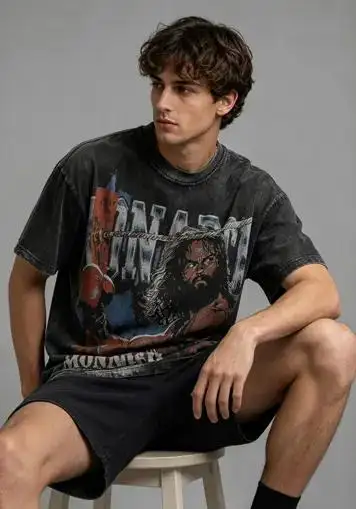
Direct-to-garment printing applies water-based ink directly to the garment. It is effective for photographs, gradients, fine lines and multicolor artwork on cotton or high-cotton T-shirts.
DTG avoids separate screens, making it suitable for samples and lower-volume releases. However, dark garments normally require pretreatment and a white underbase. Uneven pretreatment can cause dull colors, staining or inconsistent wash performance.
DTG should be evaluated by:
• Image resolution and color profile
• Pretreatment coverage
• White ink opacity
• Curing temperature and time
• Color retention after washing
Why Do Some Prints on Dark Garments Feel Stiffer?
Dark garments often require additional opacity, which may involve pretreatment, a white underbase, opaque print paste or additional ink layers.
If these layers become too heavy, or if pretreatment and curing are not properly controlled, the printed area can feel noticeably stiffer than the surrounding fabric.
The effect is especially noticeable with large solid graphics, where heavy print coverage can also affect stretch and breathability.
Surface Hair Can Affect Print Clarity
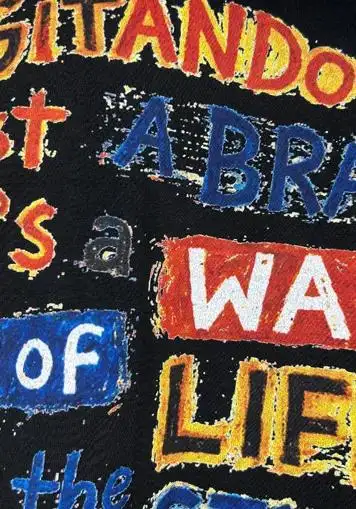
Brushed, fuzzy or highly textured fabrics can also create problems for detailed graphics.
If loose surface fibers are not properly controlled before printing, they can interrupt the ink layer and create small specks, broken edges or an uneven surface that resembles an unintended distressed or cracked effect.
For high-resolution graphics, fabric surface condition should therefore be evaluated during sampling and prepared appropriately before printing when necessary.
DTF Printing
Direct-to-film printing creates the image on a carrier film before applying adhesive powder and transferring it with heat and pressure. It works across cotton, polyester and many blended fabrics, making it useful for collections containing several garment types.
DTF supports fine detail and full color, but the transfer layer can produce a more noticeable hand feel than DTG or sublimation. Film quality, powder distribution, pressing parameters and edge finishing all influence durability. Large solid areas should be sampled because they may reduce stretch or breathability.
Sublimation Printing for Polyester Sportswear
Sublimation uses heat to convert dye into gas so that it bonds within polyester fibers. Because it does not create a thick surface film, the fabric retains much of its original stretch, moisture transfer and breathability.
For light-colored polyester sportswear and performance T-shirts, sublimation is particularly useful because it supports:
• Full-color gradients
• Complex graphics
• Player names and numbers
• Panel printing
• Seam-to-seam or all-over designs
Panel sublimation is normally completed before sewing. Artwork must therefore align with garment patterns, seam allowances and panel joins. White or light polyester produces the most predictable colors; conventional sublimation is not suitable for standard dark cotton T-shirts.
How Minghang Typically Selects a Printing Method
| Project Requirement | Method We Usually Evaluate First | Why |
| 1–4/5 solid colors + larger quantity | Screen Printing | Setup cost becomes more efficient at volume |
| Repeat bulk orders requiring consistency | Screen Printing | Approved screens help improve repeatability |
| Raised logos or 3D streetwear graphics | Puff Screen Printing | Creates a raised tactile effect |
| Many colors or complex gradients | Digital Printing | Avoids separate screen setup for every color |
| Photographic / highly detailed graphics | DTG / Digital Printing | Better reproduction of tonal detail |
| Small quantity / fast turnaround | DTG or DTF | Lower setup requirements |
| Mixed cotton/polyester collection | DTF | Broad fabric compatibility |
| Light polyester + all-over graphics | Sublimation | Full-color printing with minimal surface layer |
| Dark garment + light graphic | Test before bulk | Opacity, underbase and migration risk need review |
A brand can use more than one method within the same collection. Different printing methods can be used within the same collection, depending on the fabric, artwork, quantity and intended result.
From Artwork Approval to Bulk Print Control
At Minghang Garments, printing approval does not stop after the first sample. Styles with complex graphics, multiple print placements or detailed color requirements receive additional control before and during bulk production.
· Review the customer-approved artwork, dimensions, Pantone references and placement.
· Confirm fabric composition, color, surface condition, weight and stretch.
· Evaluate the appropriate printing method and any potential opacity or migration risk.
· Require a new pre-production print sample before every bulk run, including repeat orders.
· Compare the pre-production sample with the customer-approved production reference.
· Check not only color, but also graphic details, placement, visible defects, surface appearance and hand feel.
· Conduct relevant wash, rub, stretch or migration checks according to the product and printing process.
· Release bulk printing only after the pre-production print standard is approved.
· During finished-garment QC, verify the printing standard again rather than assuming the approved screen or digital file guarantees correct bulk output.
· Compare finished bulk garments against the approved reference before shipment.
This two-stage control — pre-production approval plus finished-garment QC verification — is particularly important for styles with complex artwork or multiple print placements. Even repeat orders are rechecked because screen condition, placement, ink preparation, fabric lots and production settings can still introduce variation.
Final Recommendation
There is no single printing method that is best for every custom T-shirt project.
At Minghang Garments, screen printing is usually preferred for larger orders with relatively simple, limited-color graphics because the initial screen setup becomes more economical as quantity increases. DTG and other digital printing methods are more practical for highly detailed graphics, complex gradients, smaller runs and fast-turnaround development. DTF provides broad fabric compatibility, while sublimation is particularly effective for light-colored polyester performance apparel and all-over graphics. Puff screen printing is also widely used for T-shirts and hoodies when a raised, three-dimensional graphic effect is required.
The final decision should also consider fabric surface, stretch, required hand feel, color opacity, migration risk and expected wash performance.
For unfamiliar fabrics or complex artwork, we prefer to test the print on the actual material and approve a pre-production sample before bulk printing. This allows the printing method to be evaluated based on real garment performance rather than theory alone.
FAQs
Q1. What T-shirt printing methods does Minghang Garments provide?
Minghang Garments supports screen printing, DTG, DTF, sublimation, heat transfer and specialty effects such as puff printing. Embroidery and other logo techniques can also be integrated into custom apparel projects.
Q2. Can Minghang Garments recommend the right printing method?
Yes. The team evaluates fabric composition, weight, stretch, artwork complexity, print coverage, order quantity and end use before recommending an appropriate process.
Q3. Which printing method does Minghang recommend for cotton T-shirts?
For larger cotton T-shirt orders with relatively simple solid-color graphics, screen printing is often our first choice. DTG is more suitable when the artwork contains photographic detail, complex gradients or many colors, while DTF can provide a flexible option for smaller runs and mixed product collections.
Q4. Which method is suitable for polyester sports T-shirts?
Sublimation is particularly suitable for white or light-colored polyester performance T-shirts, especially for full-color and all-over graphics. For dark polyester, DTF or suitable screen-printing systems may also be considered, but dye-migration risk, opacity and heat exposure should be evaluated during sampling.
Q5. Does Minghang Garments provide all-over T-shirt printing?
Yes. Panel sublimation and all-over printing can be coordinated with pattern development, cutting and sewing. Artwork placement, seam allowances and panel alignment should be confirmed during sampling.
Q6. Is puff printing suitable for custom T-shirts and hoodies?
Yes. Puff screen printing is commonly used for T-shirts, hoodies and streetwear when a raised, three-dimensional logo or graphic effect is required. Bold lettering and relatively simple shapes generally work best, while fine details should be tested before bulk production.
Written by
Minghang Garments
Apparel Manufacturing Team
Minghang Garments is a custom apparel manufacturer specializing in activewear, streetwear and private-label clothing development. Our team supports brands through fabric sourcing, product development, sampling, bulk production and quality control, with OEM and ODM solutions for startups, growing labels and established apparel businesses.
-
Share
-

-

-