 Contact Us

Table of Contents

Contact Us
Updated 4 weeks ago
How to Manufacture Clothing From a Tech Pack?
arafatshuvo
After you send a tech pack, clothing manufacturing usually moves through review and clarification, quotation, fabric and trim confirmation, pattern making, sampling and fit approval, then bulk production and quality control. A tech pack is the specification document that communicates construction, materials, measurements and finishes; the manufacturer checks it, resolves gaps, and converts it into an approved sample before bulk.
Key Takeaways
- Manufacturing from a tech pack runs through review and quote, material confirmation, pattern making, sampling and fit approval, bulk production, and quality control.
- According to BOMME Studio, tech packs support product development, sampling, costing, and production.
- Minghang Garments states that sampling takes 7–15 working days, depending on product complexity, fabric, and customization.
- Minghang Garments states that bulk production generally takes 25–45 days after sample and material approval.
- Minghang Garments describes a 5+1 QC system covering incoming materials, cutting, in-line sewing, semi-finished garments, final inspection, and pre-shipment verification.
What Happens After You Send a Tech Pack to a Manufacturer?
After you send a tech pack to a manufacturer, the pack enters a defined path: review and clarification, quotation, fabric and trim confirmation, pattern making, sampling and fit approval, then bulk production and quality control. Approval of the sample and the materials is the gate that releases the order into bulk.
According to BOMME Studio, a tech pack communicates garment construction, materials, measurements, and specifications to manufacturers, and its guide describes tech packs as supporting product development, sampling, costing, and production.
Minghang Garments' design-file guide notes that development may begin from a sketch, reference image, existing garment, mood board, or basic concept, so a complete tech pack is not always required to open a conversation with a manufacturer.
[DIAGRAM: Process flow from tech pack handoff through review and quote, material confirmation, pattern making, sample approval, bulk production and QC, with the release gates marked]
| Stage | What the manufacturer does | What the brand confirms |
|---|---|---|
| Review and clarification | Reads the pack and lists missing or unclear detail | Answers open questions |
| Feasibility and quote | Prices construction, materials, quantity, and timing inputs | Accepts the quote scope |
| Fabric and trim confirmation | Matches the bill of materials to available materials | Approves fabrics, trims, and colors in writing |
| Pattern making | Creates or adjusts the pattern to the specification | Confirms points of measure |
| Sample and fit review | Makes the sample and collects comments | Returns fit and measurement comments |
| Sample approval | Prepares the reference garment | Approves the sample in writing |
| Bulk production | Cuts, sews, decorates, washes, labels, and packs | Confirms order and shipping details |
| Quality control and packing | Inspects against the approved standard | Reviews final inspection results |
Four gates decide whether an order advances: the quote scope, the confirmed materials, the approved sample, and the released bulk order. Any one of them can pause the schedule.
How Does a Manufacturer Review a Tech Pack and Prepare a Quote?
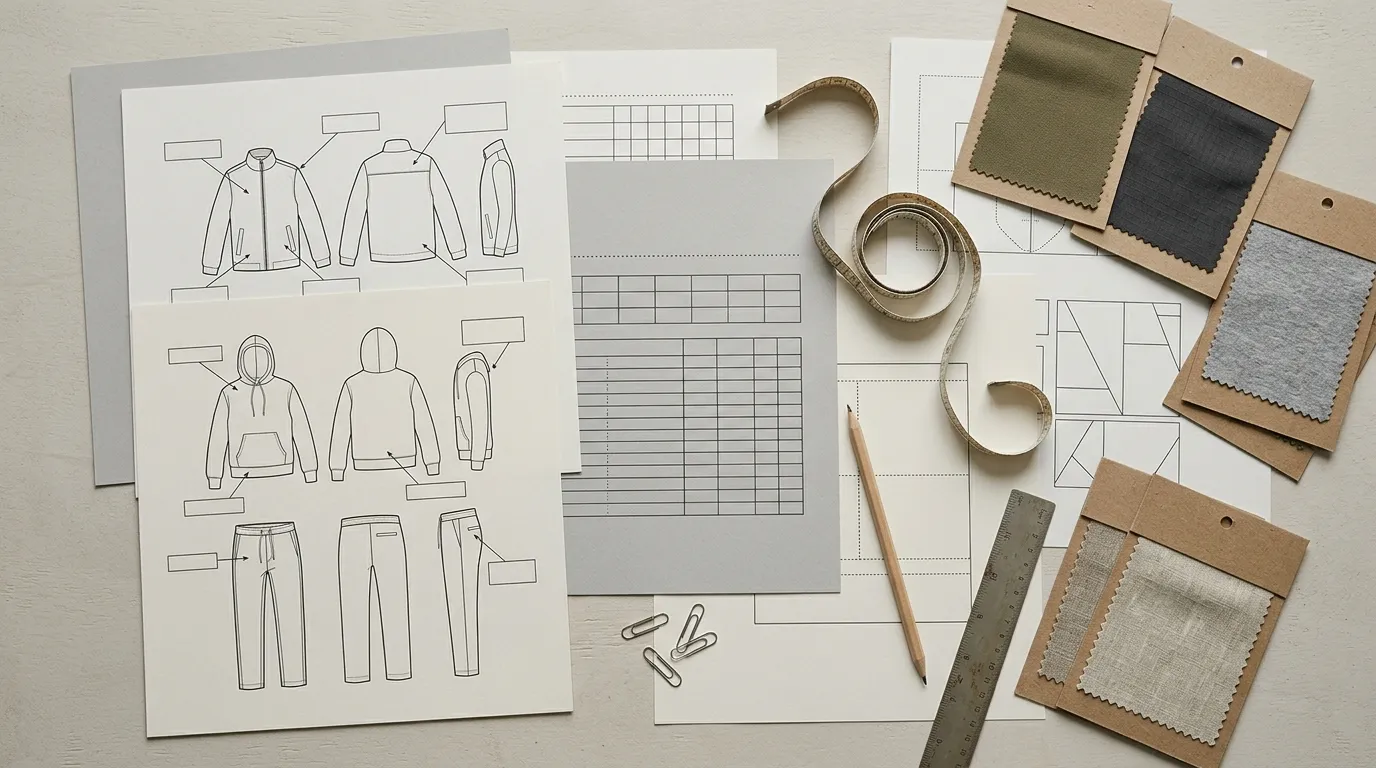
The review compares the pack against production requirements such as construction, materials, measurements, colorways, labeling, packaging, quantity, and target timing. Missing items become questions or stated assumptions in a provisional quote.
What the manufacturer checks first
According to BOMME Studio, common tech pack sections include technical flats, a bill of materials, measurement specifications, construction details, colorways, labeling, and packaging. Each of these is checked against what the factory can actually produce, source, and inspect.
What information is needed for feasibility and quote
| Tech pack input | Why the manufacturer checks it | What to confirm if missing |
|---|---|---|
| Technical flats and construction | Determines sewing operations and machine requirements | Seam types, stitch details, finishing |
| Bill of materials | Sets fabric, trim, and hardware sourcing | Composition, weight, and supplier availability |
| Measurements and points of measure | Defines the size specification | Measurement table and grading rules |
| Colorways and artwork | Drives dyeing, printing, and embroidery setup | Color standard and placement dimensions |
| Labels and packaging | Affects ordering and finishing steps | Label content and packing format |
| Quantity and colorways | Sets material volume and line planning | Total units per size and per color |
| Target timing | Shapes scheduling against capacity | Delivery window and shipping method |
Minghang Garments states that its minimum order quantity starts at 100 pieces per color per style on stock fabric. When a pack requests a custom fabric or a lower quantity, the quote or the material choice may need to change.
If an item is missing, list it as an open question rather than letting an assumption become an approved specification. Written confirmation keeps the quote, the sample, and the bulk order aligned.
For a fuller handoff checklist, see design files for clothing manufacturing.
A quick handoff readiness check
Before sending the pack, confirm that technical flats, the bill of materials, the measurement table, construction notes, color and artwork references, labeling, and packaging are present and current. Flag anything still under review as an open point instead of leaving contradictory versions in the file.
How Are Fabric and Trims Sourced or Confirmed Against the Tech Pack?
The manufacturer maps the bill of materials to in-stock or sourced fabrics and trims, then confirms composition, weight, color, handfeel, stretch, and lead time before pattern making and sampling are locked. According to BOMME Studio, the bill of materials and material details form part of the tech pack, and Minghang Garments lists fabric and trim sourcing among its services.
| Spec in pack | What to confirm | If unavailable |
|---|---|---|
| Fabric composition and weight | Match to a specific mill or stock reference | Approve a named alternative in writing |
| Color standard | Reference named on the pack | Agree a replacement reference |
| Stretch or recovery | Meets the garment's intended use | Test or re-specify before sampling |
| Trims and closures | Size, finish, and function | Confirm a functional equivalent |
| Labels and packaging | Content and format | Confirm content before printing |
If the exact material is unavailable, approve a replacement against measurable criteria: composition, weight, color reference, stretch or recovery, and the performance the garment needs.
When Does Pattern Making Happen, and How Does Sampling Approval Work?
Pattern making follows material and construction confirmation. The sample is then produced, reviewed against fit and measurement comments, revised if needed, and approved before bulk production begins.
Pattern making and sample development
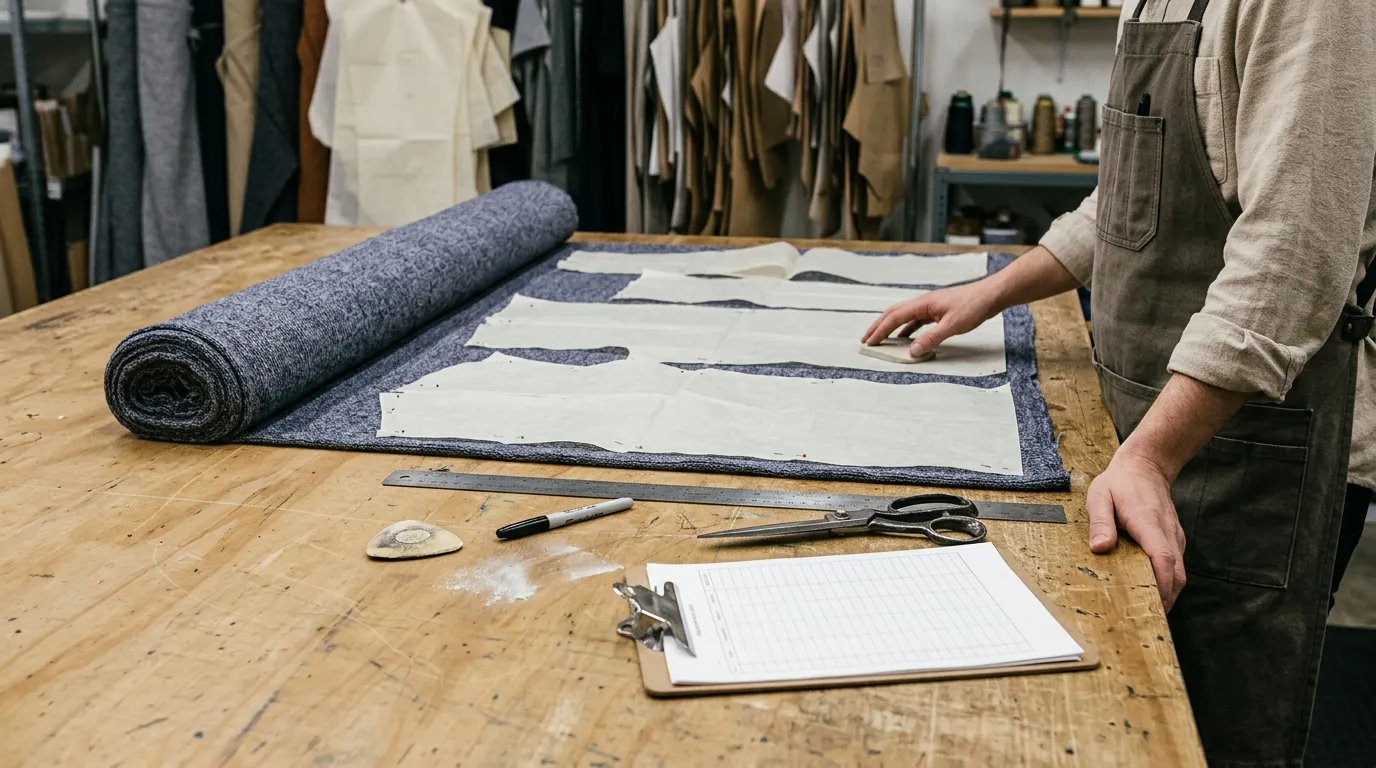
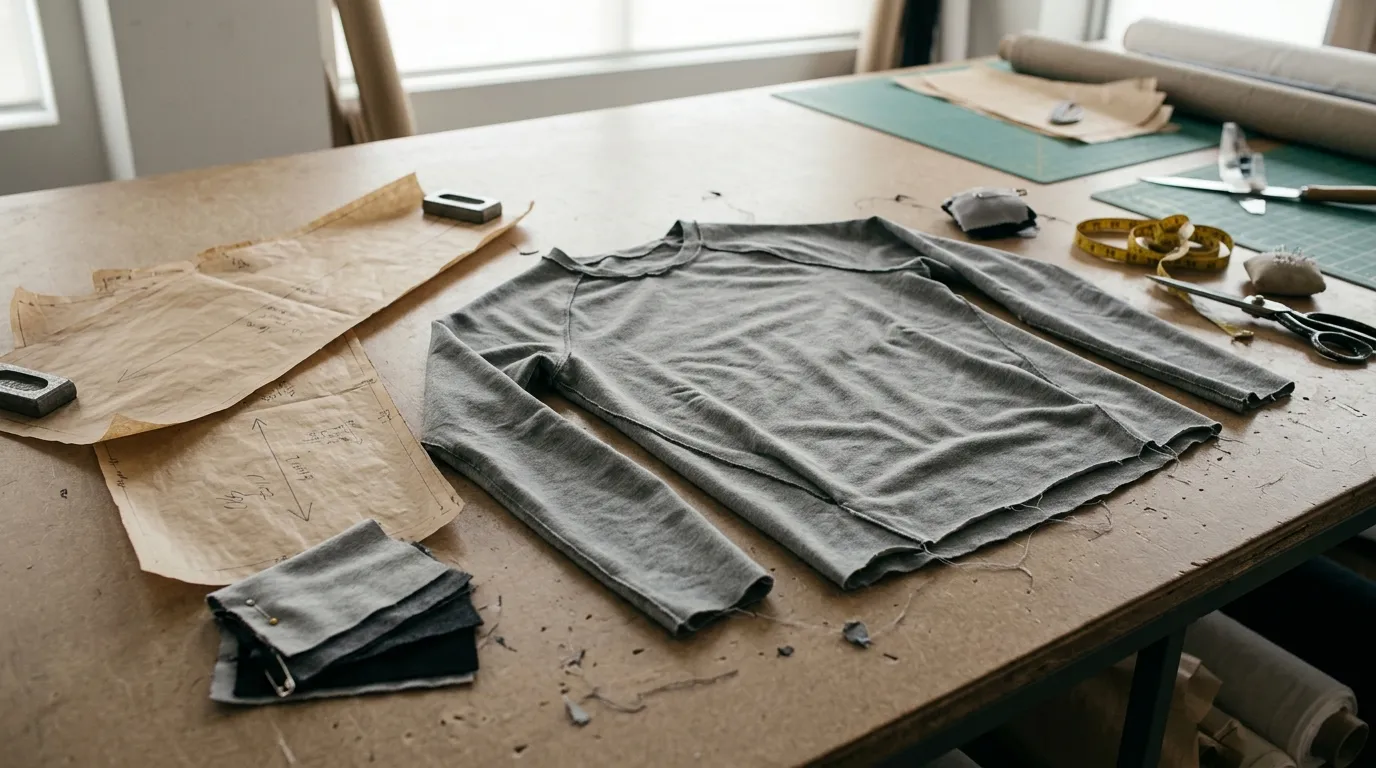
The pattern converts the written specification into a physical garment shape. Minghang Garments states that sampling takes 7–15 working days, depending on product complexity, fabric, and customization. Small, repeated details matter here: seam placement, panel shapes, and trim positions all originate in the pattern.
Fit comments, revisions, and sample approval
Fit comments are most useful when they reference specific points of measure, photos, or marked-up images rather than general impressions. Consolidate comments from all reviewers into one set before sending them, and confirm what changed between sample rounds.
The sampling process guide explains how sample rounds and fit comments are typically organised.
Approval should lock the size specification, materials, construction, color, labeling, artwork, and packing. Minghang Garments states that bulk production generally takes 25–45 days after sample and material approval. A change made after approval may require a new sample, a revised cost, and a revised schedule.
[DIAGRAM: What sample approval locks — size specification, materials, construction, color, labeling, artwork, packing]
What Happens During Bulk Production and Quality Control?
After approval, bulk materials are cut, sewn, trimmed, decorated, washed where required, labelled, packed, and inspected against the approved specification and sample. The approved sample becomes the physical reference for inspection, alongside the written specification.
Bulk production steps
Production is planned around material arrival and approved quantities, then moves through cutting, sewing and assembly, finishing and decoration, washing where the design requires it, and packing. Minghang Garments states that bulk production generally takes 25–45 days after sample and material approval.
In-process and final QC checkpoints
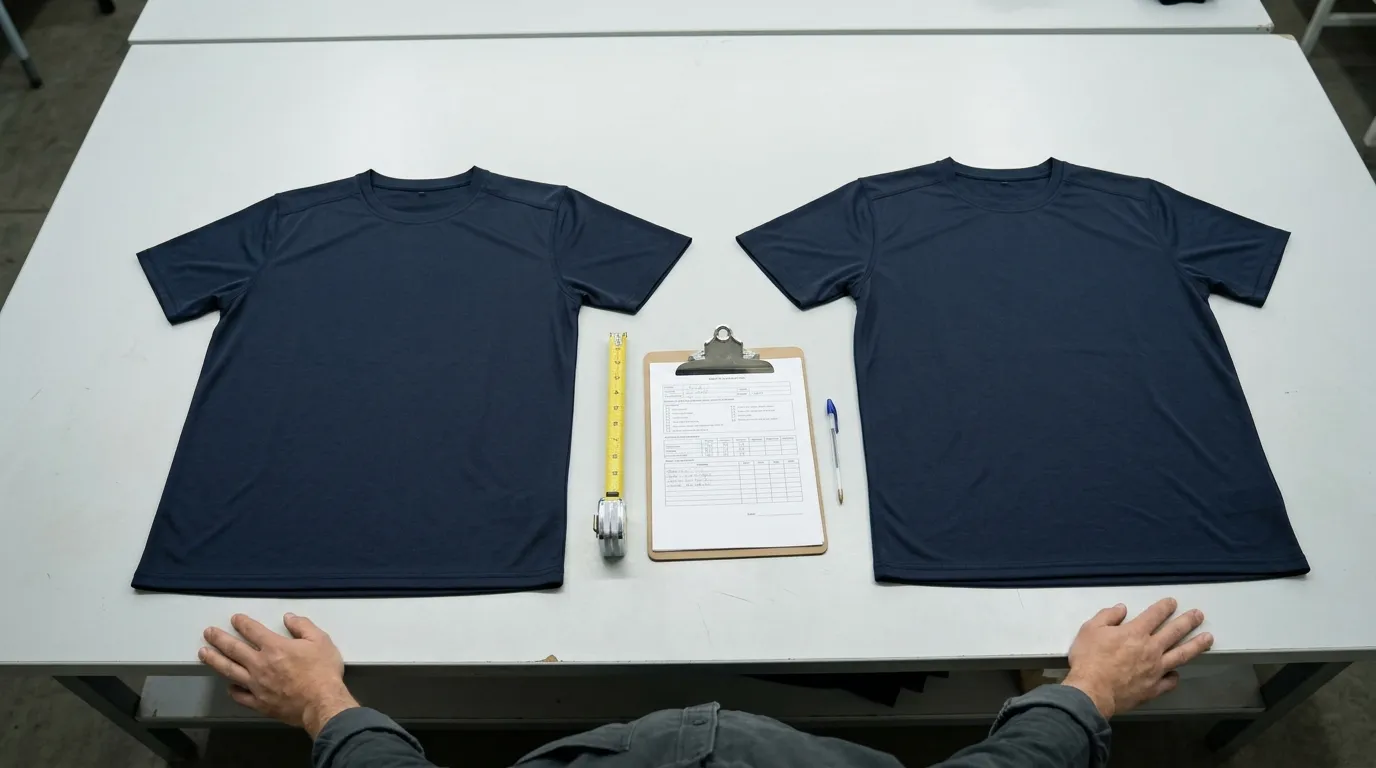
Minghang Garments describes a 5+1 QC system. The six checkpoints are incoming materials, cutting, in-line sewing, semi-finished garments, final inspection, and pre-shipment verification.
| QC checkpoint | What is checked | Source of truth |
|---|---|---|
| Incoming materials | Fabric and trim quality against the approved reference | Confirmed material specification |
| Cutting | Panel accuracy and shade matching | Approved pattern and marker |
| In-line sewing | Construction and stitch quality during production | Approved construction details |
| Semi-finished garments | Assembly and measurements before finishing | Points of measure table |
| Final inspection | Finished garment against the approved sample | Approved sample and specification |
| Pre-shipment verification | Packing, labelling, and quantities | Confirmed packing specification |
How the approved specification is used in inspection
Inspectors compare the finished garment with the approved sample and the written specification on measurements, construction, color, trim, labeling, and packing. Discrepancies raised at inspection are resolved against that single approved version rather than against earlier sample rounds.
Minghang Garments operates a 12,000 m² production floor and a 2,000 m² sample center, with capacity of up to 500,000 pieces per month. For a garment-specific example of how the process works in practice, see the custom hoodie manufacturing process.
What Should You Do When a Tech Pack Is Incomplete or Conflicts With a Sample?
Treat missing or conflicting information as an open issue rather than a silent assumption: identify the item, agree the intended specification in writing, update the approved version, and only then let production rely on it.
Minghang Garments' design-file guide notes that development may begin from a sketch, reference image, existing garment, mood board, or basic concept, so an early-stage enquiry is common. What matters is that the final agreed specification is written down and dated.
Keep an exceptions log that records the item, the conflict, the decision, who approved it, the date, and which version is now the source of truth. Prevent the same problems earlier using the handoff mistakes checklist below.
What Are the Most Common Handoff Mistakes?
The most damaging handoff mistakes are unclear version control, unapproved changes, missing measurements or bill-of-materials details, ambiguous color and trim references, and treating a sample comment as an approval. According to BOMME Studio, technical flats, the bill of materials, measurements, construction details, colorways, labeling, and packaging are the sections that carry this information, so gaps or vague wording there create handoff problems downstream.
Checklist to prevent handoff mistakes:
- Keep one current version with a named owner and date.
- Get written approval before any change takes effect.
- List measurement and bill-of-materials gaps before sampling starts.
- Name color and trim references instead of describing them loosely.
- Convert every sample comment into a decision rather than leaving it as feedback.
What Can Affect Timing Between Development and Bulk Production?
Timing depends on product complexity, fabric and trim lead times, the number of sample revisions, how quickly comments and approvals are returned, and factory capacity. Minghang Garments states that sampling takes 7–15 working days, depending on product complexity, fabric, and customization, and that bulk production generally takes 25–45 days after sample and material approval. Confirm the schedule for the specific order rather than assuming a general figure.
The custom apparel production timeline covers how these stages are sequenced for an order.
-
Share
-

-

-