 Contact Us

Table of Contents

Contact Us
Hoodie manufacturer sourcing starts with matching your product brief to factories that already make fleece and French terry garments, then vetting them on fabric weight, shrinkage control, wash and decoration compatibility, and the production steps they follow from pattern to packing. You can find candidates through manufacturing marketplaces, trade directories and direct factory outreach, then compare them on the same checklist.
- Hoodie manufacturer sourcing works best when every candidate receives the same brief and answers the same questions.
- Minghang Garments states it offers fleece, French terry, custom GSM, trims, printing, embroidery and garment washes, and its hoodie page gives no numeric GSM range — so ask each factory to state composition and GSM for your target.
- Ask every candidate to walk through the same stages, from development and sampling to quality control and packing, and to name who signs off at each one.
- Minghang Garments states sampling typically takes 7–15 working days and bulk production generally takes 25–45 days after sample and material approval, so approvals belong in your calendar.
- No universal hoodie GSM range, shrinkage tolerance or test result applies to every style, so specify and approve your own requirements per order.
Where Can You Find Hoodie Manufacturers?
You can find hoodie manufacturers through manufacturing marketplaces and directories, direct outreach to factories in garment-producing regions, and referrals from other brands. Shortlist by hoodie experience first, not by who replies fastest.
Manufacturing marketplaces are the fastest starting point. According to Maker's Row, its marketplace connects brands with U.S. manufacturers and lets users search by industry, location, capabilities and production expertise. Maker's Row states "250k+ Brands" and "20k+ Factories" on its page; those are the platform's own figures and are not independently verified.
Published buyer guides can also structure your search. Portugal Clothing Factory's guide, which states it was published on 12 May 2026, describes an eight-step approach to finding and vetting manufacturers, and says its sourcing group documents 80 Portuguese factories and has sourced since 2021 — again the publisher's own claim.
Direct outreach and referrals form the third channel. Contacting factories in garment-producing regions tends to return technical answers quickly, while referrals from other brands tell you how a factory behaves once an order is live.
Choosing between a local and an overseas manufacturer is a trade-off rather than a rule: local suppliers shorten travel and communication distance, while overseas suppliers may widen your fabric and price options. Decide by which risk you can manage.
What Types of Hoodie Manufacturers Can You Choose?
Hoodie suppliers generally fall into three models. Original equipment manufacturing (OEM) is where you supply the design and the factory manufactures it. Original design manufacturing (ODM) is where the factory offers existing designs you adapt. Private label is where a finished product carries your brand's labels and packaging.
Minghang Garments states it provides OEM, ODM and private label manufacturing including hoodies, with services covering product development, fabric and trim sourcing, pattern making, sampling, bulk production, printing, embroidery, garment washing, labels and packaging. Minghang Garments also states it operates a 12,000 m² production floor and a 2,000 m² sample center. That combination is the kind of detail a custom hoodie manufacturer typically describes on its own site, and it is worth comparing against what each shortlisted supplier states.
| Manufacturer model | What you provide | What the factory provides | Where it fits |
|---|---|---|---|
| OEM | Your design, tech pack and brand requirements | Pattern making, sourcing, sampling, bulk production and finishing | You own the design and need manufacturing capacity |
| ODM | Your brand requirements and any design changes | Existing designs plus manufacturing | You want a proven design and faster development |
| Private label | Your brand, labels and packaging requirements | A manufactured product finished with your labels and packaging | You want your brand on a product you did not design |
| Cut-and-sew or trade supplier | Your specification, sometimes your fabric | Sewing only, or sourcing plus sewing | You already have fabric, patterns or a clear spec |
What to Prepare Before You Contact a Hoodie Factory
Before you contact any hoodie factory, prepare a one-page product brief, a technical pack if you have one, reference samples or photos, target quantity per color, fabric and decoration preferences, and your timeline. A technical pack is the document that defines measurements, construction, materials and finishing for a style.
If you have no tech pack, a brief covering silhouette, measurements, fabric, GSM, colorways, decoration and quantity is enough to open the conversation. State clearly that a full specification is required before sampling begins, because factories quote differently when they are guessing.
- One-page product brief describing the hoodie you want.
- Technical pack, or a measurement list if none exists yet.
- Reference samples or clear photographs of the target look.
- Target quantity per color and per style.
- Preferred fabric and grams per square metre (GSM), the measure of fabric weight.
- Decoration and wash plan.
- Target delivery window.
How to Check a Factory's Hoodie Capability
Check hoodie capability by asking for examples of comparable styles, who develops patterns and fit in-house, how fabric and trims are sourced, and what capacity is genuinely available for your order size. Claims are easy to make; answers with names, stages and numbers are harder to fake.
- Which comparable hoodie styles has the factory made recently?
- Who develops patterns and fit, and is that work done in-house?
- Is fabric and trim sourcing handled in-house or subcontracted?
- Does the factory run a sample center, or does it sample on the production line?
- What capacity is available for your quantity and delivery window?
- Who owns your pattern and technical pack after the order?
Minghang Garments states capacity of up to 500,000 pcs/month alongside its production floor and sample center, which is an example of the specific figures to ask every candidate for. Its hoodie page lists fleece, French terry, custom GSM, trims, embroidery, printing and garment washes, so the fabric question below is worth putting to any supplier. If your design has an oversized fit, ask directly how the pattern and grading were handled on a comparable custom oversized hoodie before you approve sampling.
Fabric Questions: GSM, Fleece vs French Terry
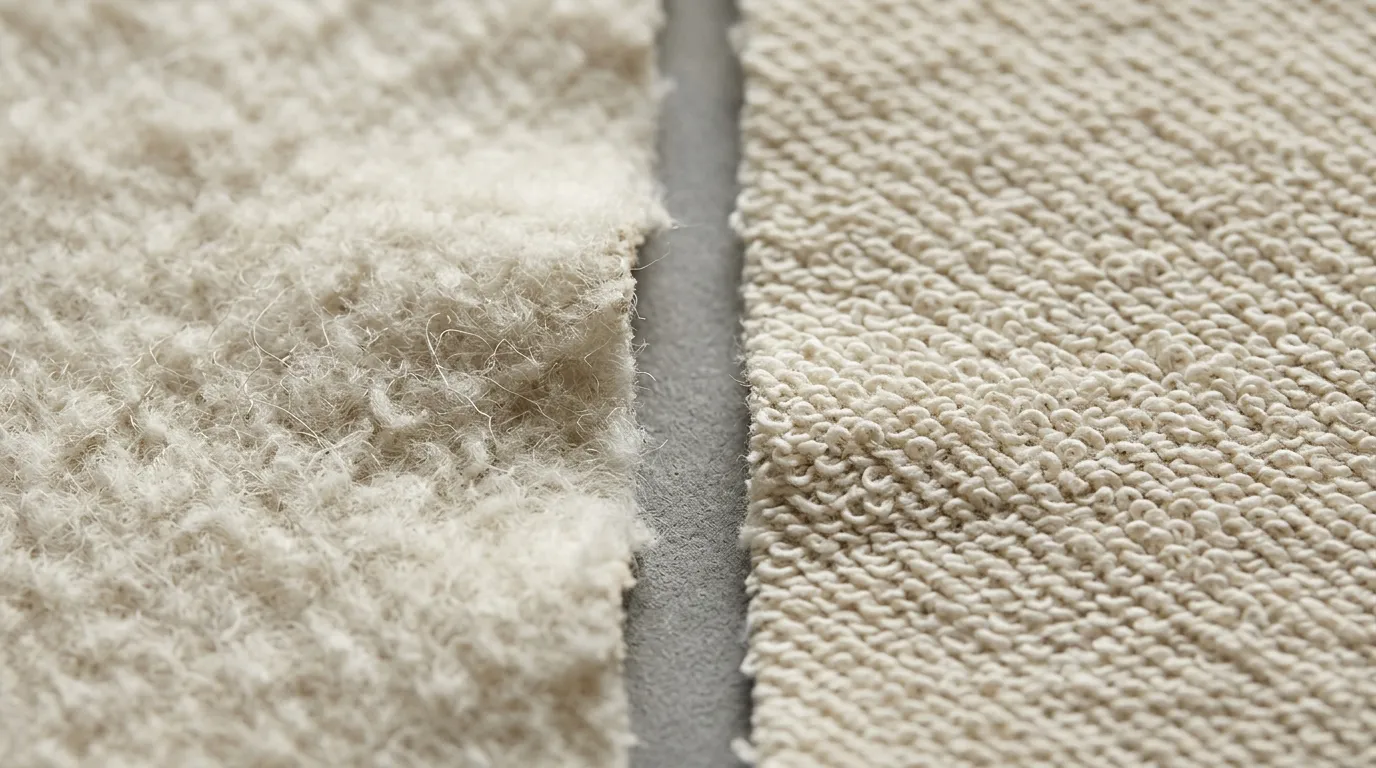
Ask every hoodie factory to state the fabric composition, structure and GSM it proposes for your style, and to explain how fleece and French terry differ in weight, hand feel and finishing for your target. Fleece is a knitted fabric with a brushed or raised inner surface; French terry has a smooth face and visible loops on the back.
There is no single GSM figure that applies to every hoodie. Treat GSM as a specification you set with the factory, and hold every candidate to the same target so quotes stay comparable.
| Fabric option | What to ask the factory | Evidence to request |
|---|---|---|
| Fleece | Proposed composition, weight and brushing method | Fabric spec sheet stating GSM and composition |
| French terry | Loop structure, weight and how it behaves after washing | Fabric spec sheet plus a washed swatch |
| Custom GSM | Whether the mill can hit your target and at what minimum | Mill confirmation for your target weight |
| Rib and trims | Rib composition, stretch recovery and colour match | Trim spec and a matched sample |
| Hood lining and drawcord | Lining fabric, drawcord material and end finishing | Physical sample of hood assembly |
[DIAGRAM: Labelled hoodie construction showing hood lining, drawcord, rib cuffs and hem, and body panels, with a side-by-side callout of brushed fleece versus French terry loop structure.]
How to Assess Shrinkage Control and Garment Washing
Ask the factory how it controls shrinkage — fabric relaxation before cutting, wash or finish testing, and the tolerance it works to — and request results for the exact fabric it will use on your order. A verbal reassurance is not a specification.
Minghang Garments lists garment washes among its hoodie capabilities. Shrinkage tolerance is different: it is a number you agree per order, and it should be written into the approval before bulk starts.
- Is the fabric relaxed before cutting, and how long does that take?
- Is a wash or finish test run before bulk production?
- What tolerance does the factory work to, stated as a percentage?
- Can it show results for the exact fabric on this order?
- What happens if bulk garments fall outside that tolerance?
If your fabric is heavy, the same questions apply but the risk is higher; how to control shrinkage in heavyweight hoodies covers that specific case in more depth.
Which Decoration Methods Work on Hoodie Fabrics?
Confirm decoration compatibility before sampling: ask which methods the factory runs in-house, how each behaves on your chosen fabric and weight, and what it recommends for your placement and artwork. A method that works on a lightweight jersey may sit differently on brushed fleece.
Minghang Garments lists printing and embroidery among its hoodie decoration capabilities. There is no single compatibility table that covers every fabric, so treat the questions below as the check rather than relying on a general claim.
| Decoration method | What to ask the factory | Evidence to request |
|---|---|---|
| Screen printing | Ink type and how it covers brushed or looped surfaces | Printed swatch on your fabric |
| Embroidery | Stitch count limits, backing and puckering control | Embroidered swatch on your fabric |
| Puff printing | Whether the fabric weight supports the raised effect | Printed swatch after washing |
| Garment wash | Order of decoration versus wash, and colour-fastness | Washed decorated swatch |
Hoodie Production Steps to Ask Each Factory About
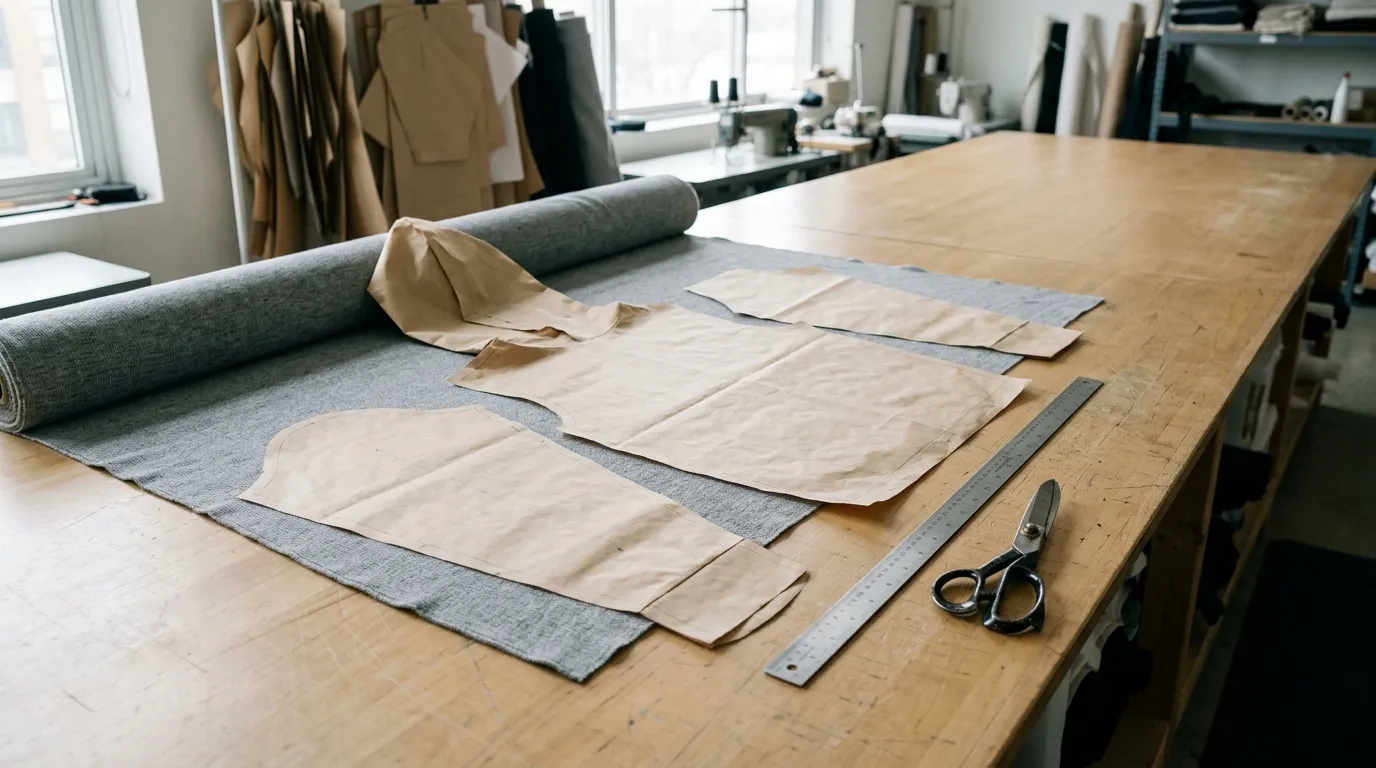
Ask every hoodie factory to explain the same stages in order: development and sourcing, pattern making, sampling and revisions, approval, bulk production, decoration and washing, quality control, and finishing and packing. The value is not the list itself but whether the factory can describe each stage with names, checkpoints and sign-off.
- Development and sourcing — who chooses the fabric and trims?
- Pattern making — who builds and grades the pattern?
- Sampling and revisions — how many rounds are included?
- Written approval — who signs, and what document is signed?
- Bulk production — which line runs the order?
- Decoration and washing — in-house or subcontracted?
- Quality control — which checkpoints and what is checked at each?
- Finishing, labels and packing — how are labels and packaging applied and verified?
Minghang Garments states its 5+1 quality control system covers incoming materials, cutting, in-line sewing, semi-finished garments, final inspection and pre-shipment verification. Minghang Garments also states sampling typically takes 7–15 working days depending on product complexity, fabric and customization, and that bulk production generally takes 25–45 days after sample and material approval. Those figures show the level of specificity a useful answer should reach; the custom hoodie manufacturing process sets out the same stages from a manufacturer's side.
[DIAGRAM: Production flow from brief and pattern through sampling, written approval, cutting, sewing, decoration and wash, quality control and packing, marking the six quality-control checkpoints.]
How to Assess a Hoodie Sample Before Bulk Approval
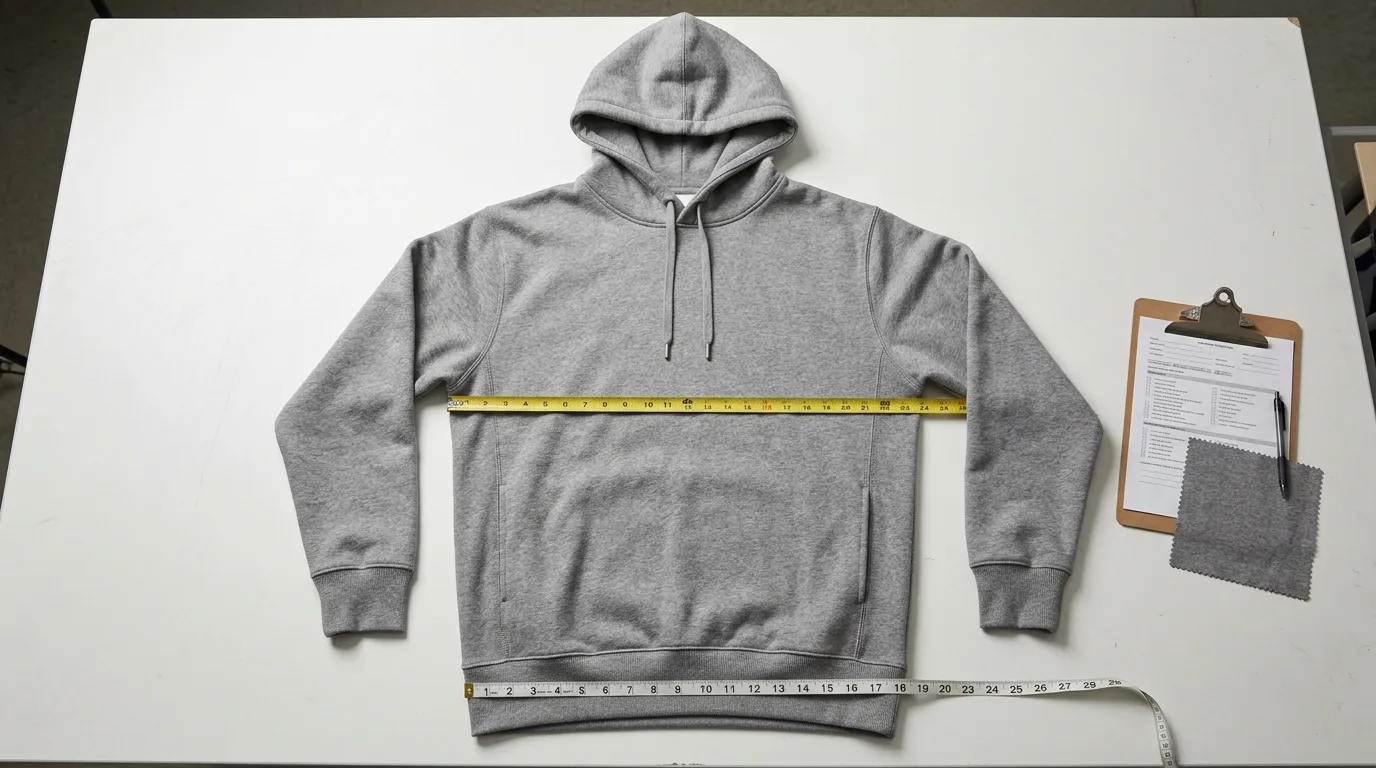
Assess a hoodie sample against your written specification, not against memory: measure it, wear and wash-test it, check construction and decoration, and record every required change in writing before you approve bulk. Approval without a written record is the most common way disputes start.
- Measurements and fit against the spec sheet.
- Fabric and hand feel against the approved swatch.
- Construction: hood shape, seams, rib, drawcord and hem.
- Decoration placement, size and quality.
- Wash behaviour of the finished garment.
- Labels and packaging as specified.
For the shrinkage questions to put alongside your wash test, see the section on assessing shrinkage control and garment washing above.
How to Compare MOQs, Sampling and Lead Times
Compare shortlisted factories on the same line items: minimum order quantity per color and style, sampling time, bulk time, quality control process, and the conditions attached to each number. Minimum order quantity (MOQ) is the smallest quantity a factory will produce for one style and colour.
Minghang Garments states its MOQ starts from 100 pcs per color per style on stock fabric, with higher minimums for some custom-developed fabrics, dyeing and seamless products. Minghang Garments states sampling at 7–15 working days and bulk production at 25–45 days after sample and material approval.
| Criterion | What the factory states | Conditions attached | Evidence requested |
|---|---|---|---|
| MOQ per color and style | Quantity | Stock versus custom fabric, dyeing, seamless | Written confirmation |
| Sample lead time | Working days | Number of revision rounds included | Written confirmation |
| Bulk lead time | Working days | After sample approval, after material in-house, or both | Written confirmation |
| Quality control process | Checkpoints | Which stages are covered | Written QC outline |
| Approval and payment terms | Terms | Deposit, balance and inspection rights | Written terms |
A bare figure is not comparable. Always record the condition attached to it — a lead time that starts after material arrives is a different promise from one that starts at order confirmation.
Common Hoodie Factory Red Flags
Treat vague answers, quotes with no conditions attached, refusal to explain quality control stages, and pressure to skip sampling as red flags. Because you are asking every factory the same questions, the differences between their answers are the signal.
- Vague fabric or GSM answers — ask for the spec sheet and a swatch.
- A price or MOQ with no conditions — ask what changes it.
- Cannot name its quality control stages — ask for the written QC outline.
- No comparable hoodie examples — ask for two recent styles.
- Pushes to skip sampling — ask why, in writing.
- Avoids written approval — ask who signs the spec.
- Slow or evasive answers to technical questions — ask the same question again and compare.
FAQ
Should I use a sourcing agent or contact hoodie factories directly?
Both routes work, with different trade-offs. An agent adds coordination and cost in exchange for local follow-up and translation. Direct outreach usually returns technical answers faster but leaves more administration with you. Decide based on how much time you can spend managing the process yourself.
How do I verify a factory's references and claims?
Ask for comparable hoodie styles, named contacts you can speak to, and the quality control stages in writing. Note that marketplace and factory figures are self-reported: Maker's Row, for example, states "250k+ Brands" and "20k+ Factories" on its own page, and those numbers are not independently verified.
What is the smallest hoodie order I can realistically place?
It varies by factory, fabric and style. Minghang Garments states its MOQ starts from 100 pcs per color per style on stock fabric, with higher minimums for some custom-developed fabrics, dyeing and seamless products. Ask every candidate for its own figure and the conditions attached to it.
Do I need to visit the factory in person?
Not to start. A sample, a written quality control explanation and a video walkthrough cover much of the same ground, and they are faster to arrange. An in-person visit remains the strongest check on real capacity and working conditions, so it is worth planning before a large repeat order.
If you want to see how a manufacturer describes its own hoodie capability and process, the hoodie pages linked in this guide show the level of detail a useful factory answer should reach.
-
Share
-

-

-