 Contact Us

Table of Contents

Contact Us
Updated 4 weeks ago
Cotton vs Polyester for Hoodies: Which Is Better?
arafatshuvo
For a hoodie, neither fiber wins outright: Hoodie Fabric Fibers should be chosen by use. Cotton gives a softer, more breathable hand feel that suits everyday and streetwear hoodies, while polyester resists shrinkage and stretching and suits performance and quick-drying hoodies. Blends sit between the two.
Key takeaways
- Sports by Sager describes cotton as breathable and naturally comfortable, and polyester as moisture-wicking and durable.
- PrintKK's sweatshirt comparison states that cotton absorbs moisture and dries slowly, while polyester moves moisture and dries quickly.
- According to Sports by Sager, polyester is less likely to shrink, wrinkle or stretch, while cotton is more prone to shrinkage in hot washing.
- Printful notes that blend feel depends on the fiber ratio, so the ratio — not the word "blend" — is the specification worth confirming.
- GSM measures fabric weight in grams per square meter and is a separate choice from fiber; Minghang Garments' streetwear fabric guide cites practical ranges of 280–350 GSM for lightweight-to-midweight sweatshirts and French terry, and 350–450 GSM for heavyweight hoodies.
Quick comparison: cotton vs polyester for a hoodie
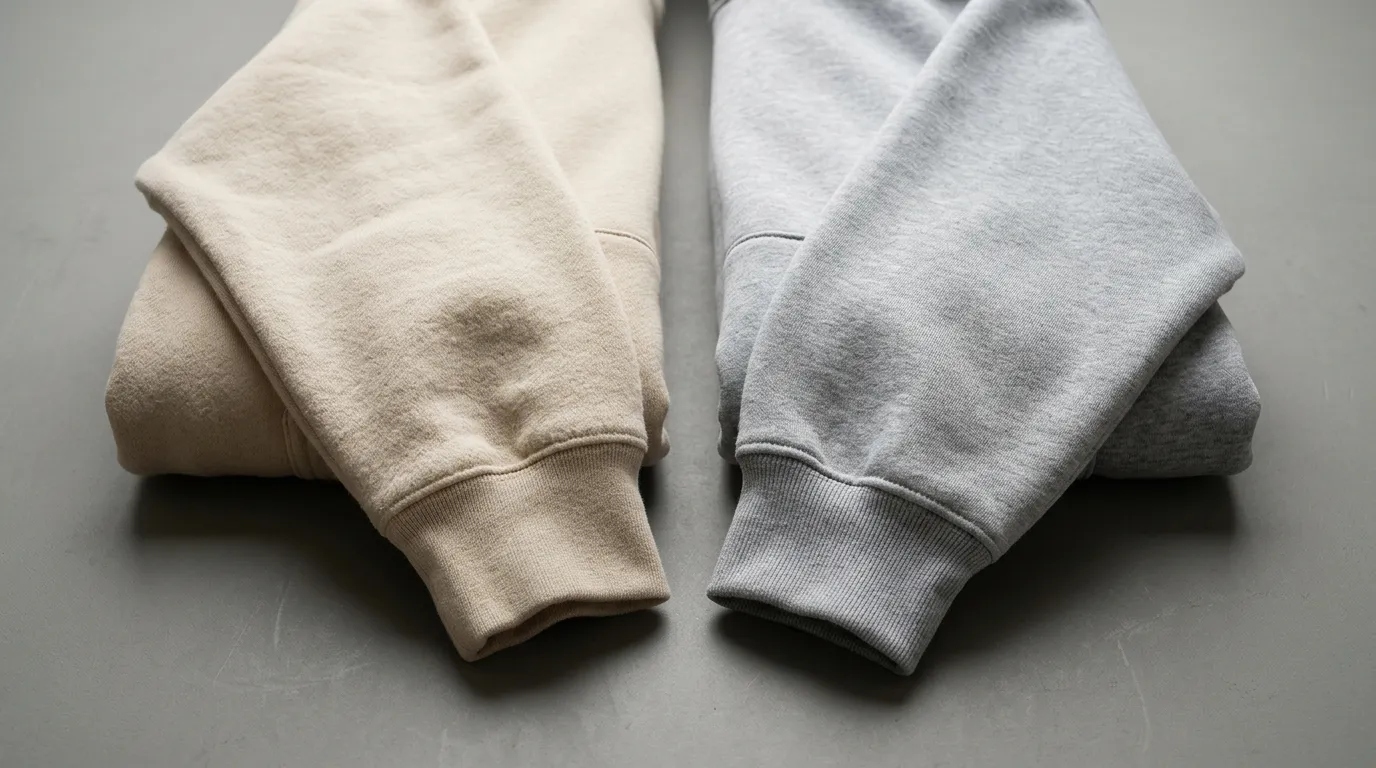
Cotton leans soft, breathable and absorbent, while polyester leans durable, quick-drying and shrink-resistant; a blend trades between the two, with the fiber ratio deciding where the finished fabric lands. The table below summarises the tendencies reported by the sources named in it.
| Attribute | Cotton | Polyester | Cotton-polyester blend |
|---|---|---|---|
| Hand feel | Described as soft and naturally comfortable (Sports by Sager, Printful) | Hand feel depends on yarn, structure and finishing — not the fiber name alone | Between the two; feel depends on the fiber ratio (Printful) |
| Breathability | Described as breathable (Sports by Sager) | Described as moisture-wicking rather than breathable (Sports by Sager) | Between the two, shifting with the polyester share |
| Moisture and drying | Absorbs moisture and dries slowly (PrintKK) | Moves moisture and dries quickly (PrintKK) | Between the two; drying speeds up as polyester share rises |
| Shrinkage and shape | More prone to shrinkage in hot washing (Sports by Sager) | Less likely to shrink, wrinkle or stretch (Sports by Sager) | More dimensionally stable after washing, because polyester resists shrinkage (René Bassett) |
| Garment dye | Cotton-rich fabric is used for garment-dyed colors and washed effects (René Bassett) | Takes dye differently from cotton; behavior depends on the dye system — verify with the supplier | May dye to a different depth or tone — verify with the supplier |
| Commonly chosen for | Everyday and streetwear hoodies | Training, high-sweat or fast-drying hoodies | Specs that need softness and shape retention together |
These cells report what the named sources state about fiber-level tendencies. They are not laboratory comparisons, and construction, weight and finishing can change the result.
How does cotton vs polyester affect softness and hand feel in a hoodie?
Cotton is generally the softer, more breathable face fabric in a hoodie, while polyester is characterised mainly by moisture wicking and durability. Sports by Sager describes cotton hoodies as breathable and naturally comfortable, and Printful's fiber comparison describes cotton as soft and breathable.
Hand feel is not fixed by the fiber name. Printful notes that the feel of a cotton-polyester blend depends on the fiber ratio, and the same yarn can be knitted and finished in different ways. The practical rule is to judge hand feel on the finished fabric sample rather than on the fiber description on a spec sheet.
Breathability, moisture and drying: how the two fibers behave
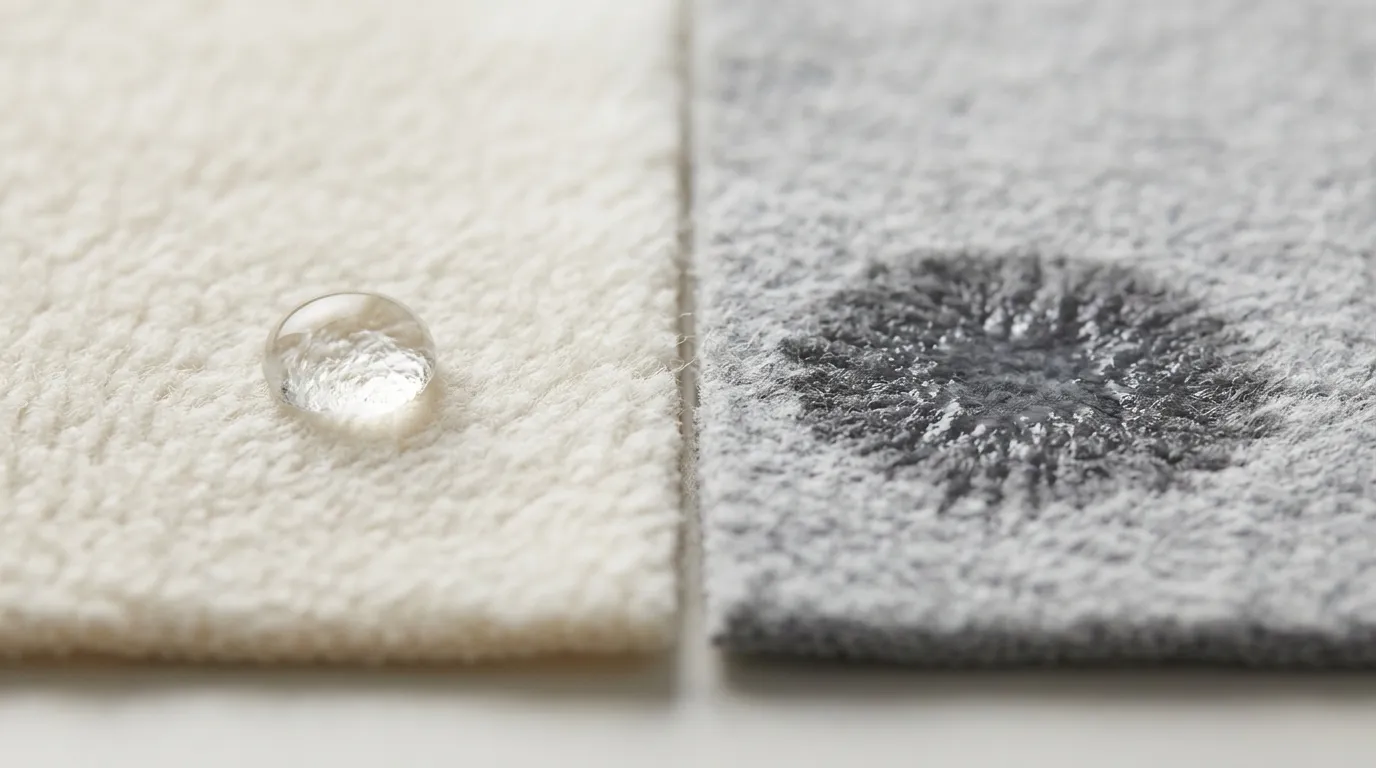
Cotton absorbs moisture and dries slowly, while polyester moves moisture away and dries quickly. Those are two different mechanisms: absorption pulls moisture into the fiber, whereas moisture movement carries it across the surface, and neither fiber automatically delivers the other behavior.
PrintKK's sweatshirt comparison states that cotton absorbs moisture and dries slowly and that polyester wicks moisture and dries quickly; Sports by Sager similarly describes polyester as moisture-wicking and cotton as absorbent and breathable. PrintKK's comparison covers sweatshirts rather than hoodies specifically, and no independent test data for hoodie fabric was available in these sources, so treat both statements as fabric-level tendencies.
[DIAGRAM: cotton fiber absorbing moisture versus polyester moving moisture along the surface, with a drying-speed axis]
What this means for workouts vs everyday and streetwear hoodies
Polyester and polyester-rich fabric suits high-sweat training and situations where a hoodie needs to dry quickly, while cotton-rich fabric suits low-sweat everyday and streetwear wear. Match the fiber to sweat rate, the drying time available before the garment is worn again, and how often it is washed — not to a brand label. Fabric weight and structure also affect warmth, so a heavy cotton hoodie and a heavy polyester hoodie are not interchangeable in every climate.
Shrinkage and shape retention: which holds up better after washing?
Polyester resists shrinkage, wrinkling and stretching better than cotton, and cotton is more prone to shrinkage in hot washing. Sports by Sager's comparison states that polyester is less likely to shrink, wrinkle or stretch, and that cotton is moisture-absorbing and more prone to shrinkage in hot washing.
Blending changes the picture. René Bassett's guide explains that cotton-poly blends are more dimensionally stable after washing because polyester resists shrinkage and helps the fabric retain its shape. Washing temperature and finishing both influence the outcome, so shrinkage behavior is not identical across every cotton hoodie. For pre-shrinking and finishing controls on heavy fabrics, see how to control shrinkage in heavyweight hoodies.
What changes when you blend cotton and polyester?
Blending trades cotton's softness and breathability against polyester's shape retention and quick drying, and the ratio decides where the finished fabric lands. Printful notes that blend feel depends on the fiber ratio, and identifies midweight cotton-polyester fleece or French terry as a common balance for casual-wear brands, adding that thicker fabric adds warmth.
| Ratio (as cited) | Cotton contribution | Polyester contribution | Commonly used for |
|---|---|---|---|
| 80/20 | Higher cotton share; softer, more breathable lean | Smaller polyester share; some added shape retention | Cotton-forward hoodies with better wash stability than pure cotton |
| 60/40 | Cotton still dominant in the hand | Noticeable quick-dry and shape-retention contribution | Everyday hoodies balancing hand feel and stability |
| 50/50 | Mid-point hand feel | Mid-point drying and shape retention | Specs that need both properties in similar measure |
René Bassett names 80/20 and 60/40 as example ratios; Printful's guide states that blend feel depends on the fiber ratio. These examples show where a blend can sit rather than ranking one ratio above another, and the actual ratio should be confirmed in writing on the fabric specification.
Some suppliers describe cotton-rich blends using the term CVC. The term is not used consistently across the industry, so treat it as a label rather than a fixed ratio, and confirm the garment's fiber content on the fabric specification instead of relying on the abbreviation.
[DIAGRAM: a single cotton-to-polyester spectrum with the cited 80/20, 60/40 and 50/50 examples marked as examples, not grades]
Does GSM decide which fiber is better for a hoodie?
No. GSM stands for grams per square meter and measures fabric weight, which is a separate choice from fiber: a heavy hoodie can be cotton, polyester or a blend. Minghang Garments' streetwear fabric guide defines GSM and gives practical ranges of 280–350 GSM for lightweight-to-midweight sweatshirts and French terry, and 350–450 GSM for heavyweight hoodies, sweatshirts and joggers, noting that these are practical ranges rather than a universal standard.
Weight and fiber interact, but neither replaces the other. Fabric structure, such as fleece versus French terry, is another variable in the same decision; the wider structural picture is covered in best fabrics for streetwear, and it is not repeated here.
[DIAGRAM: two-axis chart with fabric weight in GSM on one axis and fiber composition on the other, showing that they vary independently]
Garment dyeing: how cotton, polyester and blends behave
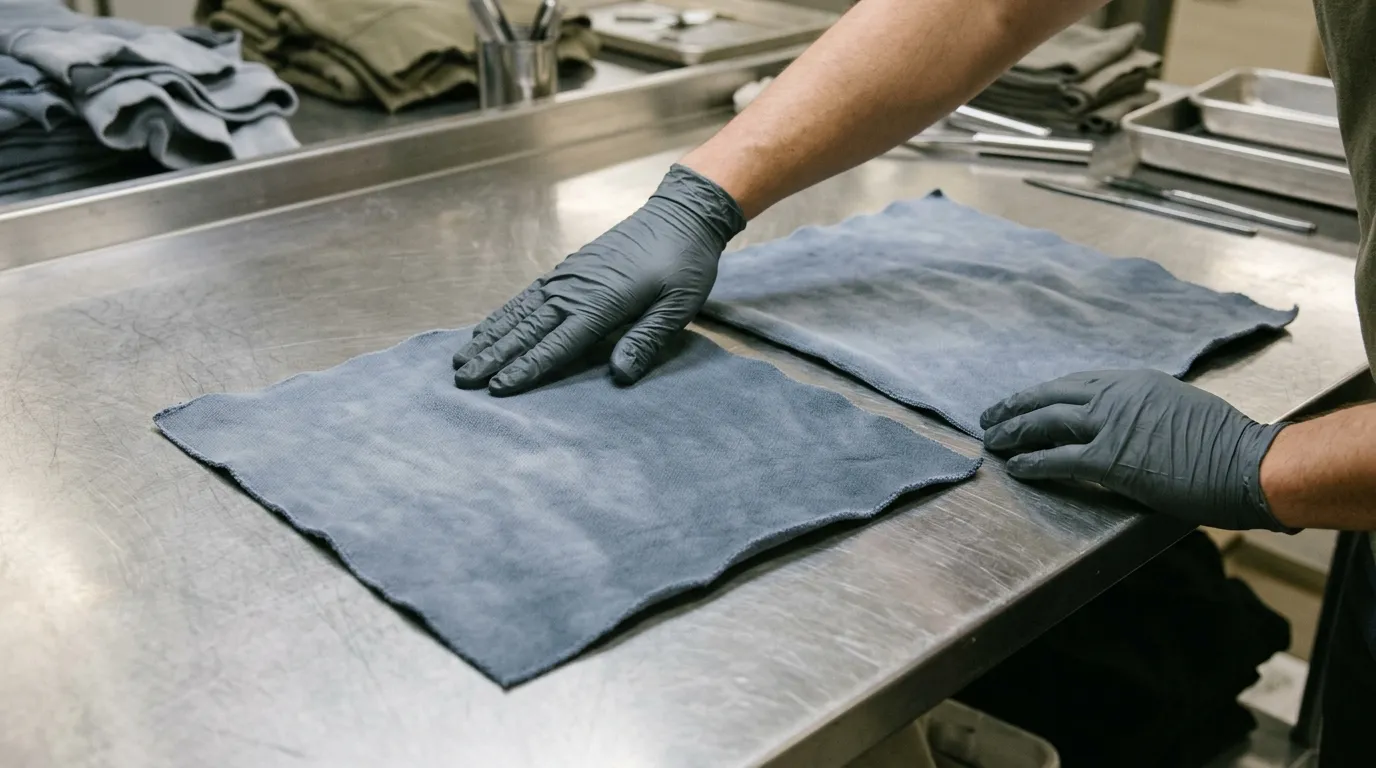
Cotton and polyester can take dye differently, so a blended hoodie may dye to a different depth or show uneven tone compared with a single-fiber fabric. René Bassett's guide describes cotton-rich fabric as used for garment-dyed colors and washed effects, and notes that cotton and polyester in a blend may take dye differently.
No source reviewed states that blends cannot be garment dyed. The practical point is that dye results depend on the dye system and on the exact composition, so they have to be validated rather than assumed. The process comparison between the two main routes is set out in garment dye vs pigment dye for streetwear.
A short validation sequence reduces the risk:
- Confirm the fiber composition of the actual fabric lot, not the intended composition.
- Agree the target shade and finish against the fabric that will be used.
- Approve a dyed sample made from the blend specified for production.
- Approve the bulk lot against that approved sample before cutting.
How to choose: cotton, polyester or a blend for your hoodie
Choose cotton-rich fabric for softness and everyday or streetwear wear, polyester-rich fabric for quick drying and shape retention in performance hoodies, and a blend when the spec needs both — then confirm the actual ratio and approve a finished-fabric sample.
A short checklist keeps the comparison practical:
- Define the use first: low-sweat everyday wear, high-sweat training, or both.
- Set the expectations that matter most: hand feel, drying speed or shrink resistance.
- Specify the fiber ratio as a percentage, not as the word "blend".
- Confirm the dye or finishing route and validate it on a sample.
- Approve a finished-fabric sample before bulk production begins.
Minghang Garments is a custom clothing manufacturer in Dongguan, China that has operated since 2017 and produces hoodies and sweatshirts for emerging brands, activewear and fitness brands, streetwear labels and established apparel companies. Sampling takes 7–15 working days, and MOQ starts from 100 pcs per color per style on stock fabric. Brands developing a hoodie program can review hoodies sweatshirts manufacturing to see how fiber choice fits into development, fabric sourcing and sampling.
Common mistakes when specifying hoodie fabric
The most common errors are treating fiber as the only variable, accepting the word "blend" without a ratio, and assuming one fiber always outperforms the other. Each has a specific fix on this page rather than a general warning.
- Treating GSM as a fiber property — it measures weight, and the two vary independently (see the GSM section).
- Assuming every polyester hoodie wicks equally well — the mechanism is described above, and construction and finishing also apply (see the moisture section).
- Assuming all cotton hoodies shrink by the same amount — washing temperature and finishing change the result (see the shrinkage section).
- Using CVC as a ratio — confirm the percentage on the fabric specification (see the blend section).
Frequently asked questions
Should hoodies be cotton or polyester?
Cotton suits soft, breathable everyday and streetwear hoodies, while polyester suits quick-drying, shrink-resistant performance hoodies; blends are used when both properties are needed. Sports by Sager describes cotton as breathable and natural and polyester as moisture-wicking and durable, so the right answer depends on the wearer's activity and climate.
Is 50/50 good for a hoodie?
A 50/50 cotton-polyester blend sits at the mid-point: roughly half the softness and breathability associated with cotton and half the shape retention and quick drying associated with polyester. It is a workable middle option, but confirm the actual ratio on the fabric specification, since the labeled ratio for a given fabric can differ from expectations.
Is 80/20 or 60/40 better for a hoodie?
Neither is universally better. René Bassett names 80/20 and 60/40 as example blends, and Printful states that blend feel depends on the fiber ratio, so the choice follows the intended use rather than a general ranking. Pick the ratio that matches the required hand feel, drying speed and shrinkage tolerance, then validate it on a finished-fabric sample.
-
Share
-

-

-