 Contact Us

Table of Contents

Contact Us
Manufacturing heavyweight T-shirts follows eight steps: choose fabric weight, knit and composition; lock the tech pack; control shrinkage before cutting; build a boxy or oversized pattern; attach the rib collar; apply print or embroidery; wash, finish and inspect; then approve samples before bulk. Fix each decision on a sealed sample, because fabric weight alone does not define the finished garment.
Key takeaways
- A heavyweight T-shirt is a weight-led specification rather than one fixed number: Merchize defines it as typically over 180 GSM or 6 oz/yd², and Real Thread describes it as 6 oz/yd² or more.
- Fabric weight travels with knit and composition. Minghang Garments' heavyweight T-shirt page lists cotton interlock at 240–320 GSM, cotton single jersey at 160–280 GSM and TC poly-cotton at 220–330 GSM, and notes that a higher GSM is not automatically better.
- Shrinkage control happens before bulk cutting: fabric inspection, shrinkage testing and pre-shrinking come first, then post-wash measurements decide release.
- Minghang Garments states that sampling generally takes 7–15 working days and bulk production 25–45 days, with MOQ from 100 pcs per color per style on stock fabric.
[DIAGRAM: Eight-step heavyweight T-shirt production sequence, showing fabric selection, the shrinkage-control loop before bulk cutting, and final sample approval.]
What Makes a T-Shirt Heavyweight?
A heavyweight T-shirt is defined by its fabric weight per unit area, usually quoted in grams per square metre (GSM) or in ounces per square yard. The exact cutoff varies by source, so the number should be agreed with the buyer rather than assumed from a single figure.
| Source | Stated heavyweight rule of thumb |
|---|---|
| Merchize | Typically over 180 GSM or 6 oz/yd² |
| Real Thread | 6 oz/yd² or more |
Both figures are the named sources' own rules of thumb, not published standards. No source reviewed here establishes an official industry threshold, and none of them treat weight as sufficient on its own: the same number produces a different garment depending on the knit structure, fibre composition and the fit it is drafted for.
This matters early. A buyer who specifies "heavyweight" without a target weight, knit and composition leaves the factory to interpret the brief, which is where most specification mismatches begin. The next step replaces that word with numbers.
Step 1: Choose the Fabric Weight, Knit and Composition
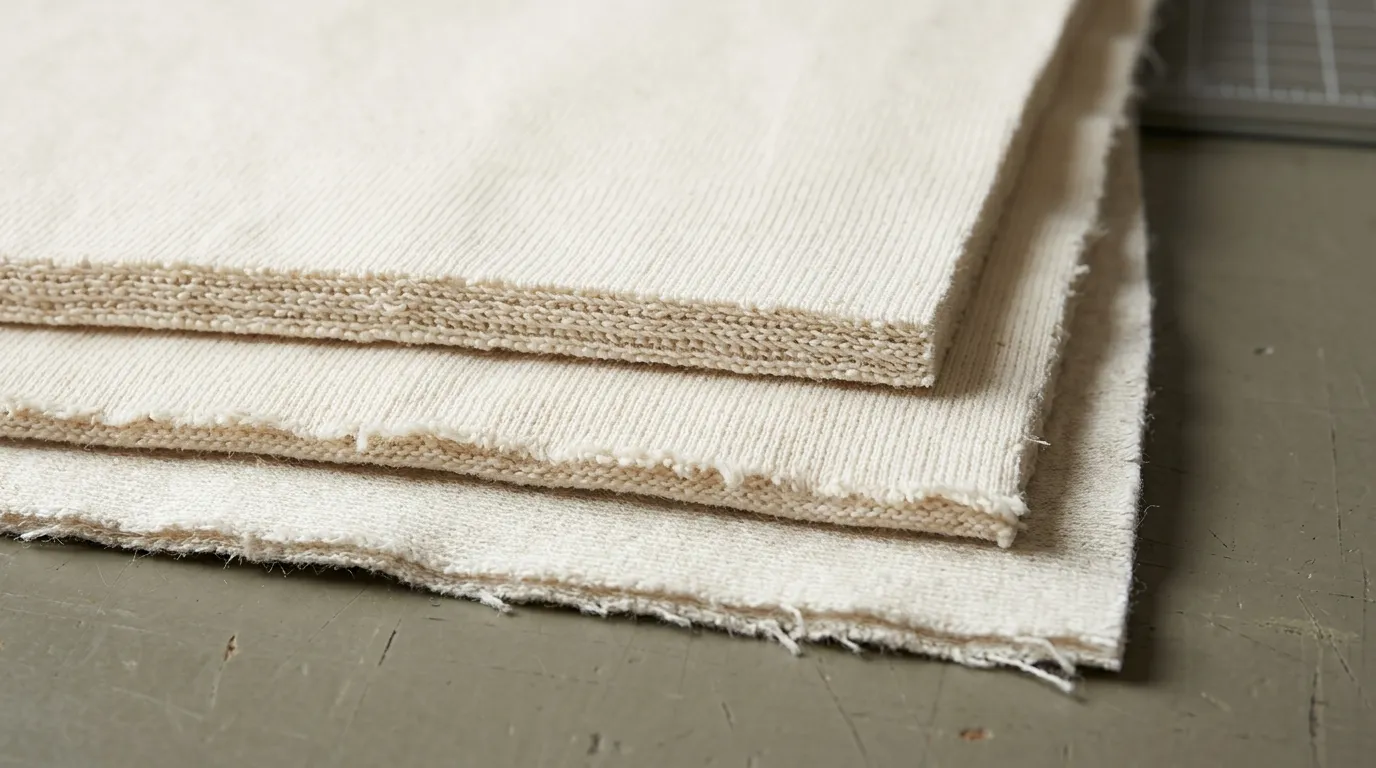
Fabric selection for a heavyweight T-shirt has to settle weight, knit and composition together, because the same GSM behaves differently as single jersey, interlock or a cotton-poly blend. Treating those three as one decision is what keeps the finished garment close to the design intent.
As a heavyweight t shirt manufacturer, Minghang Garments lists the following ranges on its heavyweight T-shirt page:
| Fabric option (listed by Minghang Garments) | Listed GSM range | Consider when | Decoration note |
|---|---|---|---|
| Cotton interlock | 240–320 GSM | You want a denser, more structured body — confirm the hand feel on a swatch first | Verify with the supplier |
| Cotton single jersey | 160–280 GSM | You want a lighter feel within a heavyweight build — confirm the hand feel on a swatch first | Verify with the supplier |
| TC poly-cotton blend | 220–330 GSM | You need a poly-cotton base for print-led designs | Listed as suitable for sublimation and all-over print applications |
| CVC cotton/polyester blend | Examples given as 60% cotton / 40% polyester, or similar | You want a cotton-forward blend rather than a pure cotton body | Verify with the supplier |
These ranges are Minghang Garments' own product-page figures, not industry standards, and the page notes that a higher GSM is not automatically better. Weight is one variable among several.
The decision rule for a tech pack is straightforward: name the composition, the knit and the target GSM, and have the buyer approve a fabric swatch before sampling starts. If the brief leans on streetwear hand feel rather than a number, a guide to the best fabrics for streetwear can help translate that language into a specification the mill can match.
Step 2: Lock the Tech Pack Before Anything Is Cut
A T-shirt tech pack is the document that carries every specification from the buyer to the factory. It should communicate measurements, materials, construction and stitching details before cutting begins.
S.I. Graphics' tech-pack guide states that a T-shirt tech pack typically communicates measurements, materials, construction and stitching details. That guide also uses a 2 cm tolerance as an example — that figure is the source's own example of a stated tolerance, not a universal standard, and any tolerance should be agreed for the individual order.
A factory-ready tech pack for a heavyweight T-shirt should carry all of the following:
- Target GSM, fibre composition and knit structure.
- Points of measure and the full size grading.
- Neckline and rib specification.
- Seam and stitch types.
- Decoration method, artwork size and placement.
- Wash and finish requirement.
- Shrinkage requirement and how it will be measured.
- Label and packaging instructions.
Anything left out of this document is left to interpretation at the machine, so it is worth closing every line before the first sample is cut.
Step 3: Plan Shrinkage Control Before Bulk Cutting
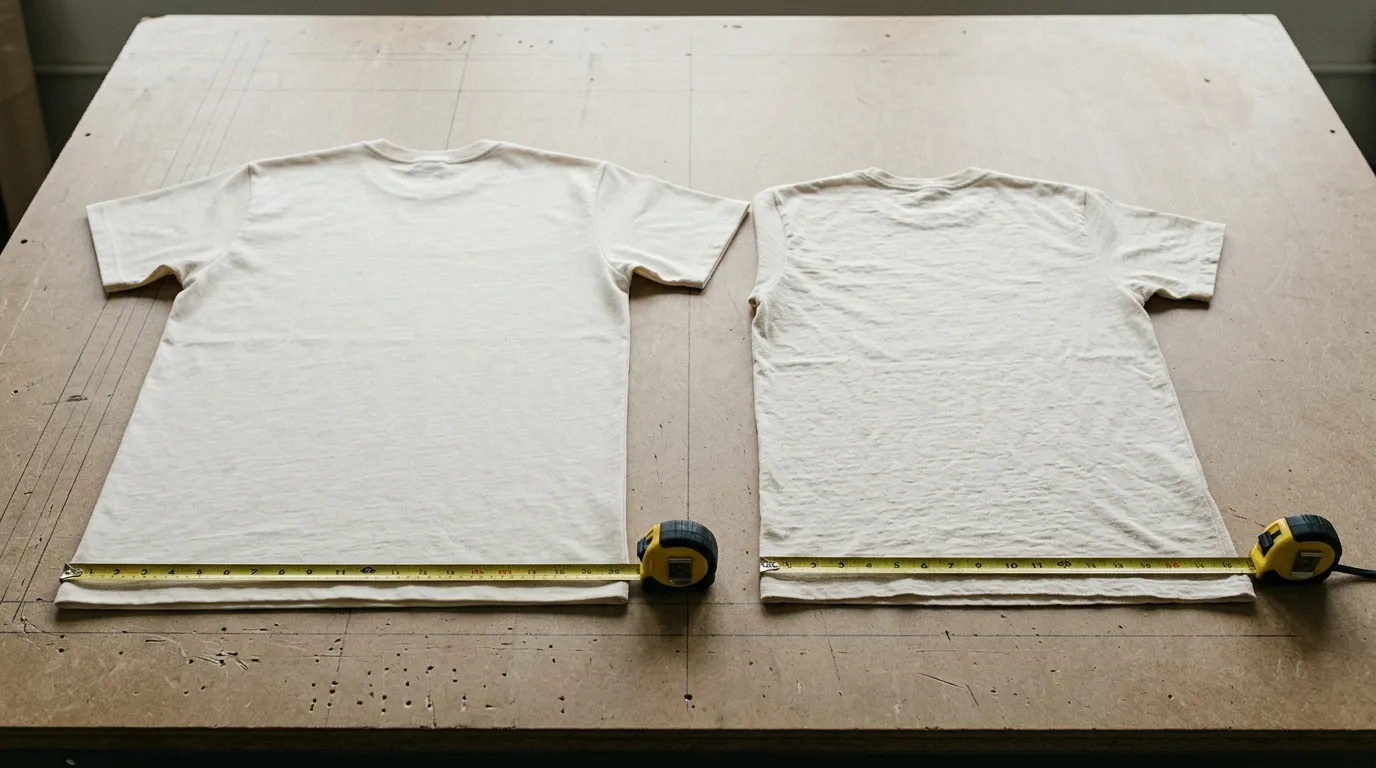
Shrinkage control is a pre-production activity, not a finishing fix. Fabric is inspected, tested for shrinkage and pre-shrunk before bulk cutting, and the finished garment's measurements are re-checked after washing against the agreed tolerance.
Minghang Garments' heavyweight T-shirt page identifies fabric inspection, shrinkage testing and pre-shrinking as considerations in heavyweight T-shirt development. The workable order for that control loop is:
- Inspect the incoming fabric.
- Test shrinkage on the actual production lot.
- Apply pre-shrinking using the method that applies to that fabric.
- Re-measure the washed pre-production sample against the tech pack.
- Release bulk cutting only once those measurements hold within the agreed tolerance.
One point to close in writing: ask which pre-shrinking method will be used on your order and how the result will be measured, then record both in the tech pack. That single question prevents a late disagreement about whether a washed garment still meets its points of measure.
Step 4: Develop the Pattern for a Boxy or Oversized Fit
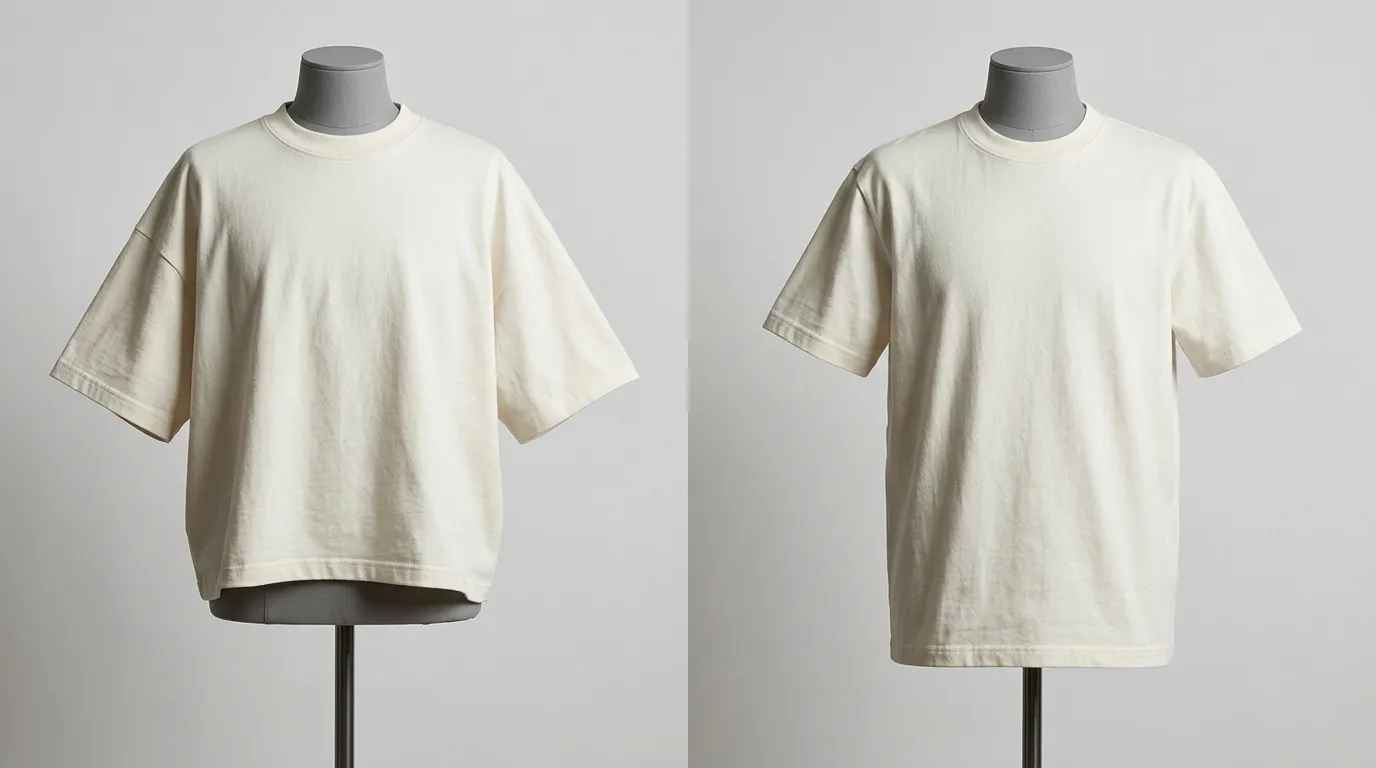
A boxy or oversized heavyweight T-shirt is drafted from target garment measurements — chest, body length, shoulder, sleeve opening and hem — rather than scaled up from a standard fit block. Minghang Garments' heavyweight T-shirt page identifies pattern development as a core consideration in heavyweight T-shirt development.
The reason drafting matters more here is fabric weight. A heavier fabric falls differently on the body, so an oversized silhouette that works in a light jersey can read as a different shape once a 300 GSM body fabric is used. Development should therefore settle the shoulder construction before the first pattern is made, and confirm the drape on the body using the specified fabric rather than a substitute. A comparison of drop shoulder vs set in sleeve helps when the shoulder line is the open question.
[DIAGRAM: Labelled points-of-measure diagram for a boxy heavyweight T-shirt, marking chest, body length, shoulder width, sleeve opening, hem and rib collar height.]
Fix the points of measure for each graded size in the tech pack, and approve the silhouette on a sample made from the production fabric.
Step 5: Build the Rib Collar So the Neckline Holds
A rib collar should be specified by rib composition, rib height, neckline width and the attachment seam, then approved on the sample rather than decided at bulk. Minghang Garments' heavyweight T-shirt page identifies neckline and rib construction as a heavyweight T-shirt development consideration.
Because the body fabric is heavier, the neckline is one of the first places a mismatch shows. Put the rib composition and rib height in the tech pack, state the neckline width for each graded size, and name the seam used to attach the collar. Treat neckline recovery as a sample-approval check: the buyer reviews how the collar behaves after the sample has been washed and measured, alongside the rest of the garment.
Step 6: Apply Decoration: Print or Embroidery
Decoration should be chosen against the fabric actually specified, because composition and weight affect how print or embroidery sits on a heavyweight T-shirt. Minghang Garments' heavyweight T-shirt page describes its TC poly-cotton blends at 220–330 GSM as suitable for sublimation and all-over print applications, and lists printing and embroidery among its services.
The tech pack should name the decoration method, the artwork size and the exact placement, and the sample should carry the decoration applied to the production fabric rather than a lighter substitute. Placement should then be checked against each graded size, since the same artwork position on a size small and a size extra large is not the same distance from the shoulder seam.
[DIAGRAM: Decision chart mapping target silhouette and decoration method to fabric weight, knit and composition options.]
One documented reference point: a custom 250gsm heavyweight print cotton t shirts project shows how a print brief and a heavyweight cotton base come together. It is one example of a specification, not a standard that applies to every order.
Step 7: Wash, Finish and Inspect
Garment washing sits before final measurement and inspection, so any change in hand feel or dimensions is captured before the goods are packed. Minghang Garments' heavyweight T-shirt page identifies garment washing as a consideration in heavyweight T-shirt development, and Minghang Garments' homepage states that it operates a 5+1 quality-control system.
The release criterion should be the post-wash measurement, not the pre-wash measurement. Measure the washed garment against the tolerance recorded in the tech pack, then inspect. Garment washing is also the point at which the final hand feel is set, so the washed sample is the version the buyer should sign off.
Step 8: Approve Samples, Then Start Bulk
Bulk production should begin only after written sample approval and a sealed reference sample, with the approved specification matching what the factory will actually run.
Timing and quantity guardrails are easier to plan around once the spec is fixed. Minghang Garments' homepage states that sampling generally takes 7–15 working days and bulk production generally takes 25–45 days, with MOQ from 100 pcs per color per style on stock fabric and a 5+1 quality-control system. Those are Minghang Garments' stated service details, not industry benchmarks, and they should be confirmed for the specific order.
Before releasing bulk, close these items:
- Confirm sample approval in writing.
- Keep the sealed sample as the reference.
- Confirm the production fabric lot matches the approved swatch.
- Confirm decoration size and placement.
- Confirm the wash and finish instruction.
- Confirm the measurement tolerance that will be used at release.
How Minghang Garments Supports Heavyweight T-Shirt Production
Minghang Garments is a custom clothing manufacturer based in Dongguan, China, operating since 2017, offering OEM, ODM and private label manufacturing of activewear, sportswear, loungewear and streetwear, including T-shirts. Its services cover product development, fabric and trim sourcing, pattern making, sampling, bulk production, printing, embroidery, garment washing, labels and packaging, and it serves emerging brands, activewear and fitness brands, streetwear labels and established apparel companies.
The company runs a 12,000 m² production floor and a 2,000 m² sample center, with capacity stated at up to 500,000 pcs/month. For a heavyweight T-shirt programme, that combination of sampling space and production capacity is what allows the shrink, fit and collar decisions described above to be settled on a sample before bulk begins. Brands that want these eight steps turned into a sealed pre-production sample can contact Minghang Garments to start the brief.
FAQ
Does a higher GSM mean a better heavyweight T-shirt?
No. Minghang Garments' heavyweight T-shirt page notes that a higher GSM is not automatically better. Fabric weight is one variable alongside knit structure, fibre composition and the fit the garment is drafted for, so a 320 GSM interlock and a 240 GSM interlock can serve different briefs equally well.
What material are heavyweight T-shirts made of?
Heavyweight T-shirts are commonly made from cotton jersey, cotton interlock or cotton-polyester blends. Minghang Garments' heavyweight T-shirt page lists cotton interlock at 240–320 GSM, cotton single jersey at 160–280 GSM, TC poly-cotton blends at 220–330 GSM, and CVC blends given as examples at roughly 60% cotton and 40% polyester.
How do you stop a heavyweight T-shirt shrinking after washing?
Control shrinkage before cutting, not after sewing. Fabric is inspected, tested for shrinkage on the production lot and pre-shrunk, then the washed pre-production sample is re-measured against the tech pack tolerance. Minghang Garments' heavyweight T-shirt page identifies fabric inspection, shrinkage testing and pre-shrinking as heavyweight T-shirt development considerations.
How long does it take to make a heavyweight T-shirt?
Minghang Garments' homepage states that sampling generally takes 7–15 working days and bulk production generally takes 25–45 days, with MOQ from 100 pcs per color per style on stock fabric. Those are Minghang Garments' stated service details rather than industry benchmarks, and timelines should be confirmed for the specific order.
-
Share
-

-

-