 Contact Us

Table of Contents

Contact Us
Updated 1 month ago
What Is the Best Clothing Manufacturer for Small Brands?
arafatshuvo
The best clothing manufacturer for small brands is one whose minimums, development support and timelines match your product and current order size — not the biggest name on a list. For example, Minghang Garments states MOQ from 100 pcs per color per style on stock fabric and 7–15 working-day sampling, terms a small brand can plan around.
Key takeaways:
- "Best" means best fit: minimums, lead times and capabilities vary by product and must be confirmed for your exact style.
- An MOQ number means little without its basis — per design, per color, per style, and whether the fabric is stock or custom.
- Full-package, CMT, development-studio, small-batch, print-on-demand and direct-overseas models are not like-for-like comparisons.
- Ask for sampling and bulk timelines, quality-control responsibility and commercial terms in writing before paying a deposit.
- Company names that appear across several published supplier lists are research starting points, not endorsements.
What Makes a Clothing Manufacturer the Best Fit for a Small Brand?
The best clothing manufacturer for a small brand is the one that matches your product category, order quantity, development needs and intended production model. A well-known supplier that cannot serve your first order well is a worse fit than a smaller factory that can.
According to Arcus Apparel Group's 2025 guide to clothing manufacturers for startups, buyers should confirm current minimum order quantities, lead times and capabilities for each specific product instead of relying on general claims. MFG Merch's 2026 guide to US clothing manufacturers for small brands separates full-package, cut-make-trim and decoration-only services, which is a reminder that "clothing manufacturer" describes several different jobs.
If you are building a shortlist for the first time, choose a clothing manufacturer walks through the same decision points in more detail.
[DIAGRAM: Decision flow showing product category → production model → MOQ basis (stock or custom fabric) → sampling and bulk timelines → quality-control responsibility]
Category and Material Expertise: How to Test It
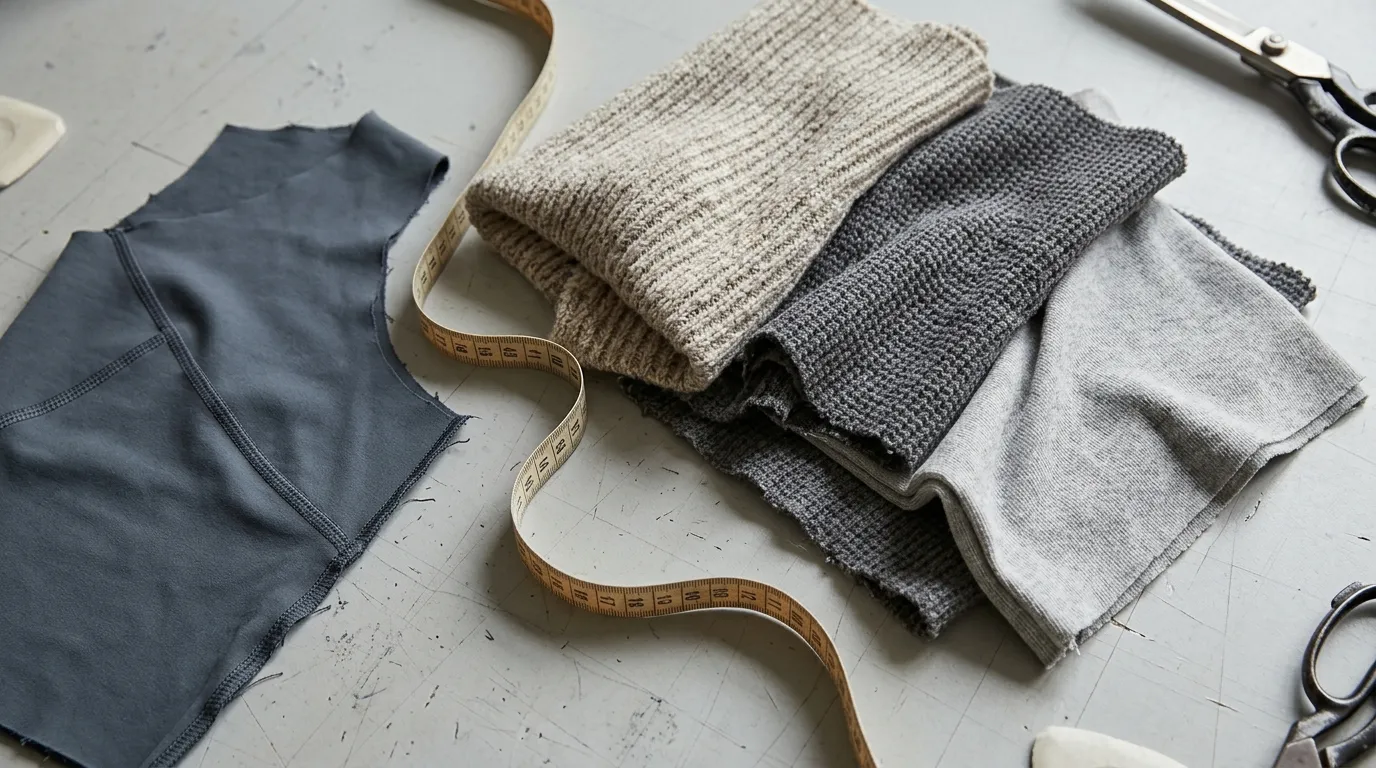
Test category fit with one direct question: which fabrics and garment constructions did you produce in my category over the last 12 months? If the answer is generic, treat category experience as unproven and move to the next supplier.
Minghang Garments is a Dongguan-based custom clothing manufacturer that has operated since 2017 and makes activewear, sportswear, loungewear and streetwear under OEM, ODM and private label arrangements, with product development, pattern making and sampling among its services.
Compare Production Models Before You Compare Manufacturers
A full-service cut-and-sew factory, a CMT unit, a development studio, a small-batch factory, a print-on-demand provider and a direct overseas factory do different jobs, so compare them against your own stage rather than against each other.
Arcus Apparel Group's 2025 startup guide separates full-service cut-and-sew, development studios, small-batch factories, print-on-demand and direct overseas factory models. MFG Merch separates full-package, CMT (cut, make, trim — where you supply the fabric and the supplier cuts, sews and finishes) and decoration-only services. TRUiC's list of clothing manufacturers for startups describes Printful as a print-on-demand service with no order minimums, which is a different offer from a factory producing your own pattern.
| Production model | What the supplier handles | Brand stage it usually suits | Confirm before quoting |
|---|---|---|---|
| Full-package cut-and-sew | Pattern, fabric sourcing, sampling, bulk sewing, finishing | Brands with a defined product who want one supplier end to end | MOQ basis — see MOQ: Read the Conditions, Not Just the Number |
| CMT (cut, make, trim) | Cutting, sewing and finishing only | Brands that already own fabric and patterns | Who supplies and approves the fabric |
| Development studio | Design support, pattern making, sample iterations | Brands without a complete tech pack | Revision limits |
| Small-batch factory | Short runs of your own design | First drop or market test | MOQ basis for your style and color |
| Print-on-demand | Decorating and shipping per order | Validation before holding inventory | Whether the base garment can change later |
| Direct overseas factory | Production, often including materials and finishing | Brands with a tested product and a clear brief | QC responsibility — see Quality Control Questions That Reveal How a Factory Works |
The table is a filter, not a ranking. A model that suits a brand testing one design may be the wrong structure for a brand with eight styles launching together.
MOQ: Read the Conditions, Not Just the Number
Compare minimums only when both suppliers state them on the same basis — per design, per color, per style, and with the fabric condition named.
MOQ stands for minimum order quantity, the smallest order a supplier will accept for a given item. Minghang Garments states MOQ from 100 pcs per color per style on stock fabric, an example of a minimum quoted with its fabric condition attached. TRUiC reports that Affix Apparel has minimums of 50 pieces per design for many services. MFG Merch reports its own minimums as approximately 12 pieces depending on service — that figure is MFG Merch's self-reported claim, not a verified industry benchmark.
Our moq guide covers how those conditions are calculated across styles and colors.
[DIAGRAM: One order quantity of 300 pieces shown under four different MOQ bases — per design, per color, per style on stock fabric, and per style on custom fabric]
Stock Fabric Versus Custom Fabric
If the minimum rises or the timeline stretches once you ask for a custom knit, print or wash, that is a fabric condition rather than a hidden fee. Ask every supplier for two figures: the minimum for the same style on stock fabric, and the minimum for that style on custom fabric. Without both, the numbers are not comparable.
What Development Support Should a First-Time Brand Expect?
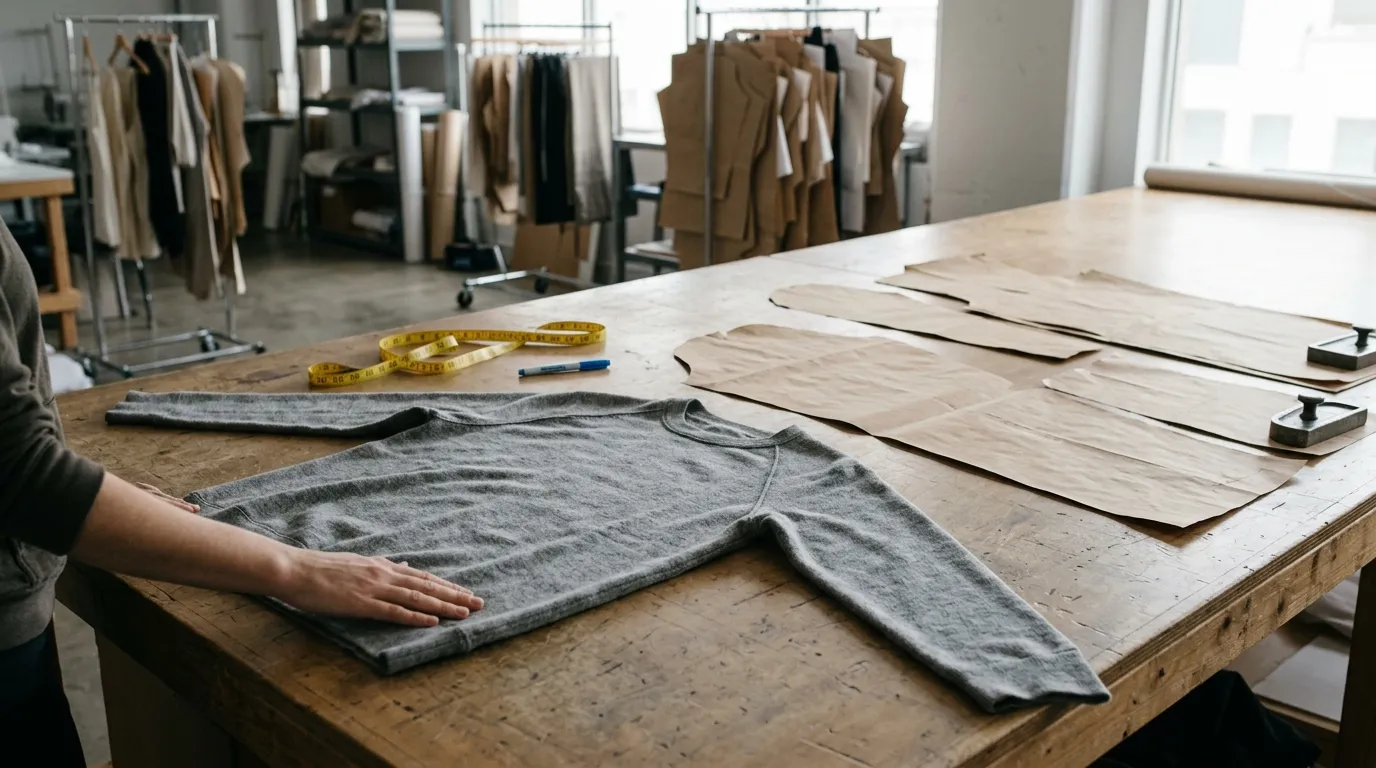
If you do not yet have a complete tech pack, filter for development support first — pattern making, fit revisions and sample iterations — before you compare unit price.
A tech pack is the document that specifies a garment's measurements, materials, construction and finishes. MFG Merch reports that Lefty Production Co. was founded in 2012, is based in Los Angeles and is described as handling development through production. Arcus Apparel Group lists development studios as a distinct production path alongside factories, which matters when a design still needs engineering work. Minghang Garments covers product development, pattern making and sampling, with sampling stated at 7–15 working days. If your product is still taking shape, read start clothing brand with manufacturer before you request prices.
Sampling and Bulk Timelines — What to Get in Writing
Ask each supplier to state the sampling time, the bulk time and the event that starts each clock — pattern approval, fabric arrival or deposit.
Minghang Garments states sampling of 7–15 working days and bulk production of 25–45 days. Arcus Apparel Group's 2025 guide advises buyers to confirm current lead times for the specific product rather than assuming published figures hold for a particular order.
- Ask for the sampling lead time in working days and what starts it — pattern sign-off, artwork approval or deposit.
- Ask for the bulk lead time in working days and what starts it — pre-production sample approval, fabric arrival or deposit.
- Confirm who approves the pre-production sample and how long that review is expected to take on your side.
- Ask what happens to the schedule if a fabric or trim arrives late.
- Keep all four answers in one email thread so the terms are in writing before you pay anything.
Quality Control Questions That Reveal How a Factory Works
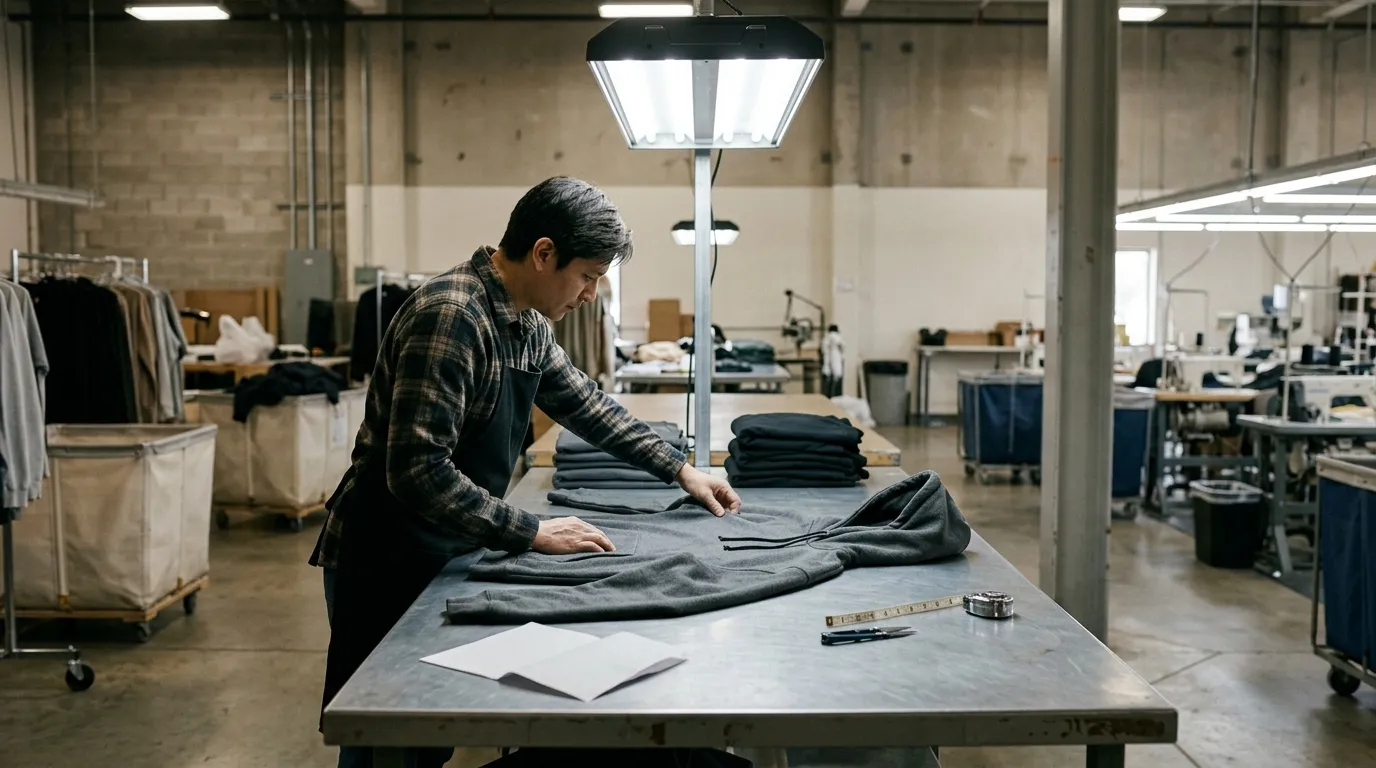
Ask who inspects, at which stages, and what happens to a failed batch — the answers tell you more than the number of checks a supplier advertises.
Minghang Garments describes a 5+1 QC system, which is one example of a supplier naming its inspection structure. Arcus Apparel Group's guide advises buyers to look for red flags and to confirm capability for the specific product. Keep the answers below in the same written confirmation as your commercial terms.
- Are checks done inline during sewing, at end line, or both?
- What written criteria or inspection standard is used?
- Who pays for rework or replacement if a batch fails?
- Do rejected units ship, and who decides?
- Is there photo or inspection-report evidence at each stage?
Domestic vs Overseas Production for a Small Brand
Domestic suppliers usually shorten shipping and travel time, while overseas production typically widens material and cost options but adds freight, sampling distance and communication planning.
The Clever Business's list of USA clothing manufacturers for startups and small businesses names 16 US manufacturers, including Lefty Production Co., Affix Apparel and Seam Apparel. MFG Merch's guide is also framed around US manufacturers. Arcus Apparel Group includes the direct overseas factory model as one of several production paths, so geography is a trade-off rather than a default answer.
| Factor | Domestic production | Overseas production | Confirm in writing |
|---|---|---|---|
| Sample review | Samples can often be reviewed in person | Samples travel further before approval | Courier cost and who pays it |
| Freight and duties | Usually domestic shipping only | Freight and import duties apply | Who handles customs paperwork |
| Material access | Limited to local mill availability | Broader fabric and trim options | Whether fabric is stock or made to order |
| Travel and in-person review | Factory visits are practical | Visits need planning | Whether remote sample approval is accepted |
| Communication | Same or near time zone | Time-zone gap affects reply speed | Named contact and expected reply window |
What to Send When You Request a Quote
Send a brief that states product type, target quantity per style and color, fabric preference, size range, decoration, packaging and required delivery month.
Arcus Apparel Group advises confirming current MOQs, lead times and capabilities for the specific product before committing, which only works if your first message contains those specifics. MFG Merch separates service models, so name the one you want: full-package, CMT or decoration-only. A short, complete brief gets a usable quote; a vague one gets a price range that means nothing.
- Product type and category, such as a sports bra, hoodie or jogger.
- Quantity per style and per color, with a note on whether the fabric is stock or custom.
- Fabric and trim preferences, or a request for recommended options.
- Size range and grading requirements.
- Printing, embroidery or garment washing, with artwork or references.
- Labels and packaging requirements.
- Target sampling date and target delivery window.
- Reference images, an existing sample or a sketch.
[PHOTO: A one-page quote request template showing the eight fields above laid out as a single brief]
Manufacturers Named Across Multiple Supplier Lists (Neutral Reference)
Two companies appear in more than one of the published supplier lists named on this page, and the details below are what those sources state — this is a reference, not an endorsement or an order of merit.
| Company | What the published source states | Named in | Source |
|---|---|---|---|
| Lefty Production Co. | Reported as founded in 2012, based in Los Angeles, and described as handling development through production | MFG Merch; The Clever Business | MFG Merch's 2026 US manufacturer guide; The Clever Business's USA manufacturer list |
| Affix Apparel | Reported minimums of 50 pieces per design for many services | TRUiC; The Clever Business | TRUiC's startup manufacturer list; The Clever Business's USA manufacturer list |
Companies named on only one list are left out, and nothing here is ordered by preference. Minimums, lead times and capabilities change, so confirm any figure directly with the supplier before you plan around it.
How to Verify Supplier Claims Before You Commit
Treat directory listings and supplier pages as source-reported claims until you confirm them in writing for your own product and quantity.
Arcus Apparel Group advises confirming current MOQs, lead times and capabilities per product before relying on them, and MFG Merch's own minimum of roughly 12 pieces depending on service is self-reported. Both points support the same habit: verify rather than assume.
- The MOQ written out with its basis — per style, per color and fabric condition.
- The payment schedule and deposit share, plus what triggers the next payment.
- Who owns the pattern, the tech pack and any physical sample.
- How many sample revisions are included and what extra ones cost.
- The tolerance on the quantity delivered against the quantity ordered.
- A named contact and the expected response window.
Frequently Asked Questions About Choosing a Clothing Manufacturer
How do I find the best clothing manufacturer for my brand?
Set your product, quantity and fabric condition first, then shortlist only suppliers whose stated MOQ basis, sampling time and category experience match those specifics. Confirm every figure in writing before comparing price, because an unmatched minimum or timeline makes any price comparison misleading.
Are there small-batch clothing manufacturers in the USA?
Yes. The Clever Business's USA manufacturer list names suppliers including Lefty Production Co., Affix Apparel and Seam Apparel. Those details are source-reported, so treat the names as research starting points and verify current minimums, timelines and capabilities directly with each supplier before you commit.
Where do small businesses get their clothes made?
Small brands usually choose one of several models: full-package cut-and-sew, CMT, a development studio, a small-batch factory, print-on-demand, or a direct overseas factory. The right choice depends on whether you need design support, very low minimums, or faster sample review and shipping.
Does a lower MOQ always mean a better manufacturer?
No. A low minimum with no stated fabric condition, an unclear sampling time and vague quality-control responsibility is not a comparable offer. Judge the whole term set — minimum basis, timeline triggers, inspection structure and written commercial terms — rather than the single lowest number.
If your product brief is ready, see why us for how Minghang Garments works, or send your style, quantity and fabric preference for a fit check against its stated terms: MOQ from 100 pcs per color per style on stock fabric, sampling of 7–15 working days and bulk production of 25–45 days.
-
Share
-

-

-