 Contact Us
Table of Contents

Contact Us
Updated 1 week ago
From Idea to Launch: How to Start a Clothing Brand With a Manufacturer

Minghang Garments
Minghang Garments is a custom apparel manufacturer specializing in activewear, streetwear and private-label clothing development. Our team supports brands through fabric sourcing, product development, sampling, bulk production and quality control, with OEM and ODM solutions for startups, growing labels and established apparel businesses.
Starting a clothing brand involves much more than creating a logo and choosing a few products.
Before a collection can reach customers, each garment has to move through a series of development and production decisions — from defining the product and selecting materials to sampling, costing, bulk production, quality control, and delivery.
For first-time founders, this process can feel complicated because many of these decisions are connected.
Changing the fabric may affect the fit. Changing the quantity may affect the available material options. A late sample revision can also push back production and ultimately delay the planned launch date.
The process becomes much easier when each stage is handled in the right order.
This guide explains how to take a clothing product from an initial idea to production with a manufacturer, what information you should prepare at each stage, and which decisions should be confirmed before moving forward.
1. Define the Product Before Looking for a Manufacturer
Before contacting factories, start by defining what you actually want to make.
You do not need to have every technical detail finalized, but the product direction should be clear enough for a manufacturer to understand the project.
At minimum, try to define:
- Product category
- Target customer
- Intended fit and silhouette
- Main fabric direction
- Key design features
- Branding requirements
- Approximate retail positioning
- Estimated order quantity
- Target launch date
For example, “I want to start an activewear brand” is still too broad.
A more useful starting point might be:
“I want to launch a women’s activewear collection with high-waisted leggings, medium-support sports bras, and fitted jackets. I am looking for soft, high-stretch fabrics with good recovery, starting with approximately 100–200 pieces per color per style.”
That gives a manufacturer a much clearer picture of the product and commercial requirements.
Start With a Focused First Collection
New brands often try to launch too many styles at once.
This can make sampling, fabric sourcing, costing, and inventory planning much harder to manage.
A smaller initial collection allows you to focus more carefully on:
- Fit
- Fabric quality
- Branding
- Product consistency
- Customer feedback
- Inventory risk
Once the first products are validated, additional colors, styles, or categories can be developed more efficiently.
For a first collection, product clarity is usually more valuable than product quantity.
2. Choose the Right Type of Clothing Manufacturer
Not every clothing manufacturer is suitable for every brand.
A factory may have strong production capacity but limited experience with your product category. Another supplier may be good at small-batch development but less suitable for larger or more technically complex orders.
For a startup, the most important question is not simply:
“Are you a factory or a trading company?”
It is whether the supplier can realistically support the type of product you want to develop.
When evaluating a manufacturer, look at factors such as:
- Product category experience
- Sampling and development capability
- Fabric sourcing ability
- Pattern making and fit support
- Available decoration techniques
- MOQ
- Production capacity
- Quality control process
- Lead times
- Communication efficiency
- Experience with custom labels and packaging
- Ability to scale if your order volume grows
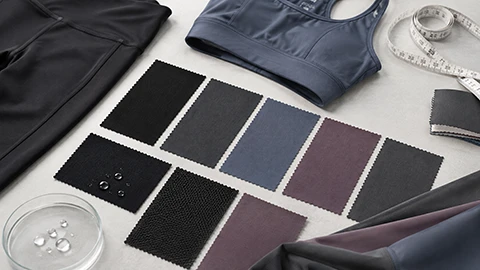
A manufacturer that regularly produces activewear, for example, is more likely to understand issues such as stretch recovery, compression, opacity, flatlock seams, and performance fabrics.
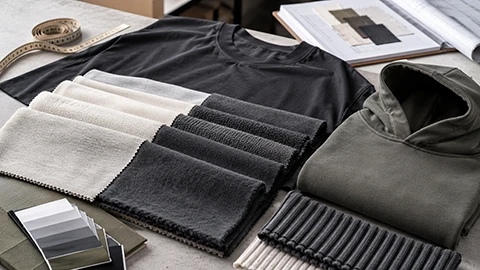
A streetwear manufacturer may have stronger experience with heavyweight fabrics, garment washing, embroidery, oversized fits, and specialty decoration techniques. clothing manufacturer MOQ
Product Development Capability Matters for New Brands
For established brands with complete tech packs and tested products, manufacturing may be relatively straightforward.
Startups often need more support.
You may still be deciding between fabrics, adjusting the fit, refining measurements, or choosing the right decoration method.
In this situation, a manufacturer with a strong sample development team can be more valuable than one that only focuses on bulk production.
Look for a supplier that can help review:
- Product feasibility
- Fabric options
- Construction details
- Measurements
- Artwork application
- Sample revisions
- Production risks
The manufacturer should be able to explain why a certain approach is recommended rather than simply agreeing to every request.
MOQ Should Match Your Stage of Growth
MOQ is another important consideration when choosing a manufacturing partner.
A factory designed primarily for very large production runs may not be suitable for a startup testing its first collection.
At the same time, extremely low MOQs can limit fabric choices, custom colors, trims, and production efficiency.
The best fit is usually a manufacturer whose MOQ allows you to test the market while still producing the product to the standard you need.
For Minghang Garments, regular activewear and streetwear programs generally start from 100 pieces per color per style, while custom-developed or custom-dyed fabrics usually require 300–500 pieces per color. Seamless products typically start from 500 pieces per color, per size, per style.
3. Prepare Your Design Information
Once you have defined the product and found a suitable manufacturer, the next step is to organize the information needed for development. how to prepare design files for a clothing manufacturer
You do not always need a complete tech pack before starting, but the manufacturer should have enough information to understand what you want to make and which details are still open for discussion.
Useful development information may include:
- Product sketches or reference images
- Existing garment samples
- Intended fit and silhouette
- Basic measurements
- Fabric preferences
- Color requirements
- Logo or artwork files
- Print or embroidery details
- Labels and trims
- Packaging requirements
- Estimated quantity
- Target price range
- Launch timeline
The clearer this information is, the easier it becomes for the manufacturer to recommend materials, estimate costs, and prepare the first sample accurately.
Be Clear About What Each Reference Means
If you send several reference images, explain what you want to take from each one.
For example, you may want the fit from one garment, the fabric texture from another, and the wash effect from a third.
Without that context, the development team may interpret the references differently from what you intended.
A simple annotated PDF, sketch, or development sheet is often enough to make the direction much clearer.
You Can Still Start Without a Complete Tech Pack
Many new brands begin development with only a few reference images, sketches, or an existing garment.
That is completely workable.
The goal is not to have every technical detail finalized before contacting a manufacturer. The goal is to give the development team enough information to identify what still needs to be confirmed before sampling begins.
4. Select and Confirm the Fabric
Fabric selection has a major impact on the final look, fit, comfort, performance, and cost of a garment.
A fabric that appears suitable in a photo may behave very differently once it is made into an actual product.
For this reason, fabric should be evaluated together with the intended fit, construction, wash process, and end use.
When discussing fabric with a manufacturer, useful information may include:
- Fiber composition
- GSM or fabric weight
- Knitted or woven structure
- Stretch and recovery
- Hand feel
- Thickness
- Drape
- Surface texture
- Shrinkage
- Colorfastness
- Pilling resistance
- Moisture management or other performance needs
- Garment wash or finishing requirements
The more clearly you describe the result you want, the easier it is for the manufacturer to recommend a suitable material.
Stock Fabric or Custom Fabric?
For smaller trial orders, available stock fabrics can often be the most practical option.
They usually allow brands to reduce development time and avoid higher fabric minimums.
Custom fabric development may be more suitable when the product requires a specific color, composition, weight, texture, performance level, or finish that cannot be achieved with available materials.
However, custom-developed or custom-dyed fabrics usually require higher minimum order quantities.
For this reason, fabric decisions should be made with both product requirements and order volume in mind.
Test the Fabric in the Actual Sample
A swatch is useful, but it does not always show how the material will perform in a finished garment.
Once the fabric is cut and sewn, its stretch, drape, recovery, shrinkage, and structure may affect the fit differently than expected.
For activewear, brands may need to evaluate:
- Opacity
- Compression
- Stretch recovery
- Moisture management
- Waistband stability
For streetwear, the focus may be more on:
- GSM
- Structure
- Hand feel
- Shrinkage
- Wash effect
- Shape retention
This is why fabric approval should happen together with sample evaluation whenever possible.
Confirm the Bulk Fabric Before Production
Before bulk production begins, make sure the approved fabric specification is clearly documented.
If the bulk fabric differs from the sample fabric, even small differences in weight, stretch, color, or finishing can affect the final garment.
For custom colors, washes, or fabric development, brands may also need to approve lab dips, strike-offs, or bulk fabric references before production.
5. Develop and Approve the Sample
Once the design direction, fabric, and key specifications are clear, the next step is to develop the first sample.
The first sample is used to evaluate whether the product works as intended before moving into bulk production.
It allows the brand and manufacturer to review important details such as:
- Fit and silhouette
- Measurements
- Fabric behavior
- Construction
- Print or embroidery placement
- Labels and trims
- Wash or finishing effects
- Overall workmanship
The first sample does not always need to be perfect.
Its purpose is to identify what should be adjusted before production.
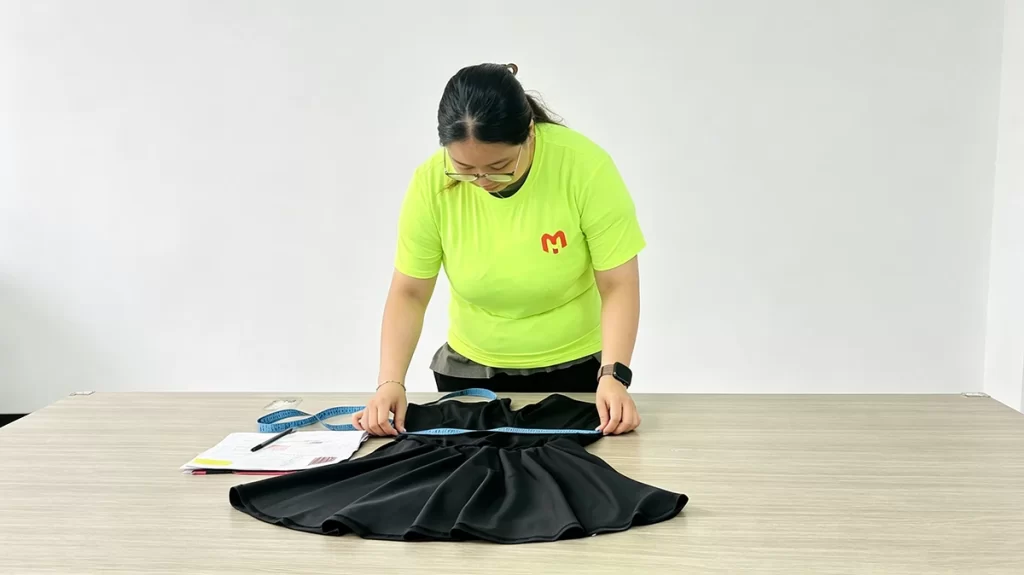
Review the Sample Systematically
When checking a sample, avoid relying only on the overall appearance.
It is better to review each important area separately.
For example:
Fit:
Does the garment match the intended silhouette?
Measurements:
Are the key dimensions within the required range?
Fabric:
Does the material have the right weight, stretch, recovery, drape, or structure?
Construction:
Are seams, panels, pockets, waistbands, collars, or other details built correctly?
Branding:
Are logos, embroidery, labels, and trims the right size and position?
Finishing:
Does the wash, dye, print, or surface treatment match the intended result?
This makes feedback much easier for the manufacturer to understand and apply.
Keep Sample Feedback Clear and Consolidated
One of the easiest ways to slow down development is to send sample comments in many separate messages.
Instead, collect the feedback into one clear revision list whenever possible.
Useful comments should be specific.
Instead of:
“The fit feels wrong.”
A clearer instruction would be:
“Reduce the body length by 2 cm and increase the sleeve width by 1.5 cm while keeping the shoulder width unchanged.”
Specific comments reduce interpretation and make the next sample round more accurate.
Approve the Final Sample Before Bulk Production
Before moving into production, the final approved sample should represent the standard that the factory is expected to follow.
At this stage, important details should already be confirmed, including:
- Final measurements
- Fabric
- Color
- Construction
- Artwork size and placement
- Labels and trims
- Wash or finishing standard
- Packaging requirements
If the product includes multiple sizes, size grading should also be reviewed before bulk production.
The goal is to make sure both the brand and manufacturer are working from the same approved reference.
6. Confirm MOQ, Cost and Production Details
Before bulk production begins, the product specification and commercial terms should be confirmed together.
A sample may already be approved, but production can still be delayed if details such as order quantity, color breakdown, packaging, payment terms, or delivery schedule remain unclear.
At this stage, brands should confirm:
- Final order quantity
- Quantity per style and color
- Size breakdown
- Fabric specification
- Final unit price
- Printing or embroidery details
- Labels and trims
- Packaging requirements
- Production lead time
- Payment terms
- Shipping method
- Required delivery date
The goal is to make sure both sides are working from the same final production plan.
MOQ Can Change Depending on the Product
MOQ is not always determined by the garment alone. MOQ Guide
Fabric, dyeing, trims, printing, and other customization requirements can all affect the minimum practical quantity.
For example, a style using an available stock fabric may support a lower starting quantity than a project requiring custom fabric development or a custom-dyed color.
This is why MOQ should be confirmed after the main product specifications are clear.
For Minghang Garments, regular activewear and streetwear programs generally start from 100 pieces per color per style. Custom-developed or custom-dyed fabrics typically require around 300–500 pieces per color, while seamless products generally start from 500 pieces per color, per size, per style.
Confirm the Final Price After Key Specifications Are Approved
Early quotations are useful during development, but the final production price should reflect the approved product.
Changes to fabric, garment weight, printing, embroidery, washing, trims, labels, packaging, or order quantity may affect the final cost.
Before placing the bulk order, make sure the quotation clearly reflects what has been approved.
A useful final quotation should make it clear what is included and whether any items are still estimated separately.
Confirm the Production Timeline Before Placing the Order
Production lead time should be discussed together with the required delivery date.
A typical schedule may include time for:
- Fabric preparation
- Trims and accessories
- Cutting
- Sewing
- Printing or embroidery
- Washing or finishing
- Quality inspection
- Packing
- Shipping
If the collection has a fixed launch date, work backward from the required arrival date rather than only from the factory completion date.
Shipping time, customs clearance, and possible revision delays should all be considered when planning the launch.
7. Move Into Bulk Production and Quality Control
Once the final sample, fabric, measurements, branding, and order details are approved, the project can move into bulk production.
At this stage, the goal is no longer to develop the product.
The goal is to reproduce the approved standard consistently across the entire order.
That requires control at multiple production stages, including:
- Fabric inspection
- Cutting
- Sewing
- Printing or embroidery
- Washing or finishing
- Measurement checks
- Final inspection
- Packing
A good bulk production process should identify problems as early as possible rather than waiting until the garments are finished.
Sample Approval Does Not Eliminate Production Risk
An approved sample provides the production team with a clear reference, but bulk production introduces additional variables.
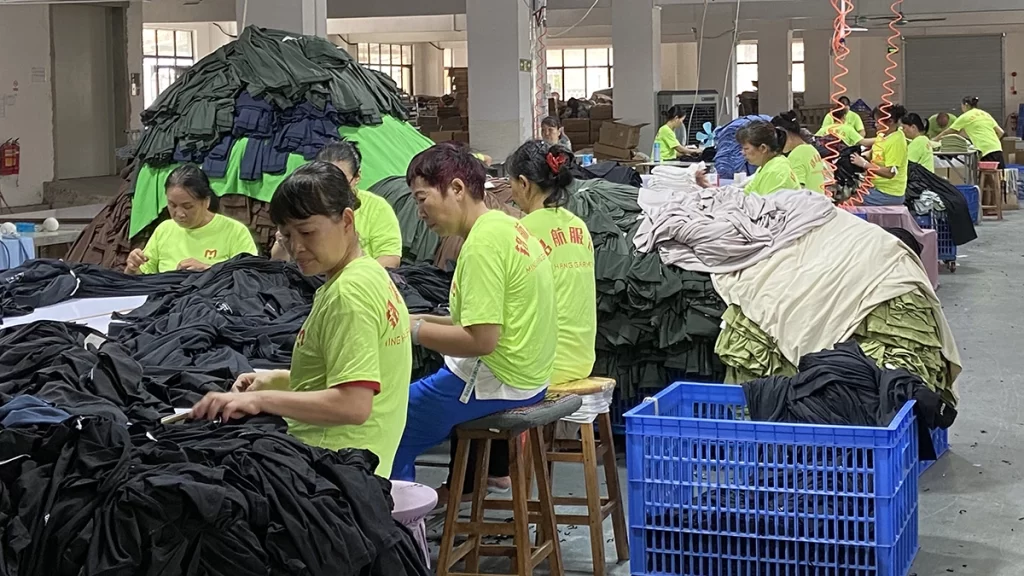
Fabric may come from a larger production lot. Multiple operators may work on the same style. Cutting, sewing, decoration, and finishing all need to remain consistent across hundreds or thousands of pieces.
For this reason, quality control should happen throughout production.
For example, cut panels can be checked before sewing, construction can be inspected during sewing, and finished garments can be reviewed for measurements, workmanship, appearance, and packaging before shipment.
Use an Approved Standard Throughout Production
Before production starts, the factory should have access to the final approved references, which may include:
- Approved sample
- Measurement chart
- Fabric specification
- Color standard
- Artwork files
- Label and trim details
- Packaging instructions
- Inspection requirements
If any of these details change during production, they should be documented clearly.
This helps reduce inconsistencies caused by outdated files or conflicting instructions.
Final Inspection Should Confirm the Product Before Shipment
Final inspection is the last opportunity to identify quality issues before the order leaves the factory.
Depending on the product and inspection standard, this may include checks for:
- Measurements
- Sewing workmanship
- Fabric defects
- Print or embroidery quality
- Color consistency
- Labels and trims
- Finishing
- Packaging
- Quantity
At Minghang Garments, our 5+1 quality control system covers raw materials, cut panels, inline sewing, craftsmanship and finishing, end-of-line inspection, and third-party AQL inspection when required.
The purpose is to control quality throughout the manufacturing process rather than relying only on the final inspection.
8. Plan Shipping Around Your Launch Date
Finishing production does not mean the products are immediately ready to sell.
Shipping, customs clearance, warehousing, and final distribution all need to be considered when planning a collection launch.
If your launch date is fixed, work backward from the date the products need to arrive rather than only from the factory completion date.
Important timing factors may include:
- Final inspection
- Packing
- Export documentation
- Freight booking
- Air or sea transit time
- Customs clearance
- Local delivery
- Warehouse receiving
- Product photography or campaign preparation
For international orders, these steps can add significant time after production is complete.
Build Extra Time Into the Schedule
Unexpected delays can happen during product development, manufacturing, or shipping.
A sample may need an extra revision. Fabric preparation may take longer than expected. Freight schedules can also change.
For this reason, avoid planning a launch date too close to the estimated delivery date.
Building in some buffer time gives the brand more flexibility if something changes.
Choose the Shipping Method Based on Timing and Cost
Air freight is generally faster but more expensive, while sea freight usually offers a lower cost for larger shipments but requires more transit time.
The right option depends on:
- Order volume
- Product weight
- Launch deadline
- Budget
- Destination
- Inventory urgency
Some brands also use a combination of methods, such as shipping a smaller quantity by air for the launch while sending the remaining order by sea.
The shipping plan should be confirmed before production is completed so that freight arrangements do not become the final cause of delay.
How Long Does It Take to Start a Clothing Brand With a Manufacturer?
There is no single timeline that applies to every clothing brand.
The total development time depends on factors such as product complexity, fabric availability, number of sample revisions, custom trims, decoration methods, order quantity, and shipping method.
For a relatively straightforward project, the main stages usually include:
- Design review
- Fabric sourcing
- Sample development
- Sample revisions
- Final approval
- Material preparation
- Bulk production
- Quality inspection
- Packing
- Shipping
At Minghang Garments, sample development typically takes around 7–15 working days per round, depending on the product.
Many activewear samples can be developed in approximately 7–10 working days, while more complex streetwear styles may take around 12–15 working days.
After the sample and materials are approved, bulk production typically takes around 30–45 days.
However, these timelines should not simply be added together and treated as a guaranteed launch schedule.
What Can Make the Timeline Longer?
Several factors can extend development or production, including:
- Multiple sample revisions
- Custom fabric development
- Custom dyeing
- Specialty washing
- Complex embroidery or printing
- Custom hardware or trims
- Large size ranges
- Delayed approvals
- Material availability
- Shipping or customs delays
For example, developing a basic hoodie from an available fabric is usually faster than creating a custom-colored heavyweight fabric with garment washing, embroidery, custom hardware, and branded packaging.
Plan From the Required Delivery Date
Instead of asking only:
“How quickly can the factory make the order?”
Start with the date you actually need the products to arrive.
Then work backward through shipping, packing, quality inspection, production, sample approval, and development.
This gives the project a much more realistic timeline and helps identify which decisions need to be made first.
Final Thoughts
Starting a clothing brand with a manufacturer becomes much easier when the process is handled step by step.
You do not need to have every detail finalized from the beginning, but each stage should reduce uncertainty and move the product closer to a clear production standard.
A practical development path usually looks like this:
- Define the product
- Choose a suitable manufacturer
- Prepare design information
- Select and confirm fabrics
- Develop and approve samples
- Confirm MOQ, pricing, and production details
- Move into bulk production
- Complete quality control
- Plan shipping around the launch date
For new brands, the goal is not to rush through these stages.
The goal is to make the important decisions early enough that they do not become expensive problems later.
A clear product direction, realistic quantity, suitable manufacturing partner, and structured sample approval process can make the transition from idea to launch much more predictable.
Written by
Minghang Garments
Apparel Manufacturing Team
Minghang Garments is a custom apparel manufacturer specializing in activewear, streetwear and private-label clothing development. Our team supports brands through fabric sourcing, product development, sampling, bulk production and quality control, with OEM and ODM solutions for startups, growing labels and established apparel businesses.
-
Share
-

-

-