 Contact Us

Table of Contents

Contact Us
Updated 1 month ago
What Is the Best Activewear Manufacturer for Startup Brands?
arafatshuvo
The best activewear manufacturer for startup brands is not a single company — it is the one whose minimum order terms, development support and sampling timeline match your first collection. For most startups that means a partner offering low stock-fabric minimum order quantities (MOQs), pattern and sample help, and written timelines, not the lowest price or the longest client list.
Key takeaways
- "Best" for a startup means fit, not a ranking: MOQ basis, development support and timeline clarity decide whether a factory can take your first order at all.
- MOQ is normally quoted per style and per colour, and stock-fabric orders usually carry different terms from custom-developed fabric, dyeing or seamless programs.
- Minghang Garments publishes MOQ from 100 pcs per colour per style on stock fabric, sampling in 7–15 working days and bulk in 25–45 days after sample and material approval — one example of stated terms, not a recommendation.
- AuraeFit's own low-MOQ page states 5 pcs in its title, 100 pieces per style in its body and 10 in its FAQ, which is exactly why every figure needs written confirmation.
- Published buyer lists repeat the same manufacturer names, but those pages rarely verify founding dates or headquarters — treat them as leads, not proof.
What Makes an Activewear Manufacturer Suitable for a Startup?
A suitable startup partner is one whose order minimums, development support, sampling process and communication match your first collection — not the one with the largest capacity or the loudest marketing. Capacity you cannot use is not an advantage when you are ordering a few hundred pieces.
Startup suitability comes down to seven things you can check before you send a single enquiry. Score each candidate on all seven rather than on price alone, because a quote built on different assumptions is not a comparison.
| Criterion | What to confirm | Why it matters at startup stage | How to verify |
|---|---|---|---|
| MOQ basis | The style, colour and fabric the minimum applies to | A headline number can shrink or multiply once colourways and custom fabric enter | Ask for the minimum in writing against your exact style and colour count |
| Development support | Whether pattern making, fabric and trim sourcing are offered | Startups rarely arrive with a complete tech pack | Ask which development services are included and which are charged |
| Sampling process | Sample lead time and how many revision rounds are allowed | First samples rarely pass unchanged | Ask for the sample timeline and revision policy before paying |
| Activewear construction capability | Experience with stretch fabrics, waistbands and sports bra construction | General cut-and-sew experience does not transfer to stretch garments | Ask what activewear categories the factory produces regularly |
| Timeline and approval points | The event each lead time starts from | A lead time without a start date cannot be planned against | Ask what approvals trigger the sampling and bulk clocks |
| Quality control stages | How many inspection stages exist and what is checked | Stage counts alone say nothing about defect handling | Ask for the inspection points and the defect classification |
| Communication and documentation | Written specs, confirmations and change handling | Verbal agreements disappear when a colour or fabric changes | Ask for confirmations in writing from the start |
What Does Low MOQ Actually Mean for a Startup Brand?
A minimum order quantity is the smallest order a factory will accept for a defined style, colour and fabric combination. That definition matters because the same factory can be genuinely low-MOQ on stock fabric and high-MOQ on custom-developed fabric, so the phrase "low MOQ" on its own tells you very little.
Published figures are often inconsistent. AuraeFit's low-MOQ page states 5 pcs in its title, "100 pieces per style" in its body copy and a typical starting point of 10 in its FAQ — three different numbers on one page. That is not unusual in this market, and it is the reason the number you plan around should be the one the factory confirms in writing for your specific style.
Minghang Garments states that regular activewear, yoga and streetwear styles start from 100 pcs per colour per style, and separately states different MOQ conditions for custom-developed fabrics and dyeing, and for seamless products. A startup ordering three colourways of one legging style should therefore expect the minimum to be assessed per colour, not per total order.
Does MOQ Apply per Style, Colour, Size or Fabric?
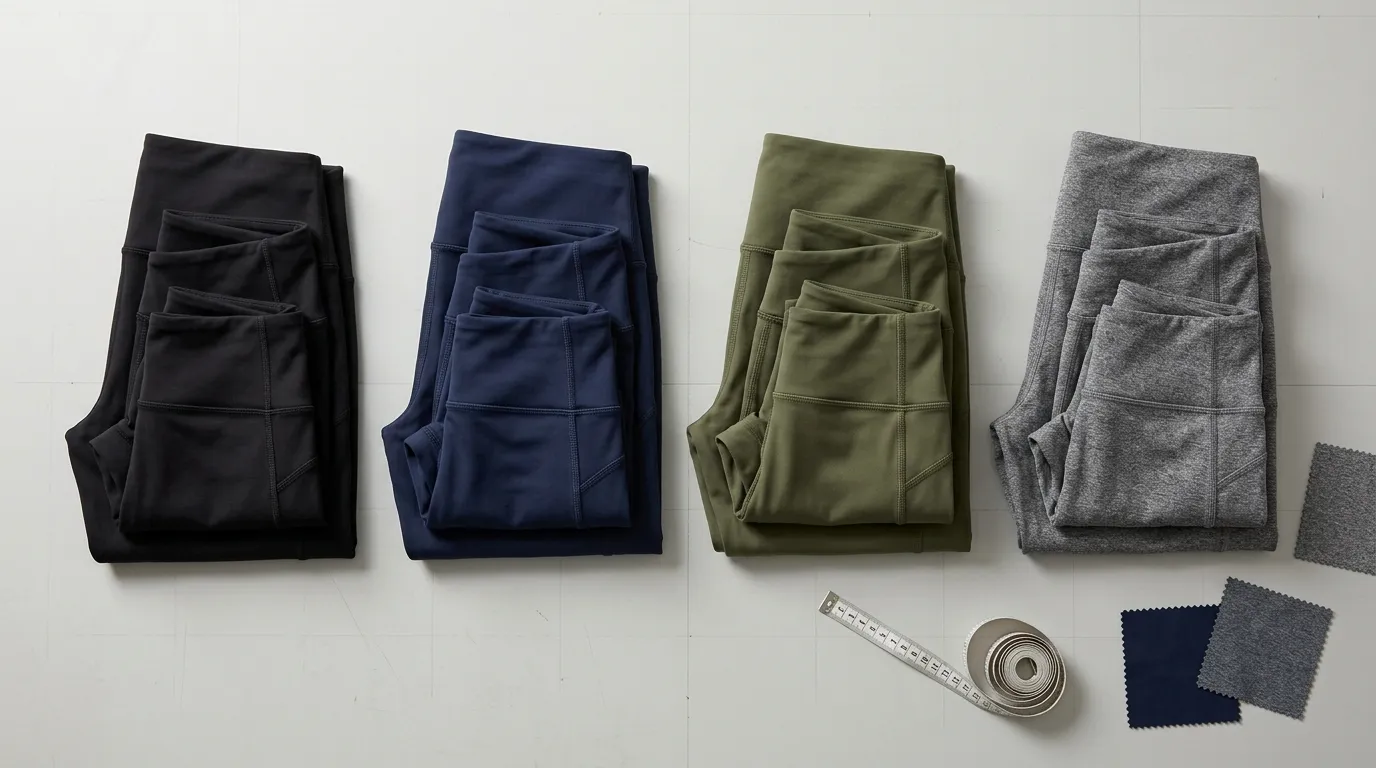
MOQ is usually applied per style and per colour, with your size ratio sitting inside that colour quantity, while the fabric choice — stock versus custom-developed — changes the minimum itself. Ask which basis applies before you convert a launch plan into a purchase order.
| MOQ basis | Question to ask | Why the answer changes your order |
|---|---|---|
| Per style | Is the minimum counted per style or per order? | Two styles may mean two minimums, not one |
| Per colour | Does each colourway carry its own minimum? | A five-colour capsule can multiply your first order five times |
| Size ratio within the colour | How freely can sizes be split inside one colour? | A wide size run may not fit inside a single-colour minimum |
| Stock fabric | Which fabrics count as stock for minimum purposes? | Stock fabric is usually the route to the lowest starting quantity |
| Custom-developed or dyed fabric | Does developing or dyeing fabric raise the minimum? | Minghang Garments states separate MOQ conditions for custom-developed fabrics and dyeing |
| Seamless or bonded construction | Does the construction method change the minimum? | Minghang Garments states separate MOQ conditions for seamless products |
Do not accept a headline MOQ figure without the basis it applies to. Ask for it in writing, next to your style, colour count and fabric choice, before you plan a launch quantity around it. If you are working through the arithmetic for the first time, this moq guide covers how the basis changes the order you actually place.
OEM, ODM or Private Label — Which Model Fits Your Stage?
OEM suits brands that already have patterns and tech packs; ODM suits brands that need the factory to develop the design; private label suits brands that want existing styles finished with their own branding. Choosing the model first narrows the factory list quickly, because not every manufacturer offers all three.
| Model | Who designs | What you must supply | Best fit at which stage | What to confirm in writing |
|---|---|---|---|---|
| OEM (original equipment manufacturing) | You | Patterns, tech pack, size spec, fabric direction | You already have developed product | Who owns the pattern and what development is charged |
| ODM (original design manufacturing) | The factory, adapted to your brand | Brand direction, target fit and price position | You need product developed for you | How much design change is included before the style is fixed |
| Private label | The factory's existing styles | Branding, labels and packaging decisions | You want speed and a proven base style | Whether the style can be modified, and how much |
| Hybrid (ODM base plus OEM branding) | Shared | A base style plus your branding and fit notes | You want a developed base with your own identity | Which parts are fixed and which are changeable |
According to Minghang Garments' homepage, the company provides OEM/ODM and private-label manufacturing covering product development, fabric sourcing, sampling and bulk production, so all three routes are handled in one place. If the differences are still unclear, oem vs odm sets them out side by side.
What Development and Sampling Support Should a Startup Expect?
Expect pattern making, fabric and trim sourcing, a first sample round and at least one revision round — and ask how many sample iterations are included before bulk production starts. Development support is where startups lose the most time, because an unfinished tech pack turns into repeated sample rounds.
Minghang Garments states that sampling typically takes 7–15 working days and bulk production generally takes 25–45 days after sample and material approval. Both numbers are conditional: they describe the factory's side of the work, not the time you spend reviewing and approving. Lefty Production Co.'s activewear service page, by contrast, describes its product categories and services but gives little concrete startup MOQ or timing detail — a reminder to ask directly rather than infer from a service page.
What to Compare in a Sample: Fit, Fabric, Construction and Branding
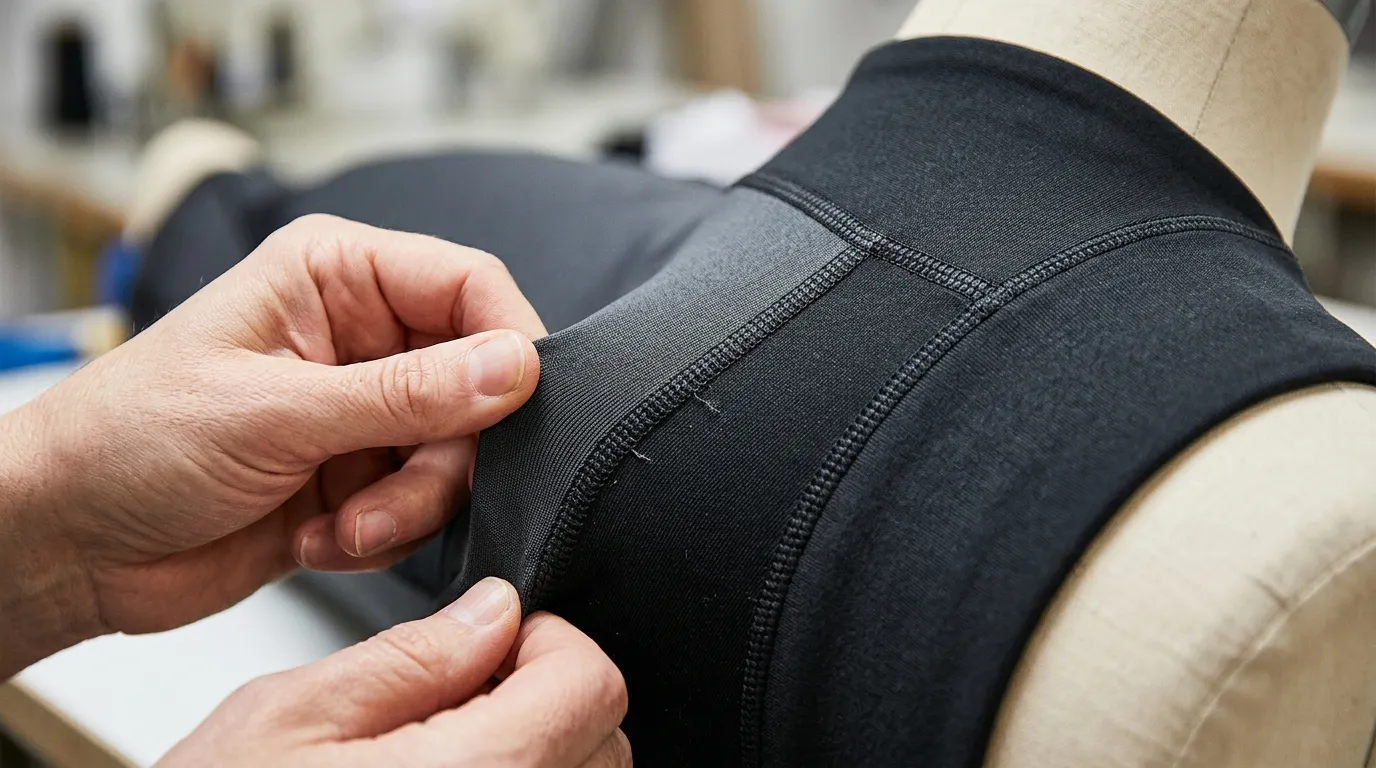
Judge a sample on four separate axes — fit against your size spec, fabric behaviour under stretch and wash, construction quality at seams and waistbands, and branding placement — and record each as pass or revise. Reviewing a sample as a single "good or bad" impression is how problems reach bulk.
[DIAGRAM: Sample review card with four axes — fit, fabric, construction, branding — and a pass/revise column for each.]
- Fit: measure against your size spec rather than trying the garment on once.
- Fabric: check recovery after stretching, and opacity where relevant to the garment and activity.
- Construction: inspect seams, waistbands, gussets and liners under tension, not flat.
- Branding: confirm print, embroidery, label and tag placement against the approved artwork.
- Packing: check folding, polybag and size labelling if these are part of your order.
Activewear-Specific Capability: Fabric, Fit and Construction
Activewear capability shows up in how a factory handles stretch, recovery, opacity where relevant, fit, compression, seam construction and the demands of the specific activity the garment is worn for. A factory that sews cotton T-shirts well may still struggle with a high-stretch legging.
Minghang Garments describes development around exactly those variables — stretch, recovery, opacity where relevant, fit, compression, seam construction and activity requirements — on its custom activewear manufacturer page. When you compare suppliers, ask which activewear categories they produce regularly and which construction methods they run in-house, rather than assuming a general apparel background covers sports bras and leggings.
Production Timeline and the Approvals That Affect It
A bulk timeline is only meaningful next to the approval it starts from — sample approval and material approval are usually the two dates that reset the clock. Ask for the start event as well as the duration, and build your launch date backwards from the later of the two.
| Stage | What Minghang Garments states | Condition attached |
|---|---|---|
| Sampling | 7–15 working days | Stated as typical |
| Bulk production | 25–45 days | Stated as generally applying after sample and material approval |
If a supplier gives you a lead time with no start event, treat it as unfinished information and ask again. Shipping, customs and your own approval turnaround sit outside these figures and need to be added separately to your launch plan.
Quality Control Questions to Ask Before You Commit
Ask how many inspection stages exist, who inspects, what is checked at each stage, how defects are classified, and what happens when a shipment fails — a stage count on its own proves nothing. The useful answer describes decisions, not slogans.
Minghang Garments states a 5+1 quality-control system, which is one example of a factory publishing its inspection structure rather than a standard you should assume applies elsewhere. Do not treat any certification, test report or quality-control stage count as verified unless the factory supplies current documentation naming your product and the standard it was tested against. For a first order, the more practical question is what happens when something is wrong: who is notified, within what period, and at whose cost.
How to Shortlist and Brief an Activewear Manufacturer
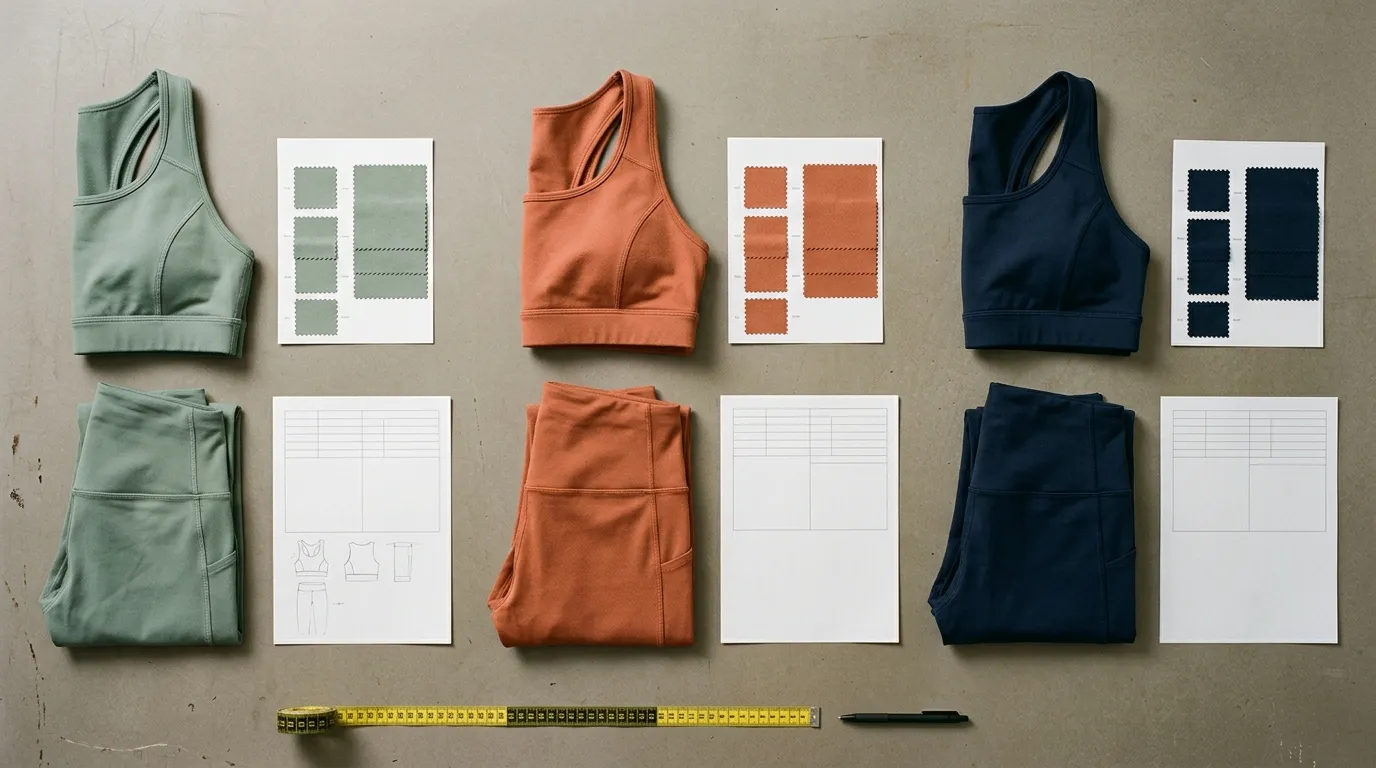
Shortlist three to five factories that pass the fit criteria, send the same written brief to each, and score the replies on completeness rather than enthusiasm. Comparing replies to one identical brief is the only way to know whether the quotes describe the same product.
What to Include in Your RFQ
A request for quotation (RFQ) is the written brief you send to shortlisted factories so their quotes cover identical ground. Include the following, in this order:
- Style and product description, including garment type and intended activity.
- Target quantity, broken into colourways and size split.
- Fabric preference, or a clear statement that stock fabric is open for suggestion.
- Branding needs: print, embroidery, labels, tags and packaging.
- A reference sample or tech pack, even if incomplete.
- Required sample and bulk dates, with the launch event you are working towards.
- A written request for MOQ basis, timeline conditions and quality-control stages.
[DIAGRAM: Decision flow from order profile — quantity, colours, fabric, branding — through the seven criteria to a shortlist of three to five factories.]
Common Supplier-Selection Mistakes
Most first-order problems trace back to a small set of avoidable decisions:
- Choosing on headline MOQ alone, without the basis it applies to.
- Accepting a lead time that has no start date.
- Skipping the sample revision round to save time.
- Never asking who owns the pattern and the tech pack.
- Leaving branding and packing out of the first quote, then discovering the cost later.
- Comparing quotes that were built on different specs, fabrics or quantities.
Manufacturers Named Across Startup Buyer Lists
The same few names recur across published buyer lists; the table below records where each was named and what that source said, with no ranking and no endorsement. The retrieved sources do not adequately verify founding dates, headquarters or certifications for these companies, so use the names as starting points for your own checks.
| Company | Named on | What the source says |
|---|---|---|
| Appareify | Wearzio's top-10 sportswear manufacturers guide, Sansan Sports' custom gym clothing manufacturers article and the LinkedIn article on private-label activewear manufacturers | Wearzio describes Appareify as serving startups that need fast turnarounds and low-volume orders |
| Alanic Global | Wearzio's top-10 sportswear manufacturers guide, Nofal Apparel's fitness clothing manufacturers list, Sansan Sports' custom gym clothing manufacturers article and the LinkedIn article on private-label activewear manufacturers | Appears in the comparison and manufacturer lists on those pages |
| Royal Apparel | Wearzio's top-10 sportswear manufacturers guide and the LinkedIn article on private-label activewear manufacturers | Appears in the manufacturer lists on those pages |
Other names appear on single lists only, including Dongguan Sansansun Sports Co., Ltd., Lefty Production Co. and White2Label in Sansan Sports' comparison table, and Iconic Apparel House, Active Apparel Group, Affix Apparel, Billoomi Fashion, Zega Apparel, Steve Apparel and Tack Apparel in the LinkedIn article. A name appearing on a list is not evidence of quality, and no company in this table is being ranked or recommended.
[PHOTO: A first sample of an activewear garment laid flat next to its size spec sheet, with measurement points marked.]
How Minghang Garments Fits as One Example
Minghang Garments is one manufacturer that publishes its startup-relevant terms, so it can be used to test the criteria above rather than as a verdict on the question. Based in Dongguan, China and operating since 2017, it runs a 12,000 m² production floor and a 2,000 m² sample centre with up to 500,000 pcs/month capacity.
According to Minghang Garments' homepage, the company states MOQ from 100 pcs per colour per style on stock fabric, sampling of 7–15 working days, bulk production of 25–45 days and a 5+1 quality-control system. Read those figures the way this article recommends reading any supplier's: as published terms to check against your own style, colour count and fabric choice, not as an answer for every startup. If your first order fits stock-fabric terms, you can check Minghang Garments' published MOQ, sampling and bulk timelines against your tech pack before deciding — and if you are still planning the launch itself, start clothing brand with manufacturer covers that earlier stage.
[DIAGRAM: MOQ anatomy showing one style divided into style, colour, size ratio and fabric layers, with the minimum attached to each layer.]
Frequently Asked Questions
How do I compare domestic and overseas activewear manufacturers?
Compare on total landed cost and communication cycle rather than unit price. Look at MOQ basis, sample iteration speed, time-zone overlap, shipping and duty, and who handles fabric sourcing. A lower unit price with a longer approval loop can cost more time than a nearby supplier charging slightly more.
What should I ask about printing, embroidery, labels and packaging?
Ask which decoration methods the factory runs in-house, the minimum quantity per decoration type, artwork file requirements, label and tag sourcing, and whether packing is quoted on the same MOQ basis as the garment. Branding and packing are frequently left out of the first quote and added later.
Who are the best clothing manufacturers for startups?
There is no single verified answer. Published lists name Appareify, Alanic Global and Royal Apparel repeatedly, along with many single-list names, but those pages rarely verify headquarters or founding details. Score each candidate against your own MOQ basis, development needs and timeline requirements instead of trusting a ranking.
-
Share
-

-

-