 Contact Us

Table of Contents

Contact Us
Updated 1 month ago
Yoga Pants vs. Leggings: Fabric, Fit, and Function Compared

Minghang Garments
Minghang Garments is a custom apparel manufacturer specializing in activewear, streetwear and private-label clothing development. Our team supports brands through fabric sourcing, product development, sampling, bulk production and quality control, with OEM and ODM solutions for startups, growing labels and established apparel businesses.
The Yoga Pants vs. Leggings distinction is often blurred because both products can use stretch fabric and a close-fitting silhouette. From a manufacturing perspective, however, the difference is more technical: yoga pants are usually engineered around mobility, coverage, and waistband stability, while leggings cover a wider range of activewear, athleisure, fashion, and layering applications.
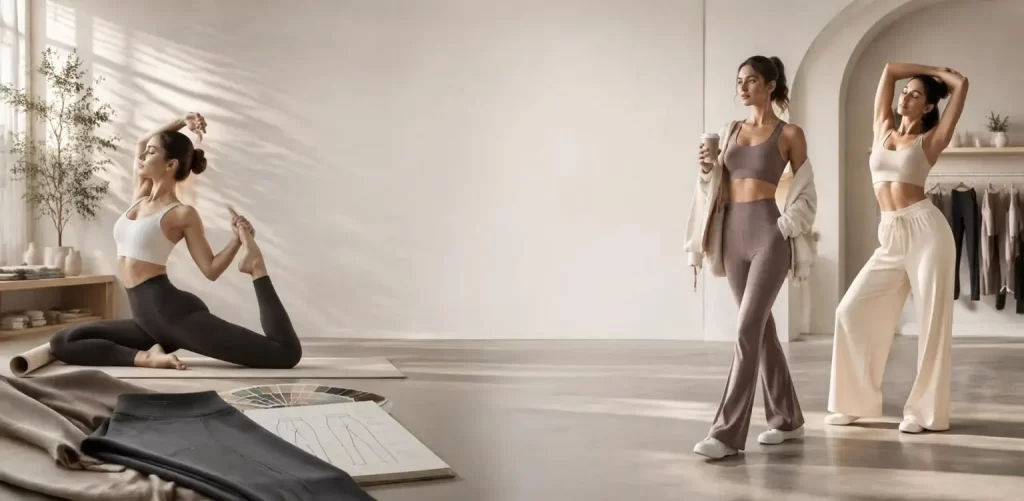
At Minghang Garments, we recommend defining the activity, target fit, fabric performance, and construction before assigning the product name. A fitted yoga pant and a performance legging may look almost identical, yet their pattern reduction, fabric recovery, seam placement, and wear requirements can be different.
Yoga Pants vs. Leggings at a Glance
Yoga pants are designed primarily for yoga, Pilates, stretching, studio training, and related movement. They can be fitted, straight-leg, bootcut, or flared.
Leggings are generally close-fitting and may be developed for workouts, running, casual wear, layering, or fashion. Their performance level varies considerably.
| Decision Factor | Yoga Pants | Leggings |
| Primary purpose | Yoga, Pilates, mobility, studio wear | Training, running, athleisure, fashion, layering |
| Common silhouettes | Fitted, straight, bootcut, flared | Usually fitted from hip to ankle |
| Fabric priority | Stretch, recovery, softness, coverage | Depends on the intended market |
| Waistband | Usually wide, stable, and supportive | Basic elastic or technical waistband |
| Construction | Gussets, flat seams, shaped panels | From simple seams to technical construction |
| Compression | Usually light to medium | None to high compression |
| Typical concern | Waist slippage or transparency in deep poses | Sagging, poor recovery, seam stress, or insufficient support |
The category names overlap. The correct Yoga Pants vs. Leggings decision should therefore be based on measurable specifications rather than appearance alone.
Activewear Fabric Choice: Beyond Fiber Content
There are various characteristics of fabrics such as stretch, recovery, moisture management, and coverage. Activewear usually consists of a combination of nylon and spandex, or polyester and spandex. Lifestyle leggings usually contain cotton-spandex.
Nylon-Spandex
Nylons have a smooth texture and are resistant to abrasion, therefore, they are suitable for yoga pants and leggings that have a body-contouring design.
Polyester-Spandex
Polyesters have excellent moisture management and retain color and printed designs well, making them suitable for training leggings and other activewear that is printed and dries quickly.
Cotton-Spandex
Cotton-rich fabric offers a familiar, natural hand feel but normally absorbs more moisture and dries more slowly. It is better suited to casual leggings than intensive workouts.
Fabric development should consider:
•Fiber composition and yarn characteristics
•Fabric weight and knitted density
•Two-way or four-way stretch
•Stretch recovery after repeated extension
•Moisture-wicking and drying performance
•Pilling and abrasion resistance
•Colorfastness after washing and perspiration
•Opacity at the garment's actual wearing extension
A higher GSM does not automatically make a garment squat-proof. Opacity also depends on knit density, yarn coverage, color, finishing, and pattern reduction. Similarly, a higher spandex percentage does not always create stronger compression; elastane power, fabric construction, and garment dimensions work together.
At Minghang Garments, fabric selection begins with the intended activity and target price position—not simply a fabric swatch that looks attractive.
Fit Engineering in Yoga Pants vs. Leggings
The fit of a garment is determined by several aspects including the shape of the pattern, the amount of negative ease, how the fabric recovers, and size grading. Having too much negative ease can result in transmissions, waistbands that roll down, and increased compression as well as distorted seam lines. Having too little negative ease can result in kneeling and sagging in the seating area.
Waistbands and Rise
A stabilized performance waistband should be able to maintain its position during bending and moving without cutting in.
Other factors include:
•Positioning of high-rise, mid-rise, or low-rise
•Finished waistband height
•Double-layer fabric or enclosed elastic
•Straight or contoured waistband shape
•Internal support or a drawcord
•Waist-to-hip grading across the size range
Gussets, Seams and Leg Shape
A crotch gusset adds more mobility to the design and helps distribute seam stress. For cost saving, flatlock seams can be used, but an overlock seam creates a better interior. Removing the front rise seam eliminates some stress and improves the design, but it increases the difficulty of patterning.
Fitted, straight, bootcut, and flared yoga pants also require different knee, calf, and hem proportions. A flared silhouette cannot simply be created by widening the bottom of a legging pattern.
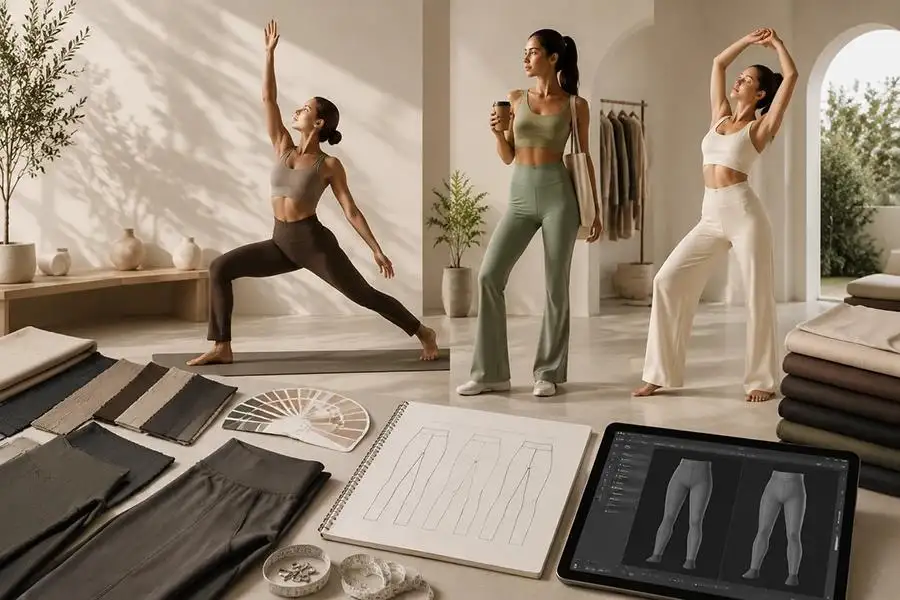
Function and End-Use Comparison
The Yoga Pants vs. Leggings choice becomes clearer when matched to a specific activity.
| Application | Recommended Direction | Critical Requirements |
| Yoga and Pilates | Yoga pants | Four-way stretch, coverage, soft hand feel, stable waist |
| Strength training | Performance leggings | Compression, durable seams, gusset, moisture control |
| Running | Technical leggings | Secure waistband, pockets, quick drying, low friction |
| Everyday athleisure | Either category | Comfort, appearance, recovery, easy care |
| Layering | Lightweight leggings | Low bulk, close fit, softness |
| Studio-to-street | Flared yoga pants | Flexible fabric with controlled drape |
Product testing should reflect the intended use. A yoga pant should be reviewed during squatting, bending, lunging, and seated poses. Running leggings require greater attention to waist stability, pocket security, moisture management, and seam friction.
Specifications Brands Should Confirm Before Sampling
Descriptions such as "buttery soft," "high-waisted," and "squat-proof" are useful marketing language, but they are not complete production instructions.
A development brief should define:
•Target customer and activity
•Fabric composition, weight, and finish
•Required stretch and recovery
•Compression and opacity expectations
•Waist rise and waistband construction
•Inseam, hem width, and size range
•Gusset and seam configuration
•Pocket position and usable dimensions
•Logo, print, label, and packaging requirements
•Wash, pilling, colorfastness, and measurement standards
Minghang Garments uses these details to support fabric recommendations, custom design, pattern development, sample review, branding application, and bulk-production consistency. Samples should be checked for both static appearance and performance during movement.
Final Yoga Pants vs. Leggings Decision
When thinking about mobility and the need for a comfortable studio environment, as well as coverage and stability of the waistband, yoga pants are the better option. On the other hand, when a close-fitting product is needed for activities such as training and running, or for fashion and layering, leggings are the better choice.
When it comes to activewear, the best decision between yoga pants and leggings is determined by the fabric, fit, construction, and testing as well as pricing for the end user. Brands that are creating a private-label collection are able to take their initial design to a production-ready sample with Minghang Garments' custom yoga pants and leggings manufacturing services.
FAQs
Q1. Does Minghang Garments Offer Private-Label Customization?
Minghang Garments supports private-label development, including custom colors, patterns, sizing, logos, labels, packaging, and selected garment details. Available branding methods depend on the fabric, artwork, placement, order quantity, and intended visual effect.
Q2. What Is the Main Difference Between Minghang's Yoga Pants and Leggings?
The difference is determined mainly by function and construction. Yoga pants normally focus on mobility, coverage, and waistband stability, while leggings can be designed for workouts, running, everyday wear, fashion, or layering. Some fitted yoga pants and performance leggings may use similar specifications.
Q3. What Fabrics Can Minghang Garments Use for Custom Yoga Pants?
Common options include nylon-spandex, polyester-spandex, and other stretch knitted fabrics. Minghang Garments can recommend materials based on required softness, four-way stretch, recovery, compression, moisture management, opacity, durability, and target cost.
Q4. Can Minghang Garments Develop Squat-Proof Yoga Pants?
Minghang can develop products with improved coverage by evaluating fabric density, color, stretch level, pattern reduction, and garment fit together. Brands should confirm opacity on fitting samples under realistic bending, squatting, and stretching conditions before bulk production.
Q5. Can Waistband Height and Compression Be Customized?
Yes. Brands can specify high-rise or mid-rise fits, waistband height, double-layer construction, contoured shaping, enclosed elastic, or an internal drawcord. Compression should be balanced with comfort, recovery, and waist stability rather than determined only by spandex percentage.
Written by
Minghang Garments
Apparel Manufacturing Team
Minghang Garments is a custom apparel manufacturer specializing in activewear, streetwear and private-label clothing development. Our team supports brands through fabric sourcing, product development, sampling, bulk production and quality control, with OEM and ODM solutions for startups, growing labels and established apparel businesses.
-
Share
-

-

-