 Contact Us
Table of Contents

Contact Us
Updated 6 days ago
Pattern Grading for Oversized & Baggy Clothing: What Brands Need to Know

Minghang Garments
Minghang Garments is a custom apparel manufacturer specializing in activewear, streetwear and private-label clothing development. Our team supports brands through fabric sourcing, product development, sampling, bulk production and quality control, with OEM and ODM solutions for startups, growing labels and established apparel businesses.
Oversized and baggy clothing may look simple, but maintaining the same design intention across multiple sizes requires careful pattern grading.
A size M oversized hoodie cannot simply be made larger in every direction to create an XL. If too much width, shoulder drop, sleeve length, or body length is added, the larger size may lose the proportions that made the original sample work. clothing sampling process
The same problem can happen in reverse when grading down.
A smaller size can become too short, too narrow, or lose the relaxed silhouette if every measurement is reduced at the same rate.
This is why pattern grading is not simply about making a garment bigger or smaller.
It is the process of adjusting different points of the pattern according to specific grading rules so that fit, proportion, and design balance remain consistent across the size range.
For brands developing oversized T-shirts, boxy hoodies, baggy sweatpants, and other relaxed streetwear silhouettes, understanding this process can help prevent fit problems before bulk production begins.
What Is Pattern Grading?
Pattern grading is the process of increasing or decreasing a base garment pattern to create additional sizes.
The approved sample size — often called the base size — provides the starting point.
From there, key measurements are adjusted according to predetermined grade rules.
These may include:
- Chest or body width
- Shoulder width
- Body length
- Sleeve length
- Armhole
- Neck opening
- Waist
- Hip
- Rise
- Inseam
- Leg opening
The important point is that these measurements are not always increased by the same amount.
Different areas of the garment need different grade increments to preserve the intended fit.
Grading Is Different From Scaling
A garment pattern should not simply be enlarged like an image.
If every dimension were increased by the same percentage, the result could distort important proportions.
For example, an oversized T-shirt may need additional chest width when moving from M to L, but the shoulder width and body length may require much smaller increases.
Similarly, a baggy sweatpant may need more room through the hip and thigh without adding the same amount to the leg opening.
Pattern grading therefore uses controlled measurement changes rather than uniform scaling.
Scaling
Uniform enlargement
- Every dimension changes together
- Proportions may become distorted
- Not suitable for apparel production
- Can exaggerate oversized features
Pattern Grading
Controlled size development
- Different measurements use different increments
- Fit proportions can be maintained
- Garment function is considered
- Suitable for creating production size ranges
Key takeaway:
Pattern grading adjusts each area of the garment according to fit requirements rather than simply enlarging or shrinking the entire pattern.
Why Oversized Clothing Needs Different Grading Logic
Oversized clothing is designed around intentional extra volume, but that volume still needs to remain controlled across the size range.
The goal is not simply to make each larger size wider and longer.
Instead, grading should preserve the relationship between width, length, shoulder position, sleeve volume, and overall silhouette.
If these proportions are not controlled, the garment can quickly become too large in the wrong areas.
Width and Length Should Not Increase at the Same Rate
One of the most common grading problems in oversized clothing is adding too much length as the garment gets wider.
A boxy T-shirt may need noticeable increases in chest width between sizes, but only a small increase in body length.
If length grows too quickly, the larger sizes can lose the cropped or controlled proportion that gives the style its intended look.
The same applies to hoodies and sweatshirts.
A garment may need more body width and sleeve room while keeping the total length relatively stable.
Drop Shoulder Needs Controlled Grading
Drop shoulder styles require special attention because shoulder width already extends beyond the natural shoulder point.
If the shoulder is graded too aggressively, larger sizes can become excessively wide and the sleeve may begin too far down the arm.
If it is graded too little, the oversized effect may disappear in larger sizes.
The relationship between:
- Shoulder width
- Sleeve length
- Armhole depth
- Chest width
- Sleeve opening
needs to be reviewed together.
Sleeve Proportion Can Change the Entire Silhouette
Sleeves are a major part of oversized design.
For boxy hoodies and T-shirts, sleeve width and length often contribute as much to the visual balance as the body itself.
If sleeve length increases too quickly, larger sizes may look sloppy rather than intentionally oversized.
If sleeve width does not increase enough, the body may remain oversized while the sleeves look comparatively narrow.
This is why sleeve grading should be coordinated with shoulder and body grading.
Standard Fit Grading
Typically focuses on:
- Balanced increases in width and length
- Closer relationship to body measurements
- More predictable size increments
- Less extreme shoulder variation
Oversized Fit Grading
Usually requires:
- More controlled length growth
- Careful shoulder grading
- Coordinated sleeve volume
- Preservation of boxy or relaxed proportions
Key takeaway:
Oversized grading should preserve the silhouette, not simply increase garment dimensions.
Common Grading Problems in Oversized & Baggy Fits
Even when the base sample looks correct, grading errors can appear once the style is extended across multiple sizes.
These problems usually come from using grade rules that are too aggressive, too uniform, or not suited to the original silhouette.
Too Long
Problem:
The garment becomes progressively longer in larger sizes.
Common causes:
- Body length graded too aggressively
- Standard-fit grade rules used on a boxy silhouette
- Width and length increased at similar rates
- Cropped or controlled proportions not preserved
This is especially noticeable in oversized T-shirts and hoodies where the design relies on a wide body but relatively controlled length.
Too Wide
Problem:
The garment becomes excessively broad and loses balance.
Common causes:
- Chest width increased too quickly
- Shoulder width graded too aggressively
- Sleeve volume added without coordination
- Hip or thigh width over-graded in baggy bottoms
An oversized garment should still look intentional rather than simply oversized everywhere.
Lost Proportion
Problem:
Different parts of the garment no longer work together visually.
Examples include:
- Sleeves that look too narrow for the body
- Shoulders that extend too far
- Body length becoming too long
- Leg openings becoming too wide
- Rise or inseam no longer matching the intended silhouette
This is why grading should be reviewed as a complete garment rather than as a list of individual measurements.
Key takeaway:
A grading problem is often a proportion problem, not simply a measurement problem.
How Fabric Weight and Structure Affect Grading
Pattern grading cannot be evaluated completely separately from fabric. Best Fabrics for Streetwear
The same pattern can look very different when made in a lightweight jersey, dense heavyweight cotton, French terry, or brushed fleece.
Fabric weight, stretch, drape, and structure all influence how the graded garment behaves on the body.
For oversized and baggy clothing, this matters because the visual effect often depends on the fabric holding a specific silhouette.
Heavier Fabrics Can Make the Same Pattern Look Larger
A dense or heavyweight fabric usually creates more body and structure. fabric selection for custom apparel
This can make an oversized garment appear wider or more substantial even when the actual garment measurements have not changed.
For example:
- A 260 GSM cotton jersey may create a softer oversized T-shirt
- A 320 GSM compact jersey may create a boxier, more structured shape
- A 400–450 GSM fleece may add more volume to an oversized hoodie
This means grading rules should be reviewed together with the intended fabric rather than copied automatically from another style.
Stretch Can Change Fit Across Sizes
Stretch fabrics introduce another variable.
If a fabric has significant stretch and recovery, the garment may tolerate different measurements compared with a rigid or low-stretch material.
This is especially important for:
- Ribbed cuffs and hems
- Stretch waistbands
- Fitted panels
- Joggers with elastane blends
- Hybrid streetwear-activewear products
The more stretch a fabric has, the more important it becomes to consider how the material behaves under tension across different sizes. custom hoodie manufacturer
Drape Affects the Visual Result
Two fabrics with the same GSM may still create very different silhouettes.
A softer fabric with more drape may fall closer to the body, while a denser fabric may stand away from the body and exaggerate the oversized effect.
This is why grading should be checked on actual samples whenever the fabric changes significantly.
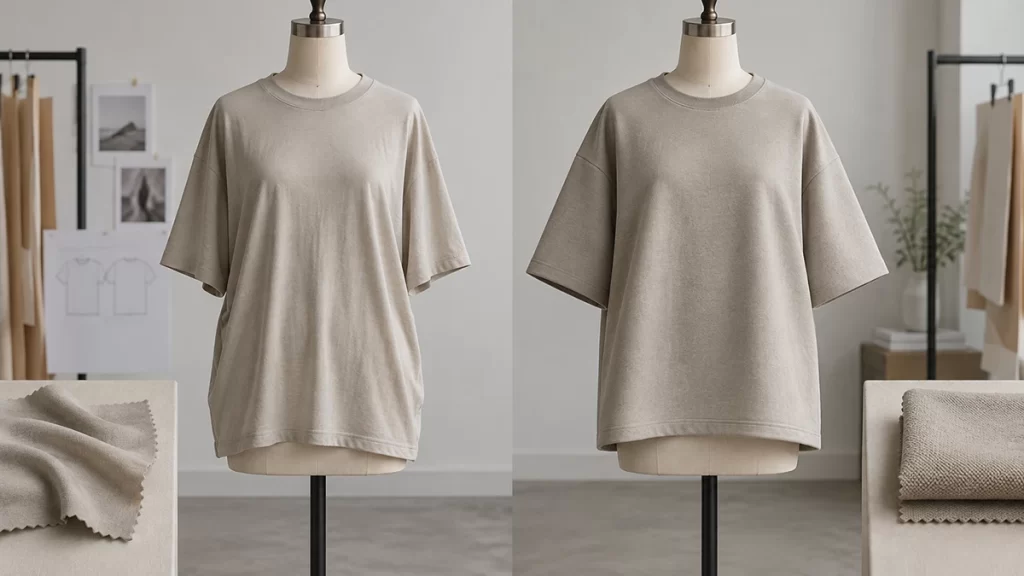
Size Set Samples and Fit Verification
Approving the base size does not automatically guarantee that every other size will fit correctly.
For oversized and baggy garments, this is especially important because small grading errors can become much more visible as the size range expands.
A size set sample allows the brand and manufacturer to check whether the intended silhouette is maintained across multiple sizes before bulk production.
Why Size Set Samples Matter
A size set can help identify problems such as:
- Larger sizes becoming too long
- Shoulder drop becoming excessive
- Sleeves becoming disproportionately wide
- Smaller sizes losing the oversized effect
- Hip or thigh volume changing too quickly
- Leg openings becoming too narrow or too wide
- Rise and inseam proportions becoming unbalanced
These issues may not be obvious when only the base size is reviewed.
Check Proportion, Not Just Measurements
A graded garment can technically meet the measurement chart and still look wrong.
For example, the chest width may be correct, but the shoulder, sleeve, and body length may no longer create the intended boxy silhouette.
This is why size set evaluation should include both:
- Measurement verification
- Visual fit and proportion review
For oversized clothing, the relationship between different areas of the garment is often more important than any single measurement.
Which Sizes Should Be Checked?
It is not always necessary to make every size before production, but it is useful to review sizes that show how the grade behaves across the range.
For example, if the collection runs from XS to XXL, the brand may review:
- Base size
- One smaller size
- One larger size
- Largest size when proportions change significantly
This helps confirm whether the grade rules remain consistent from one end of the size range to the other.
What Brands Should Approve Before Bulk Production
Before bulk production begins, brands should make sure that both the graded specifications and the physical garment have been approved.
For oversized and baggy styles, this is especially important because small proportion errors can become much more obvious once the full size range is produced.
A useful final approval should cover two areas:
Specification Approval
Confirm the graded specifications
- Final measurement chart
- Grade rules
- Size range
- Shoulder increments
- Body width increments
- Body length increments
- Sleeve grading
- Hip and thigh grading
- Rise and inseam grading
- Leg opening measurements
Garment Approval
Confirm the physical result
- Base size fit
- Size set proportions
- Oversized silhouette
- Shoulder position
- Sleeve balance
- Body length
- Fabric behavior
- Movement and comfort
- Visual consistency across sizes
- Final approved sample
Key takeaway:
Approve both the measurement grade and the visual proportion before bulk production.
A measurement chart alone is not enough.
The graded garment should also be checked visually to confirm that the design intention remains consistent across the size range.
Keep the Final Grade Rules Documented
Once the size set is approved, the final grade rules should be clearly documented and used as the production reference.
This reduces the risk of different pattern versions or outdated measurements being used during bulk production.
If the fabric, fit, or construction changes significantly after grading approval, the size range may need to be reviewed again.
Final Thoughts
Pattern grading for oversized and baggy clothing is not simply a matter of making each size larger or smaller.
The goal is to preserve the original design intention across the full size range.
For oversized garments, this means carefully controlling the relationship between:
- Body width
- Body length
- Shoulder width
- Sleeve volume
- Rise and inseam
- Leg opening
- Fabric behavior
A successful grade should maintain the intended silhouette while still allowing each size to fit and move correctly.
For brands, the most reliable approach is to approve the base sample first, review the grade rules, check selected size set samples, and confirm both measurements and visual proportions before bulk production.
This reduces the risk of a style looking balanced in the sample size but losing its shape once the full size range is produced.
Written by
Minghang Garments
Apparel Manufacturing Team
Minghang Garments is a custom apparel manufacturer specializing in activewear, streetwear and private-label clothing development. Our team supports brands through fabric sourcing, product development, sampling, bulk production and quality control, with OEM and ODM solutions for startups, growing labels and established apparel businesses.
-
Share
-

-

-