 Contact Us

Table of Contents

Contact Us
To find a streetwear manufacturer, define your styles, quantities and fabric weights first, then shortlist factories through referrals, trade events and supplier directories, and screen each one on heavyweight fabric handling, garment washing, decoration methods and small-drop MOQ before you request samples. Streetwear manufacturer sourcing is a screening process, not a search result: a listing proves a factory exists, not that it can produce your drop.
Key takeaways
- Finding a factory is the easy part; the screening criteria — heavyweight fabric, wash, decoration and MOQ conditions — decide whether the drop ships correctly.
- Always ask for MOQ per style, per colour and per fabric, and ask what changes the number, because "low MOQ" is not one universal figure.
- Ask who physically performs each step — cutting, sewing, washing, printing, embroidery — so you know what happens on site and what is subcontracted.
- A physical sample in your chosen fabric and treatment tells you more than a catalogue or a price list; judge it against your written specification.
- Treat published capability claims from any factory, including Minghang Garments, as claims to verify with your own sample and written order terms.
Where Do Brands Find Streetwear Manufacturers?
Brands find streetwear manufacturers through referrals from other labels, trade and sourcing events, supplier directories and platforms, targeted web search, and direct outreach to factories whose existing work looks like the product they want. No single channel proves capability, so shortlist from at least two of them.
A directory listing is a lead, not a qualification. It tells you a factory exists and is willing to be contacted. It does not tell you whether that factory can run a 400 GSM fleece, control shrinkage through an enzyme wash, or hold a print registration across a washed hoodie. Those answers come from screening, and screening is the subject of the rest of this page.
Referrals, brand peers and industry networks
Referrals are the fastest route to a factory that already understands streetwear construction, because someone else has already paid for the mistakes. Ask specific questions rather than "are they good": what was the sample turnaround, did the wash match the approved sample, who handled problems, and what would you change next time?
Peer networks are strongest for small drops. Another label that runs 150-piece drops will tell you honestly whether a factory tolerates small runs, and that single fact can save months of rejected inquiries.
Trade events and sourcing shows
Trade events put production staff and physical samples in one room, which lets you feel fabric before committing. A sourcing event such as sourcing at magic new york 2026 is one example of this channel. Confirm dates and exhibitor lists yourself before planning travel, and treat a conversation at a booth the same as a directory listing: it starts screening, it does not complete it.
Directories, supplier platforms and search
Directories and supplier platforms are useful for volume and filtering. They are self-reported by the factories that list there, so use them to build a longlist of 10 to 20 names, then cut it with the criteria in the screening sections below. Search works better when you search for the product, not the label — "heavyweight fleece hoodie manufacturer" surfaces more relevant factories than "streetwear manufacturer".
Domestic vs overseas sourcing: what actually differs
Distance changes logistics and communication rhythm, not quality. A local factory shortens sample shipping and makes site visits practical. An overseas factory may widen access to specialist fabric, wash and decoration options, but it raises the value of written specifications, photo or video sample approval, and explicit process-ownership questions. Do not generalise about quality by country; screen the individual factory.
[DIAGRAM: Sourcing funnel narrowing from four discovery channels through fabric, wash and decoration screening, process-ownership confirmation and sample approval, ending at bulk production, with the gate criteria written on each arrow.]
What to Prepare Before You Contact a Streetwear Manufacturer
Before outreach, write down your styles, target quantities by colour, fabric and weight, decoration, wash, sizing and target dates, and put the core of that into a simple tech pack. Factories quote faster and more accurately from a written specification than from a conversation.
A tech pack is the document that describes what you want made: construction, measurements, materials, colourways, decoration placement and finishing. It does not have to be finished before your first email. It does have to exist in draft, because the gaps in your brief are the gaps in the quote.
Minghang Garments' streetwear page states that its development process considers silhouette, fabric weight, shrinkage, wash effects, decoration sequence and finishing. Those are the same variables your brief should settle, whichever factory you approach. If you want to see how a supplier describes that scope before you write your brief, review its published manufacturing capabilities.
| Item to prepare | Why the factory needs it | Minimum useful detail |
|---|---|---|
| Product type and silhouette | Determines the pattern block and sewing line | "Oversized boxy hoodie, dropped shoulder, ribbed cuffs" |
| Quantity per style and colour | Drives fabric booking and MOQ fit | "300 total: 100 black, 100 sand, 100 washed grey" |
| Fabric type and weight | Decides what the factory can source or run | "400 GSM brushed-back fleece, 100% cotton" |
| Wash or finish | Changes sequencing, timing and risk | "Enzyme wash, soft hand-feel, no heavy abrasion" |
| Decoration method and placement | Determines print or embroidery setup | "Puff print front chest, 22 cm wide, plus woven label" |
| Measurement spec and size range | Lets the factory confirm its block | "Size chart XS–XXL, garment measured flat" |
| Trims, labels and packaging | Affects lead time on non-fabric items | "Woven neck label, hangtag, polybag" |
| Target sample and delivery dates | Shapes the production slot offered | "Sample approval by mid-March, delivery by mid-May" |
Checklist — what your first inquiry must contain: the styles; quantities by colour; fabric and weight in GSM (grams per square metre); wash and decoration; tech-pack status, even if incomplete; and the two dates you actually care about — sample approval and delivery. Anything missing here comes back as a question and adds a round trip.
How to Screen a Factory's Heavyweight Fabric and Fit Experience
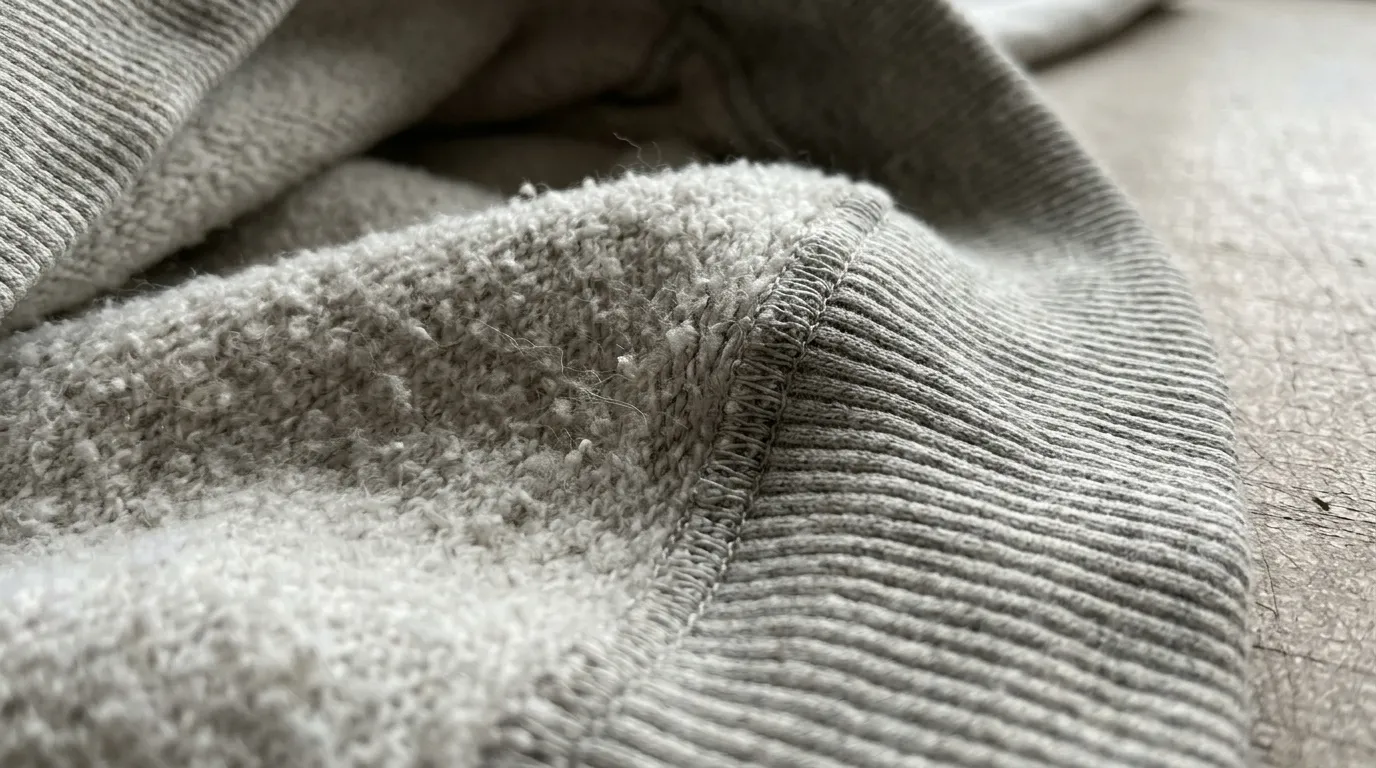
Ask the factory which specific heavyweight fabrics and constructions it runs — fleece, French terry, heavy jersey, washed cotton — at what weights, and ask to see garments it has already produced in that weight. Heavyweight streetwear lives or dies on shrinkage control, hand-feel and silhouette, so ask how each of those is controlled.
Minghang Garments' streetwear page lists graphic, washed, heavyweight, jacket, oversized and cargo streetwear categories, and states that development considers silhouette, fabric weight, shrinkage, wash effects, decoration sequence and finishing. Use that as a framework for your own questions: if a factory cannot name the weights it runs comfortably, it is guessing.
Weight alone is a weak signal. A 400 GSM fleece that shrinks two sizes after washing is worse than a well-controlled 350 GSM one. What matters is whether the factory measures and compensates for shrinkage in the pattern before cutting, and whether it can show you a finished garment that has already been washed.
| Question to ask | What a strong answer includes | Warning sign |
|---|---|---|
| Which fabric weights do you normally run? | Named ranges in GSM with examples of recent styles | A single number quoted for every request |
| How do you control shrinkage? | Tested shrinkage figures plus pattern compensation before cutting | "It won't shrink much" with no test or compensation step |
| Do you own the pattern and block? | Clear answer on who holds the pattern files and who adjusts them | Reluctance to say who owns or edits the block |
| What oversized and relaxed fits have you made? | Photos or garments in the silhouette you want | Only slim or standard fits shown |
| How is fabric sourced and validated? | Named mills or suppliers, plus an incoming inspection step | Fabric source treated as an afterthought |
[PHOTO: The same heavyweight hoodie or tee shown in several finished treatments side by side — enzyme wash, pigment dye, puff print, rhinestone detail — with each treatment labelled.]
How to Check Garment Washing and Decoration Capability
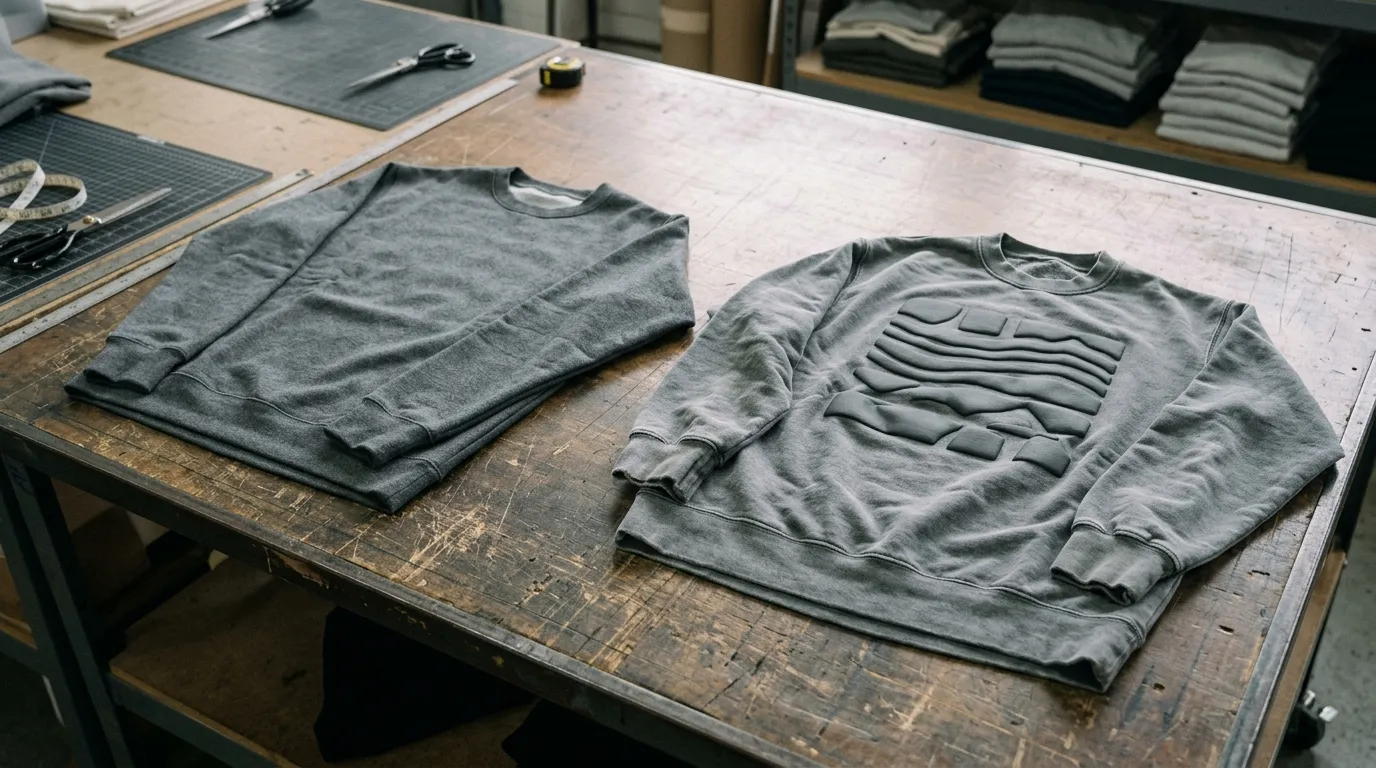
Name the exact wash and decoration you want and ask the factory to show its own past output in that treatment, including how wash and print or embroidery are sequenced. A factory with decoration experience but no wash experience, or the reverse, will usually outsource the missing step, which changes cost, timing and risk.
Minghang Garments' streetwear page names screen printing, puff and high-density printing, crack effects, direct-to-garment (DTG) printing, silicone details and reflective details among its branding options, and describes garment-wash and dye options including pigment dye, enzyme wash, vintage wash and tie-dye. Treat these as the company's own published capability statements, and verify them the same way you would verify any supplier's: with a sample in your fabric and your treatment.
Two processes sometimes assumed to be standard are worth asking about explicitly. Direct-to-film (DTF) printing and acid washing are not verified for Minghang Garments in any published material, so this page does not present them as available there. Ask every factory you shortlist the same question: "Does the factory offer DTF, and does it run it on site?" The same applies to acid wash. If a factory cannot answer that clearly for its own treatments, assume it does not control them.
The sequence question
Ask whether wash happens before or after printing and embroidery, and how the sample approval reflects that order. A print applied before a heavy wash may fade, crack or distort; a print applied after the wash has to bond to fabric that has already changed dimension. The correct answer depends on the effect you want, but a factory that has never considered the question will not raise it.
When you compare suppliers, judge the full wash-and-decoration scope rather than a single technique. A supplier page such as streetwear manufacturing for fashion brands is useful for seeing how a factory groups these services, but the comparison that matters is the one you run on your own sample.
| Treatment | What to ask the factory | Evidence to request |
|---|---|---|
| Enzyme wash | Softening level, and whether strength is controlled batch to batch | Washed sample plus the tested result on your fabric |
| Pigment dye | Colour consistency between dye lots and after wash | Dyed sample and a shade reference for approval |
| Vintage wash | How the effect is achieved and how repeatable it is | Two samples from different batches for comparison |
| Tie-dye | Whether pattern placement is repeatable per piece | Sample set showing the variation you should expect |
| Screen printing | Mesh, ink type and how registration is held on heavy fabric | Printed sample at your placement and size |
| Puff and high-density print | Height, coverage limits and cracking risk at fold lines | Finished, washed sample with folded areas checked |
| DTG | Fabric compatibility and wash durability | Printed sample after one wash cycle |
| DTF | Whether the factory offers it and whether it runs it on site | Verify with the supplier before relying on it |
| Rhinestone | Attachment method and how it survives washing | Sample washed and inspected |
| Embroidery | Stitch density on heavy fabric and backing used | Embroidered sample at your placement |
Is the Work Truly In-House? How to Check Subcontracting
Ask, step by step, who physically performs cutting, sewing, washing, printing, embroidery and finishing, and ask which steps leave the premises. Two quotes are not comparable if one factory subcontracts washing and another runs it under the same roof.
Published material does not settle this for any factory, including Minghang Garments: no retrieved page establishes which named processes that company performs on site, so this page makes no in-house claim for it or for anyone else. The question is yours to ask.
Decision rule: if a factory will not name who performs each step, or cannot show that step in a sample review, a site visit or a factory video, treat that step as subcontracted when you compare quotes and timelines.
Checklist — process ownership to confirm: cutting; sewing line; washing and dyeing; screen printing; DTG or DTF; embroidery; rhinestone application; finishing and packing; and the inspection points along the way. On that last point, a documented multi-stage inspection process is one signal of internal control — Minghang Garments' homepage describes a 5+1 quality-control system covering incoming materials, cutting, in-line sewing, semi-finished garments, final inspection and pre-shipment verification, again as a company-published statement to verify against your own order.
How to Pin Down MOQ, Samples and Lead Times for Small Drops
Ask for the minimum order quantity per style, per colour and per fabric, not one headline number, and ask what changes it: custom fabric, custom dye, a special wash or a brand-new pattern. Ask the same about sample and production timing, then put both in writing.
A minimum order quantity (MOQ) is the smallest number of pieces a factory will accept for one order. It is rarely a single figure. "Low MOQ" usually means the number applies to stock fabric in an existing colour; the moment you specify a custom knit, a custom dye lot or a new wash, the real minimum can rise. Minghang Garments states an MOQ starting from 100 pieces per colour per style on stock fabric, which is a concrete example of how a quoted minimum is tied to conditions rather than being universal.
Minghang Garments' streetwear page also states that standard streetwear samples typically require around 12–15 working days, with more complex wash or decoration programmes requiring additional development. The same company publishes sampling of 7–15 working days and bulk production of 25–45 days, with capacity of up to 500,000 pieces per month across a 12,000 m² production floor and a 2,000 m² sample centre. Use these as illustrations of the questions to ask, not as market norms — every factory sets its own.
| Question | Why it matters | What to get in writing |
|---|---|---|
| MOQ per style | Determines whether your drop is viable at all | A number, with the style it applies to |
| MOQ per colour | Colour changes can multiply the real minimum | Whether each colour needs its own minimum |
| MOQ per fabric | Stock fabric and custom fabric behave differently | Which fabrics the quoted number applies to |
| Stock versus custom fabric | Custom knitting or dyeing usually raises the minimum | The minimum for each route, side by side |
| Sample lead time and fee | Sets your whole calendar | Days, fee, and what revisions cost |
| Bulk lead time | Determines whether you hit your drop date | Days from approved sample, not from inquiry |
| What voids the quoted lead time | Protects you if the plan slips | The specific triggers that reset the clock |
What to Request to Judge Quality Before You Commit
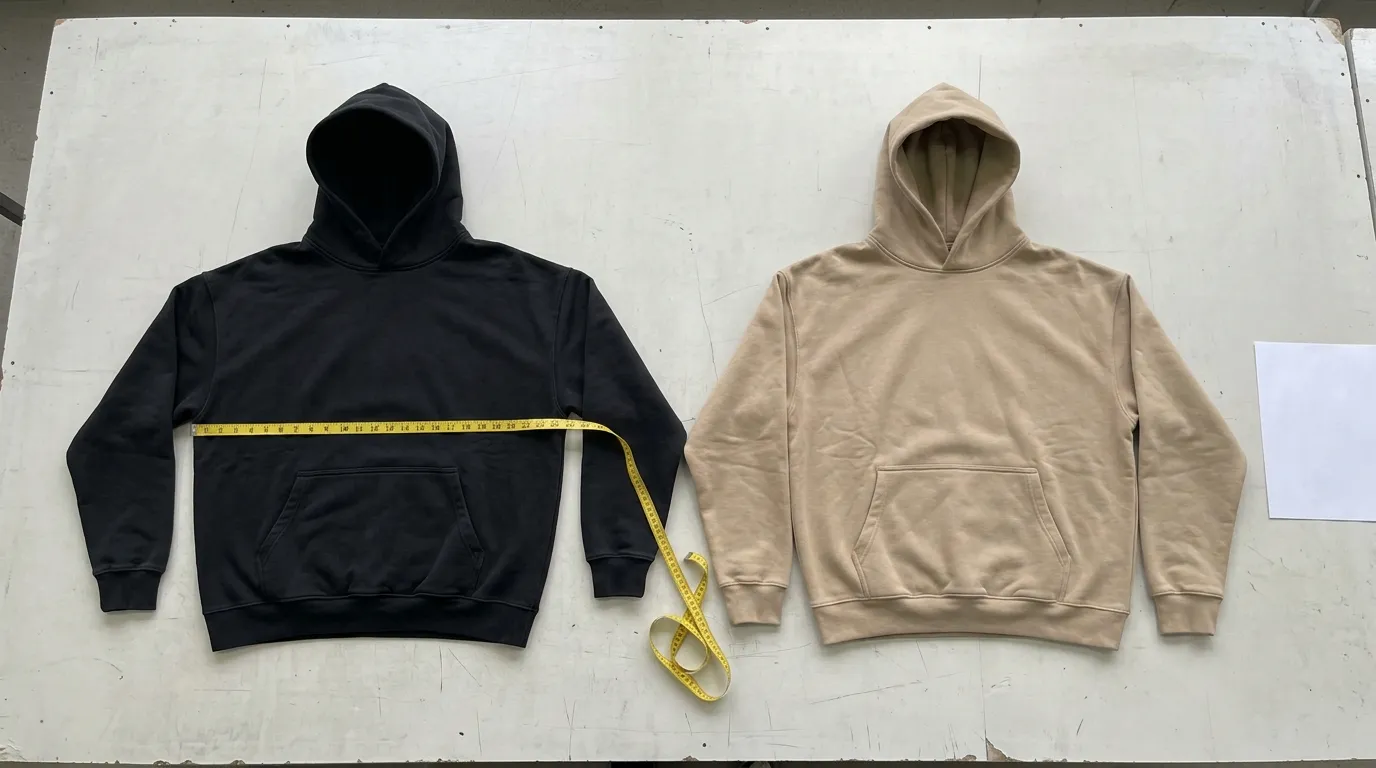
Request a physical sample in your chosen fabric and decoration, photos of the same style at each production stage, and details of how and when the factory inspects. Judge the sample against your written specification — measurements, weight, wash result and decoration placement — not against a photo on a screen.
Colour, hand-feel and weight do not survive photography. A sample is the only artefact that lets you check all three at once, and it is also the reference you will use later if bulk production differs. Measure it flat against your size chart, weigh it if weight matters to you, and wash it once if the finished garment is meant to be washed.
Checklist — evidence to request: a sample in the agreed fabric and weight; measurements checked against your specification; wash and decoration applied to that same sample; in-process photos; documented inspection stages; a packaging and labelling sample; and the name of the person who will own your order day to day.
Minghang Garments' homepage describes a 5+1 quality-control system covering incoming materials, cutting, in-line sewing, semi-finished garments, final inspection and pre-shipment verification. That is the kind of stage list worth asking any factory to describe, because a factory that can name its checkpoints can usually explain what happens when one fails.
How to Compare Streetwear Manufacturers Side by Side
Compare factories on the same criteria in one table: streetwear and heavyweight experience, wash and decoration scope, process ownership, MOQ conditions, sample process, communication, documented quality control and quoted timing. A cheap quote only wins if the specification behind it is identical.
None of the buyer guides reviewed for this page provides a neutral attribute-by-attribute framework for streetwear specifically, so build your own. Fill one row per factory, and where a cell cannot be answered, write "verify with the supplier" rather than leaving it blank — a blank cell becomes an assumption later.
| Criterion | Factory A | Factory B | Factory C |
|---|---|---|---|
| Heavyweight fabric experience | |||
| Wash scope | |||
| Decoration scope | |||
| Steps performed on site vs subcontracted | |||
| MOQ per style and colour | |||
| Sample lead time and fee | |||
| Bulk lead time from approved sample | |||
| Quality-control documentation | |||
| Communication cadence and named contact | |||
| Fit with your drop size |
A worked comparison makes the point. Two factories quote the same hoodie. Factory A's price assumes stock fleece with no wash; Factory B's assumes a custom knit, an enzyme wash, a puff print and a rhinestone detail. Factory B is doing more work, so its number is not comparable to Factory A's. Normalise the specification first, then compare the price.
Streetwear Manufacturer Red Flags
Walk away, or slow down, when a factory will not specify who performs each process, quotes a minimum that changes when you ask about colour, cannot show its own output in your fabric weight or treatment, or answers sample and timing questions only verbally.
Checklist — red flags: a single MOQ number for every style and colour; no answer on wash and decoration sequencing; no physical sample in your fabric; no named contact; a lead time quoted without reference to sample approval; specification changes accepted without written confirmation; and prices far below the rest of your shortlist with no corresponding difference in specification.
Most of these are communication failures rather than production failures, and they tend to surface in bulk, when you have already paid a deposit and the drop date is fixed. Screen for them during the quote stage, when switching suppliers still costs you nothing but time.
From Shortlist to First Drop: The Step-by-Step Process
The workable sequence is: define the brief, shortlist from at least two channels, screen on fabric, wash, decoration and MOQ, confirm process ownership, request a sample against specification, compare quotes like-for-like, then approve the sample and written terms before bulk starts.
- Write the brief. Styles, quantities by colour, fabric and weight, wash, decoration, sizing, key dates.
- Shortlist from two channels. Referrals, events, directories and search — then cross-check.
- Screen fabrication and treatments. Heavyweight experience, shrinkage control, wash and decoration scope.
- Confirm process ownership. Who cuts, sews, washes, prints, embroiders and inspects.
- Clarify MOQ, sample and timing in writing. Per style, per colour, per fabric, with the conditions attached.
- Request and assess evidence. Physical sample, in-process photos, inspection stages, packaging sample.
- Compare like-for-like and approve. Match specifications, then approve the sample and the written terms together.
Each step feeds the next. Skipping step one produces vague quotes; skipping step four produces quotes you cannot compare; skipping step seven is how a drop slips.
[DIAGRAM: A one-page inquiry template showing where style, quantities by colour, fabric weight in GSM, wash, decoration, sizing and the two key dates go.]
Frequently Asked Questions
Do streetwear manufacturers work with brand-new labels?
Many do, and the minimum usually depends on fabric and colour rather than brand size. Ask what MOQ applies to stock fabric versus custom fabric and dyeing before assuming you are too small. Minghang Garments, for example, states an MOQ starting from 100 pieces per colour per style on stock fabric, which is a workable starting point for a first drop.
Do I need a complete tech pack before contacting a factory?
No. A clear written brief is enough to start: styles, quantities by colour, fabric weight, wash, decoration, sizing and target dates. A full tech pack can follow once you have shortlisted a factory and agreed to sample. Factories quote more accurately from a written brief than from a phone call.
What is the difference between OEM, ODM and private label?
Original equipment manufacturing (OEM) means the factory builds to your design and specification. Original design manufacturing (ODM) means the factory's existing design is adapted for you. Private label means your branding goes on a product the factory already develops. The three routes differ in how much design work and risk sits with you.
Should I choose a local or an overseas streetwear factory?
Local sourcing shortens sample and shipping logistics and makes visits practical. Overseas sourcing may widen access to specialist fabric, wash and decoration options, but it raises the value of written specifications, photo or video sample approval and clear process-ownership questions. Do not choose by country; screen the individual factory on the criteria above.
How long does it take to find and start with a streetwear manufacturer?
Screening and sampling drive the timeline. Research and shortlisting typically take weeks, then sample development, revisions and approval must happen before bulk. Minghang Garments' streetwear page states that standard streetwear samples typically require around 12–15 working days, with more complex wash or decoration programmes needing additional development — one illustration of the sample stage, not a market norm.
If you want to see how a streetwear brief is turned into samples and production, review how a custom streetwear manufacturer describes that process — then apply the same screening questions in this guide to whichever factories you shortlist.
-
Share
-

-

-