 Contact Us

Table of Contents

Contact Us
Updated 1 month ago
Streetwear Manufacturing vs. Fast Fashion: Customization and Brand Identity Explained

Minghang Garments
Minghang Garments is a custom apparel manufacturer specializing in activewear, streetwear and private-label clothing development. Our team supports brands through fabric sourcing, product development, sampling, bulk production and quality control, with OEM and ODM solutions for startups, growing labels and established apparel businesses.
Streetwear identity begins with the pattern block, fabric specification, wash recipe, construction and tolerance standard. This is the practical difference behind Streetwear Manufacturing vs. Fast Fashion: one system develops recognizable products around a brand, while the other prioritizes trend response and volume efficiency.
Streetwear Manufacturing vs. Fast Fashion: Two Operating Systems
Custom streetwear is design-led. A collection may start with a reference garment or tech pack, but production requires defined measurements, graded sizing, material specifications and decoration trials. Fast fashion is demand-led: trends are converted into styles through established blocks, available fabrics and compressed approvals.
| Dimension | Streetwear Manufacturing | Fast Fashion |
| Objective | Proprietary product | Rapid demand capture |
| Patterns | Custom blocks | Standard blocks |
| Materials | GSM, handle and performance | Availability and cost |
| Volume | Focused drops | Broad, high-volume SKUs |
| Main risk | Development cost | Excess inventory |
| Brand value | Distinction and consistency | Speed and accessibility |
The choice depends on customers, retail price, product lifecycle, working capital and required exclusivity.
Customization Is More Than a Logo
A useful Streetwear Manufacturing vs. Fast Fashion comparison must examine how deeply a garment can be changed.
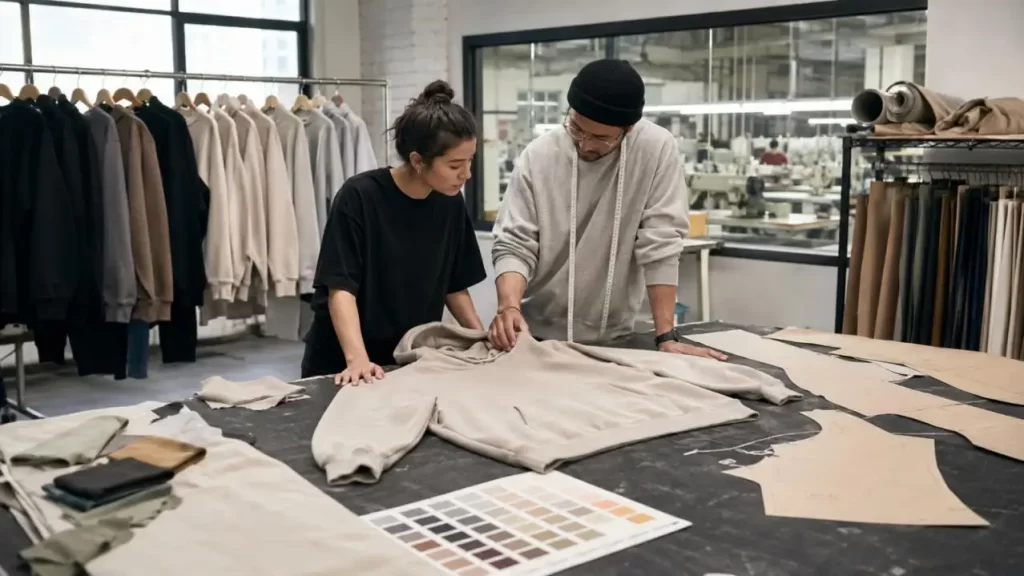
Pattern, Fit and Grading
Shoulder drop, chest width, armhole depth, sleeve volume and body length must work together. After fitting the base size, the pattern must be graded correctly. Otherwise, an oversized medium can become an excessively long XL rather than a balanced larger fit.
Fabric and Color Control
"Cotton" or "fleece" is not a complete specification. Production documents should define:
•Fiber composition and knit construction
•Finished GSM, stretch and recovery
•Shrinkage, pilling and colorfastness
•Approved lab dip or bulk color
A 300 GSM jersey and a 450 GSM jersey produce different drape even when cut from the same pattern.
Washes, Graphics and Trims
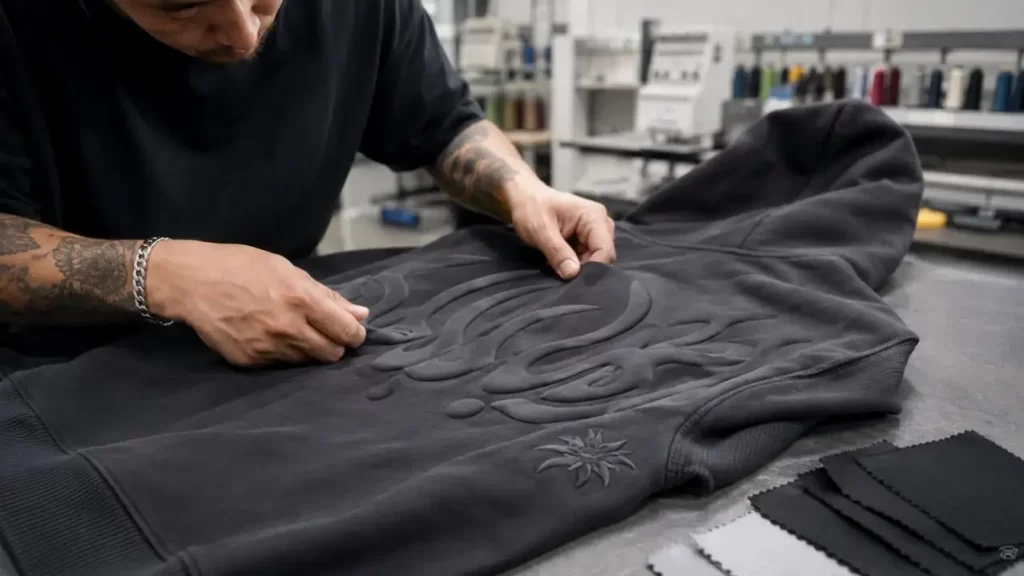
Garment dyeing, acid washing and enzyme washing require trials because treatment can change dimensions, shade and fabric strength. Screen print, DTG, puff print, embroidery and appliqué need strike-offs to approve placement, texture and color.
Labels, zippers, drawcords, ribbing and packaging complete the physical brand system. Fast-fashion production can include these features, but options are often restricted to protect cost and lead time.
Brand Identity Requires Repeatability
Customization creates identity only when it can be reproduced. In Streetwear Manufacturing vs. Fast Fashion, technical documentation makes repeatability measurable.
| Brand Detail | Production Control | Brand Effect |
| Signature fit | Measurement tolerances | Recognizable silhouette |
| Heavyweight handle | GSM and shrinkage | Consistent quality |
| Custom wash | Recipe and shade band | Distinctive finish |
| Graphic placement | Artwork guide | Consistent visuals |
| Workmanship | In-line inspection | Fewer returns |
An approved pre-production sample should become the bulk-production reference. "Same as last order" is insufficient without measurements, artwork placement, material records and tolerances.
Cost, Speed, MOQ and Inventory Risk
There are advantages to fast fashion. Mass producing designs with standard patterns and fabrics stocked by the supplier can reduce the unit cost and lead time of a product. Fast fashion can work with broad trend testing and price-sensitive markets.
But there are other costs associated with manufacturing:
True Product Cost = Development + Production + Quality Loss + Returns + Inventory Discounts
In Streetwear Manufacturing vs. Fast Fashion, fast fashion may have lower unit costs, but probably a greater commitment to SKUs. Custom streetwear has greater development costs, but can use small batch production to eliminate unsold inventory with pre-orders and phased replenishment.
MOQ should be confirmed by style, color and size. Fabric minimums, dye-lot quantities, print setup charges and custom-trim minimums may differ from garment MOQ.
Which Model Fits Your Brand?
Following is an analysis based on the product strategy:
•Graphic testing: You may be able to get by with premium blanks.
•Signature fit or fabric: Custom cut-and-sew is the likely option.
•Price-led retail: Consider volume production.
•Limited drops: Small batch production maintains exclusivity and control of inventory.
•Proven essentials: Orders lead to improving unit economics.
Growing brands scale their proven products and, at the same time, test new products in smaller runs. This allows growing brands the ability to control the pace of the streetwear industry and protect their core identity.
A Manufacturer's Development and Quality Role
A capable supplier should support patterns, tech packs, fabric sourcing, sampling, decoration, private-label trims and scalable production. Quality control should cover:
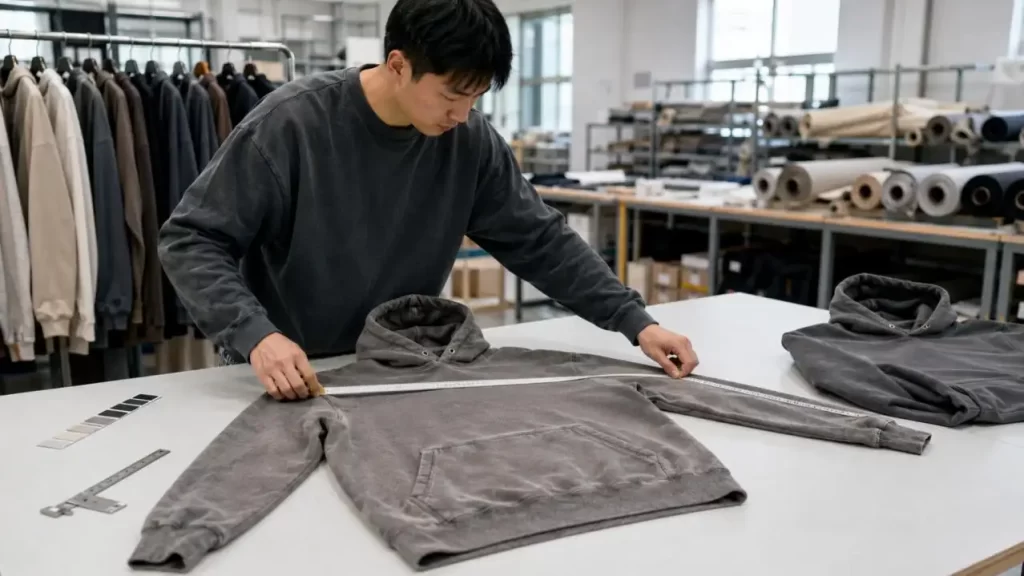
•Finished measurements and tolerances
•Shrinkage and shade consistency
•Print or embroidery placement
•Stitching and seam condition
•Labels, packing ratios and presentation
Material specifications and an approved pre-production sample turn creative ideas into inspectable standards.
How Minghang Garments Approaches Custom Streetwear
From Minghang Garments' perspective, Streetwear Manufacturing vs. Fast Fashion shows why design intent must become measurable production information.
Our OEM and ODM process includes pattern and sample making, fabric and color choices, logo trials, washes, labels, trims and packaging. Fit and all other aspects of the sample are finalized against the approved sample. Inspections focus on measurements, appearance and workmanship during in-line and final inspection.
A flexible MOQ of 100 pieces per style allows brands to test their scaled production of the developed product. Our goal is to help our clients manufacture a garment that is consistent in size and across all repeat orders.
Conclusion
Streetwear Manufacturing vs. Fast Fashion is not simply premium production versus cheap production. Fast fashion emphasizes speed, assortment and cost efficiency; streetwear manufacturing emphasizes controlled fit, material character, craftsmanship and repeatability.
If your collection depends on custom silhouettes, heavyweight fabrics, wash development or private-label details, Minghang Garments can review your tech pack, reference sample or concept and help define a practical route from sampling to scalable production.
FAQs
Q1. Does Minghang Garments provide OEM and ODM streetwear manufacturing?
Yes. Minghang Garments supports both OEM and ODM projects, including pattern development, fabric selection, sampling, logo applications, custom trims, labels, packaging and bulk production.
Q2. What is Minghang Garments' MOQ for custom streetwear?
The standard MOQ starts from 100 pieces per style. The final requirement may depend on the number of colors, size breakdown, fabric availability, dye-lot minimums and custom accessories.
Q3. Can Minghang Garments develop custom oversized streetwear fits?
Yes. The development team can adjust shoulder drop, chest width, sleeve volume, garment length, armhole depth and other measurements. Fit samples should be approved before size grading and bulk production.
Q4. Do I need a complete tech pack to request a sample?
A detailed tech pack is preferred because it reduces uncertainty. However, brands can also provide reference garments, sketches, artwork or measurement requirements for an initial development review.
Q5. What fabrics can Minghang Garments customize?
Fabric development can cover fiber composition, knit construction, GSM, color, stretch, recovery and surface feel. Availability and minimum quantities depend on the selected fabric and color requirements.
Written by
Minghang Garments
Apparel Manufacturing Team
Minghang Garments is a custom apparel manufacturer specializing in activewear, streetwear and private-label clothing development. Our team supports brands through fabric sourcing, product development, sampling, bulk production and quality control, with OEM and ODM solutions for startups, growing labels and established apparel businesses.
-
Share
-

-

-