 Contact Us

Table of Contents

Contact Us
Updated 3 weeks ago
Acid Wash vs Stone Wash: What's the Difference?
arafatshuvo
Acid wash and stone wash are two different garment-finishing treatments. Stone wash uses mechanical abrasion — tumbling garments with pumice — to create a softer, more evenly worn fade. Acid wash uses a chemical or oxidising treatment to produce a sharper, mottled, high-contrast pattern. The typical visual difference is even softening versus marbled contrast, though results depend on fabric, method and process control.
Key takeaways
- Stone wash is abrasion-led: pumice tumbling softens the surface and produces a worn-in fade (Wikipedia; Changhong Jeans).
- Acid wash is contrast-led: published accounts describe oxidiser-treated pumice or potassium permanganate methods, not one fixed acid bath (Wikipedia; Changhong Jeans; MakeYourOwnJeans).
- Acid wash usually reads as marbled and high-contrast; stone wash as subtle and evenly softened (Anomie Gallery; Changhong Jeans).
- Neither finish is automatically more repeatable or more print-friendly — both need a sealed reference sample and testing on your own fabric.
- Minghang Garments lists acid wash and stone wash among its washed-finish options.
What Is Stone Washing?
Stone washing is a garment-finishing treatment that tumbles garments with stones so the stones abrade the fabric surface. According to Wikipedia, the process abrades denim in a rotating drum to create a worn appearance, and pumice is the material most commonly used, although chemical methods can imitate a similar look. Changhong Jeans describes stone washing as mechanical abrasion using pumice stones in a rotating drum. Anomie Gallery describes a pumice method without bleach or chemicals, which is that page's account of one approach rather than a universal definition.
How stone washing creates a softened, worn-in fade
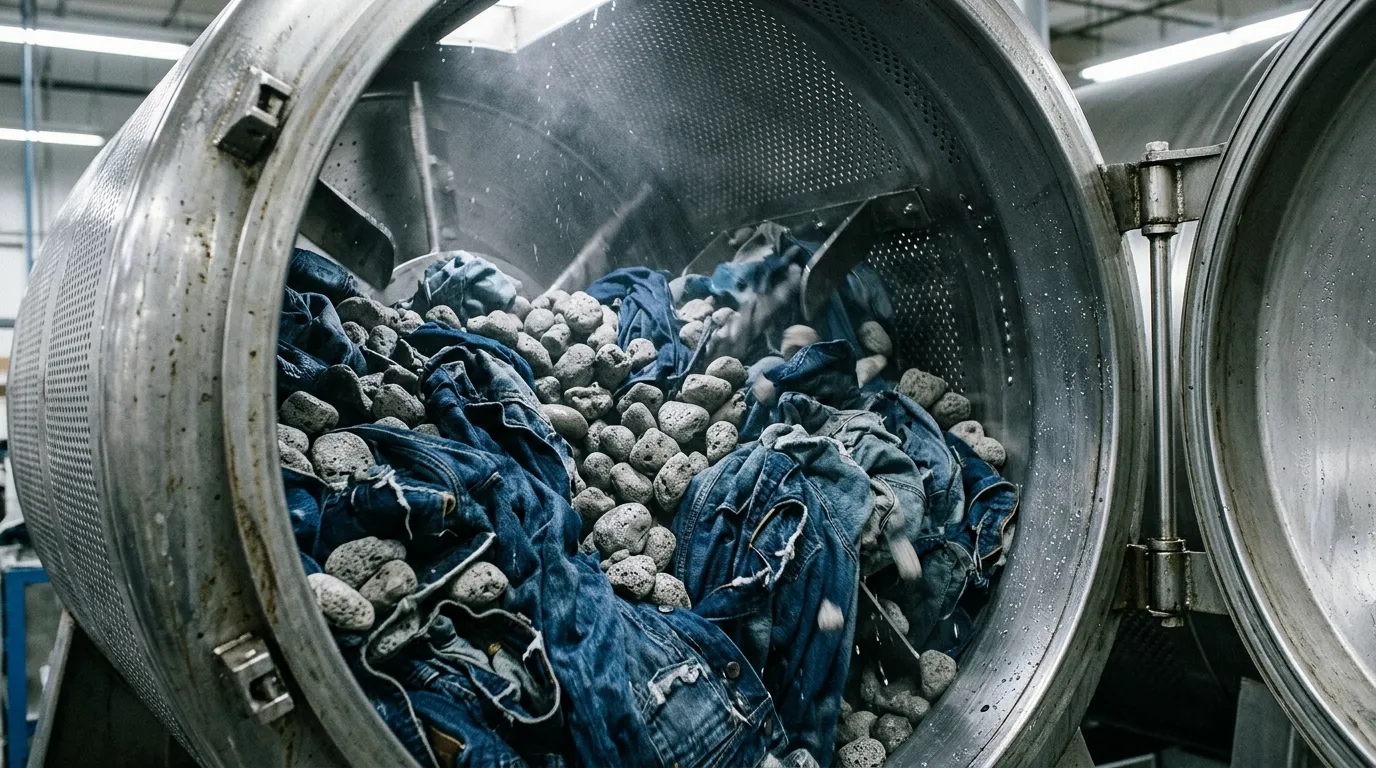
Repeated contact between stones and fabric removes colour gradually, and the removal is heaviest at seams, edges and raised points. That distribution is why stone wash tends to look evenly worn rather than patterned. Changhong Jeans characterises the outcome as a soft, natural-looking fade instead of a sharp design.
[PHOTO: macro side-by-side of the same fabric and colour in a stone-wash finish and an acid-wash finish]
What Is Acid Washing — and Does It Really Use Acid?
Acid wash is a fashion term for a garment finish in which a chemical or oxidising treatment lifts colour unevenly from the fabric. The name does not guarantee a literal acid bath. According to Wikipedia, acid-washed denim has been produced using pumice and chlorine, and potassium permanganate also appears in the process history it summarises. Changhong Jeans describes two common approaches: pumice treated with an oxidiser, and a potassium permanganate spray. MakeYourOwnJeans describes acid wash as chemical distressing but explains it as a literal acid bath, which conflicts with the other two accounts.
The practical consequence for buyers is that "acid wash" names a look, not a recipe. Before comparing quotes, ask which method sits behind the label — treated pumice, spray, or a bleach-based route — because the method, not the name, drives the result. Acid washing is a finishing step rather than a colouring method; for the colouring side of production, see garment dye vs pigment dye.
Why acid wash looks marbled and high-contrast
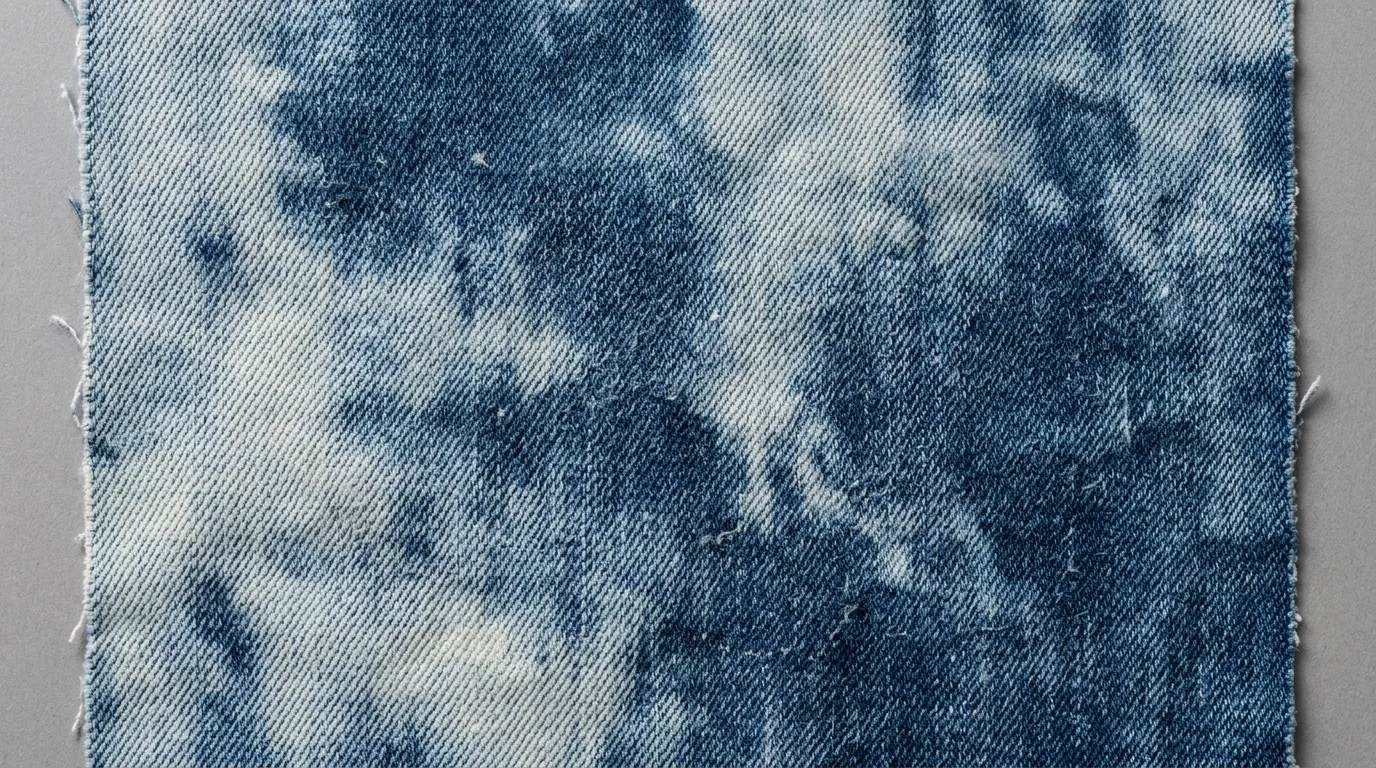
Chemical action removes colour unevenly across the garment, so the light and dark areas sit next to each other as a mottled pattern rather than a smooth gradient. Anomie Gallery describes acid wash as sharper, mottled and high-contrast compared with a stone-washed look, and Changhong Jeans likewise contrasts sharper acid-wash patterning with the subtler stone-wash fade.
[DIAGRAM: abrasion path with pumice tumbling beside a chemical path using treated pumice or spray, labelled "method varies by factory"]
Acid Wash vs Stone Wash: Side-by-Side Comparison
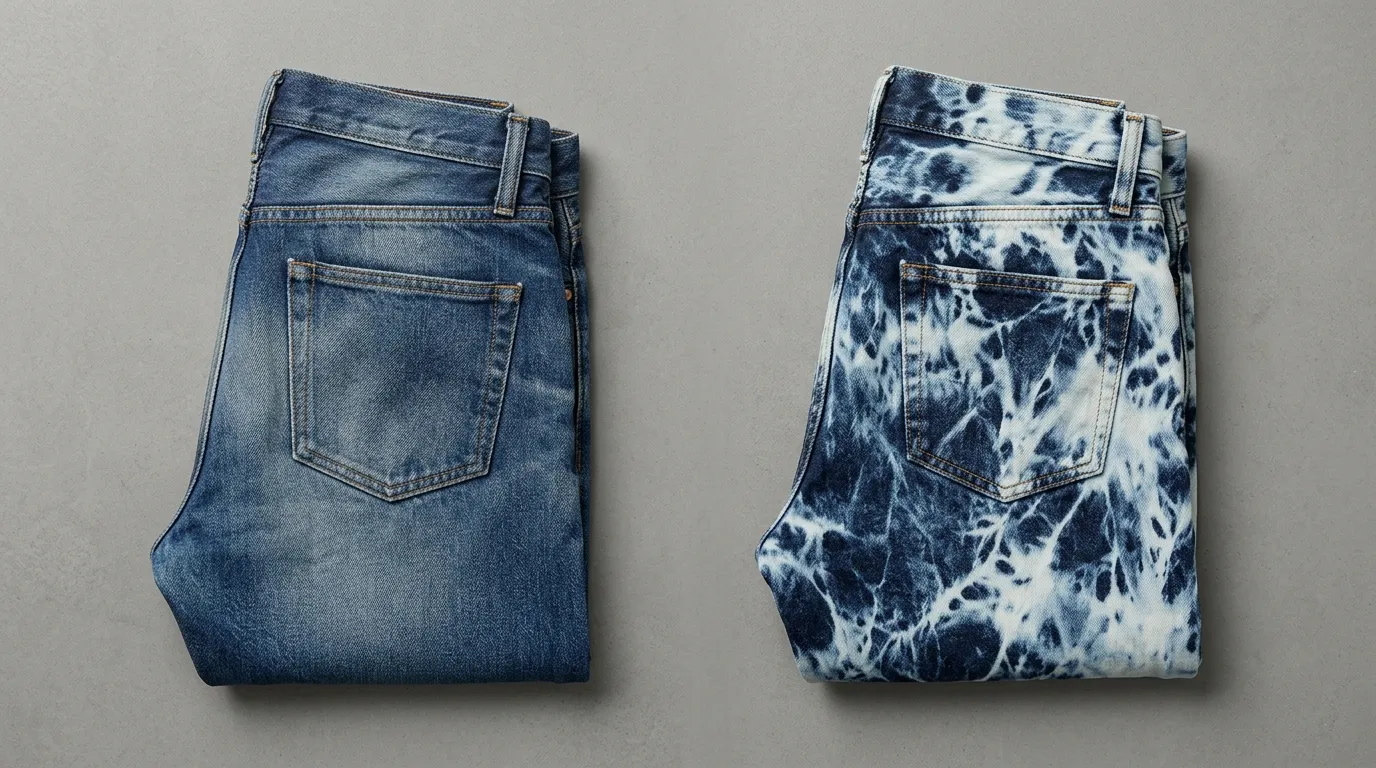
The two finishes differ in how they act on fabric and in what they produce visually: stone wash is mechanical and produces an even fade, while acid wash is chemically assisted and produces visible contrast. The table below sets out the comparison, with each performance entry attributed to a named source or replaced by a verification instruction.
| Stone wash | Acid wash | |
|---|---|---|
| Process action | Pumice abrasion in a rotating drum (Wikipedia; Changhong Jeans) | Chemically assisted method, such as oxidiser-treated pumice or potassium permanganate spray (Wikipedia; Changhong Jeans) |
| Typical visual result | Even, softened, worn-in fade (Changhong Jeans) | Marbled, mottled, high-contrast pattern (Anomie Gallery; Changhong Jeans) |
| Hand feel | Softer, broken-in (Anomie Gallery) | Less broken-in than stone wash (Anomie Gallery) |
| Potential fabric-strength effect | Changhong Jeans lists reduced strength as a possible limitation — a source claim, not a test result | Changhong Jeans states acid wash may involve less mechanical damage — a source claim, not a test result |
| Print and decoration | Verify with the supplier | Verify with the supplier |
| Repeatability in bulk | Varies with stone load, cycle and fabric; control with a sealed reference sample | High-contrast patterning is harder to match between batches; control with a sealed reference sample |
| Garments it suits | Denim, sweatshirts and T-shirts needing a subtle finish | Denim, T-shirts, hoodies and streetwear needing a statement finish |
Which Wash Is More Repeatable in Bulk Production?
Neither wash is automatically more repeatable. High-contrast acid-wash patterning is typically harder to match from one batch to the next, because small differences in chemical action show up as visible pattern, while stone wash shifts with stone load, drum time and fabric. Changhong Jeans lists strength and consistency among the production considerations for both finishes, and those remain its comparative claims rather than published test results.
The workable rule is to fix the finish with a sealed physical reference sample plus an agreed variation range before bulk production starts, rather than expecting an exact match. Minghang Garments' published case notes state that wash effects can be adjusted according to reference images, which is a reference-matching approach; no numeric tolerance is published, so none should be assumed. The approval sequence is set out under "How to Approve a Wash Sample Before Bulk Production".
How Each Wash Can Affect Fabric Strength, Hand Feel and Prints
Process mechanics are covered in the comparison table; the questions here concern performance. Stone washing's abrasion softens the garment, and Changhong Jeans lists reduced strength as a possible stone-wash limitation while stating that acid wash may involve less mechanical damage. Both statements are that source's comparative claims, so treat strength as something to test rather than something the finish name settles.
- Strength: Changhong Jeans attributes possible strength reduction to the mechanical action of stone washing. If strength matters for the garment, request strength testing on your own fabric and construction rather than relying on finish-level claims.
- Hand feel: Anomie Gallery describes stone-washed fabric as softer and broken-in, and acid-washed fabric as less so. This is a general characterisation, not a guarantee for every fabric weight.
- Print and decoration: No published account establishes that either wash protects prints or embroidery better. Validate the actual print, fabric and wash sequence — including whether decoration happens before or after the wash — and confirm that order in writing with the supplier before bulk.
Which Wash Should You Choose?
Choose stone wash for a subtle, softened, worn-in look, and acid wash when the visible, high-contrast marbling is the point of the design — then confirm the result on a sample, because fabric and method change the outcome.
- Choose stone wash when you want an even, low-contrast fade; you want a visibly softened hand feel; or the design is a solid colour or a subtle logo.
- Choose acid wash when the pattern itself is the design feature; you want sharper contrast in a streetwear-led style; or the artwork tolerates an uneven base.
- Either way, approve the finish on the actual fabric and colour before bulk production.
Most published comparisons use denim as the example, but the finishes are also applied to streetwear, T-shirts and sweatshirts, as Anomie Gallery's streetwear comparison and Wanna Ink's cotton T-shirt guide both show. For how these finishes are handled on lighter and heavier garments, see custom washed t shirts and custom washed hoodie.
How to Approve a Wash Sample Before Bulk Production
Approve a physical wash sample, agree how much variation is acceptable, then seal that sample as the production reference. The sequence below keeps either finish workable at bulk scale.
- Specify the garment, fabric, colour and the wash you want — name the method, not just "acid" or "stone".
- Supply a visual reference, ideally a photo plus a physical swatch.
- Have the wash sample produced on the real fabric and colour.
- Compare the sample against the reference under agreed lighting.
- Agree an acceptable variation range instead of expecting a perfect match.
- Seal the approved sample as the production standard.
- Re-check production output against the sealed sample during the run.
FAQ
Is stone wash the same as acid wash?
No. They are different processes with different visual signatures. Stone washing abrades fabric with pumice to give an even, worn fade, while acid wash uses a chemically assisted method for sharper contrast. The two can overlap: Changhong Jeans describes acid-wash methods that also use treated pumice, so mechanical and chemical action may occur in one finish.
What's the difference between mineral wash and acid wash?
Published wash definitions do not agree on a single meaning for mineral wash, so treat it as a separate finish term rather than a synonym for acid wash. Ask the supplier which process sits behind the label and judge the result from a physical sample, not from the name on the finish.
Does acid wash cost more than stone wash?
Published sources do not give a reliable per-piece cost difference between the two finishes, so no blanket "more" or "less" claim holds. Cost depends on the method used, the fabric, the colour, the quantity and the production location, so request a per-style quotation before comparing options.
Minghang Garments manufactures custom clothing in Dongguan, with both acid wash and stone wash listed among its washed-finish options. Sampling takes 7–15 working days and bulk production 25–45 days.
-
Share
-

-

-